This chapter constructs the envelope of an \(\infty \)-operad, which freely promotes its operations to a symmetric monoidal \(\infty \)-category. It is the \(\infty \)-categorical analogue of the classical construction from Section 12.3: every colored operad \(\Oo \) has an envelope \(\Env (\Oo )\), and \(\Oo \)-algebras in a symmetric monoidal category \(C\) correspond to symmetric monoidal functors \(\Env (\Oo )\to C\).
We will establish the analogous adjunction \[ \Env \colon \Op _{\infty } \rightleftarrows \Cat _{\infty }^{\otimes }\noloc \Mm . \] We will further show that the envelope construction induces a fully faithful functor \(\Env \colon \Op _{\infty } \hookrightarrow (\Cat _{\infty }^{\otimes })_{/(\Fin ,\amalg )}\) and characterize its essential image. Here \((\Fin ,\amalg )\) is the category of finite sets, with the symmetric monoidal structure given by disjoint union.
The envelope \(\Env (\Oo )\) of an \(\infty \)-operad \(\Oo \) is obtained by considering the functor \(\Oo ^{\otimes } \to \Span (\Fin )\) and ‘freely adding’ cocartesian lifts of all forward spans. Since \(\Oo ^{\otimes }\) already admits cocartesian lifts of backwards spans, the resulting functor to \(\Span (\Fin )\) will be a cocartesian fibration, and one can show that its straightening \(\Span (\Fin ) \to \Cat _{\infty }\) preserves finite products, thus encoding a symmetric monoidal \(\infty \)-category \(\Env (\Oo )\).
Let us preview the resulting symmetric monoidal \(\infty \)-category before developing the categorical machinery needed to construct it. Its underlying \(\infty \)-category is the pullback \[ \Env (\Oo ) \simeq \Fin \times _{\Span (\Fin )} \Oo ^{\otimes }, \] where \(\Fin \hookrightarrow \Span (\Fin )\) is the subcategory of forward spans. Thus the objects of \(\Env (\Oo )\) are finite unordered tuples of colors, the tensor product is concatenation, and the hom animae are given by \[ \Hom _{\Env (\Oo )}(\{x_i\}_{i \in I},\{y_j\}_{j \in J}) \simeq \coprod _{f\colon I\to J}\prod _{j\in J} \Oo (\{x_i\}_{i\in f^{-1}(j)};y_j). \] This formula, proved in Lemma 17.3.17, makes precise the sense in which the envelope retains exactly the operations of \(\Oo \) while freely adjoining tensor products of objects.
It will be convenient to construct envelopes in a slightly more general setting, in particular encompassing Lurie’s definition of \(\infty \)-operads as well. The same procedure will then produce an analogous functor \(\Env ^{\mathrm {Lurie}}\colon \Op _{\infty }^{\mathrm {Lurie}} \to \Cat _{\infty }^{\otimes }\), which is compatible with the functor \(\Env \), in the sense that the following diagram commutes:
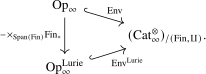
We will see that the functor \(\Env ^{\mathrm {Lurie}}\) is also fully faithful when sliced over \((\Fin ,\amalg )\), and that it has the same image as \(\Env \). In particular, the comparison functor \(\Op _{\infty } \to \Op _{\infty }^{\mathrm {Lurie}}\) is an equivalence, making the span approach to \(\infty \)-operads taken in this book compatible with the Lurie model used more commonly in the literature.
Sections
Factorization systems
Factorization systems in ∞-categories.
Freely adjoining cocartesian lifts
Free cocartesian completion along a factorization system.
Operadic envelopes
Operadic envelopes and their universal property.
Comparison to Lurie's operads
Comparison with Lurie's finite-pointed-set model.
Generated from the authoritative LaTeX source.