As mentioned in Remark 12.4.4, our definition of \(\infty \)-operads does not agree with Lurie’s definition, which instead works with \(\infty \)-categories over the category \(\Fin _*\) of finite pointed sets. In this section, we recall Lurie’s definition, and show that the \(\infty \)-category \(\Op _{\infty }^{\mathrm {Lurie}}\) of Lurie’s \(\infty \)-operads is equivalent to \(\Op _{\infty }\).
Definition 17.4.1. Given a finite set \(I\), we write \(I_+ := I \sqcup *\) for the resulting finite pointed set. A morphism \(f\colon I_+ \to J_+\) of finite pointed sets is called inert if on the preimage of \(J\) it restricts to a bijection \(f^{-1}(J) \iso J\). We say that \(f\) is active if \(f^{-1}(*) = \{*\}\).
Given a finite set \(I\), the Segal map \(\rho _i\colon I_+ \to \{i\}_+\) for \(i \in I\) is defined as the map that is the identity on \(\{i\}\) and sends all other \(j \in I \setminus \{i\}\) to the basepoint.
Remark 17.4.2. Recall from Lemma 5.3.8 that there is an equivalence \[ \Span _{\inj ,\all }(\Fin ) \simeq \Fin _*, \] given on objects by sending \(I\) to \(I_+\) and on morphisms by sending a span \(I \xhookleftarrow {f} K \xrightarrow {g} J\) to the pointed map \(h\colon I_+ \to J_+\) given by \(h(i) = g(k)\) whenever \(i = f(k)\) is in the image of \(f\) and \(h(i) = *\) otherwise. Under this equivalence, the inert maps in \(\Fin _*\) correspond to the backwards spans \(I \xhookleftarrow {f} K \xrightarrow {=} K\), and the active maps in \(\Fin _*\) correspond to the forward spans \(I \xleftarrow {=} I \xrightarrow {g} J\). The Segal maps \(\rho _i\) correspond to the backwards spans \[ I \hookleftarrow \{i\} \xrightarrow {=} \{i\}. \] We will write \(\Fin _* \hookrightarrow \Span (\Fin )\) for the inclusion of the subcategory \(\Span _{\inj ,\all }(\Fin )\).
Definition 17.4.3. Let \(\Fin _*\) be the category of finite pointed sets. An \(\infty \)-operad in the sense of Lurie is a pair \((\Oo ^{\otimes }, p_{\Oo })\) consisting of an \(\infty \)-category \(\Oo ^{\otimes }\) equipped with a functor \(p_{\Oo }\colon \Oo ^{\otimes } \to \Fin _*\) satisfying the following conditions:
- (1)
-
For any inert morphism \(f\colon I_+ \to J_+\) and any object \(X \in \Oo ^{\otimes }_I\) there is a \(p_{\Oo }\)-cocartesian lift \(X \to Y\) in \(\Oo ^{\otimes }\).
- (2)
-
Let \(X\) and \(Y\) be objects of \(\Oo ^{\otimes }\) and let \(I_+ := p(X)\) and \(J_+ := p(Y)\). For every \(j \in J\), let \(Y \to Y_j\) denote a \(p_{\Oo }\)-cocartesian lift of the Segal map \(\rho _j \colon J_+ \to \{j\}_+\). Then the induced commutative square
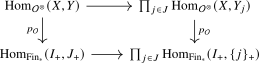
is a pullback square.
- (3)
-
For every finite collection \(\{X_j\}_{j \in J}\) of objects \(X_j \in \Oo ^{\otimes }_{\{j\}}\), there exists an object \(X \in \Oo ^{\otimes }_J\) and a collection of \(p_{\Oo }\)-cocartesian morphisms \(X \to X_j\) covering \(\rho _j \colon J_+ \to \{j\}_+\).
We say a functor \(f\colon \Oo ^{\otimes } \to \Pp ^{\otimes }\) over \(\Fin _*\) is a morphism of Lurie-\(\infty \)-operads if it preserves cocartesian morphisms over inerts. We let \(\Op _\infty ^{\mathrm {Lurie}} \subseteq (\Cat _{\infty })_{/\Fin _*}\) denote the \(\infty \)-category of the Lurie \(\infty \)-operads and their morphisms.
Let \(\Ff _{\mathrm {Lurie}} := (\Fin ,\Fin _{\inj },\Fin )\), so that \(\Span _{\inj ,\all }(\Fin ) \simeq \Fin _*\).
Lemma 17.4.4. Under the equivalence \(\Span _{\inj ,\all }(\Fin ) \simeq \Fin _*\), the \(\Ff _{\mathrm {Lurie}}\)-operads of Definition 17.3.10 are precisely the \(\infty \)-operads in the sense of Lurie, and the two notions of morphism agree. In particular, there is a canonical equivalence \[ \Op _{\Ff _{\mathrm {Lurie}}} \simeq \Op _\infty ^{\mathrm {Lurie}}. \]
Proof. Condition (1) in the two definitions is the same. Suppose first that \(p_{\Oo }\colon \Oo ^\otimes \to \Fin _*\) is an \(\infty \)-operad in the sense of Lurie. The functor \[ \Oo ^\otimes _J \longrightarrow \prod _{j \in J}\Oo ^\otimes _{\{j\}} \] induced by cocartesian transport along the Segal maps is essentially surjective by condition (3) of Definition 17.4.3. It is fully faithful as well: condition (2), restricted to the fiber over \(\id _{J_+}\), identifies the hom anima in \(\Oo ^\otimes _J\) with the product of the hom animae in the fibers over the singletons, using cocartesian transport along the Segal maps on the sources. Thus condition (2) holds for the decomposition of \(J\) into singletons, and hence for every finite decomposition by grouping the singleton factors. Condition (3) follows similarly from condition (2): apply it to the singleton decomposition of \(J\) and to those of the summands \(J_i\), and group the resulting factors according to \(J = \bigsqcup _i J_i\).
Conversely, if \(\Oo \) is an \(\Ff _{\mathrm {Lurie}}\)-operad, condition (1) gives the required cocartesian lifts of inert maps. Specializing condition (3) to the decomposition of \(J\) into singletons gives condition (2) of Definition 17.4.3, while condition (2) gives condition (3). Finally, both notions of morphism require precisely the preservation of cocartesian morphisms over inert maps. □
Construction 17.4.5. Using Lemma 17.4.4, Proposition 5.3.9, we define the Lurie operadic envelope \[ \Env ^{\mathrm {Lurie}}\colon \Op _\infty ^{\mathrm {Lurie}} \longrightarrow \Cat _\infty ^\otimes \] as the functor \(\Env _{\Ff _{\mathrm {Lurie}}}\) of Proposition 17.3.12, followed by the equivalence from \(\Ff _{\mathrm {Lurie}}\)-monoidal \(\infty \)-categories to symmetric monoidal \(\infty \)-categories.
Lemma 17.4.6. If \(\Oo = (\Oo ^{\otimes },p_{\Oo })\) is an \(\infty \)-operad in the sense of Definition 14.1.1, then its pullback \(p_{\Pp }\colon \Pp ^{\otimes } := \Oo ^{\otimes } \times _{\Span (\Fin )} \Fin _* \to \Fin _*\) is an \(\infty \)-operad in the sense of Lurie. Moreover, forming pullbacks along the inclusion \(\Fin _* \hookrightarrow \Span (\Fin )\) induces a ‘forgetful functor’ \[ \Op _{\infty } \to \Op _{\infty }^{\mathrm {Lurie}}. \]
Proof. Any \(p_{\Oo }\)-cocartesian lift of a backwards span \(I \hookleftarrow J \xrightarrow {=} J\) will still be \(p_{\Pp }\)-cocartesian, verifying condition (1). Condition (2) is immediate from Lemma 14.1.10. Condition (3) is immediate from condition (ii) in Proposition 14.1.9. The claim on morphisms is checked similarly. □
Lemma 17.4.7. Let \[ u\colon \Fin _* \simeq \Span _{\inj ,\all }(\Fin ) \hookrightarrow \Span (\Fin ) \] be the inclusion, and let \(\Rr _*\) and \(\Rr \) denote the forward morphisms in \(\Fin _*\) and \(\Span (\Fin )\), respectively. For every functor \(p\colon E \to \Span (\Fin )\), there is a natural equivalence of functors over \(\Fin _*\) \[ u^*E_{\Rr }(p) \simeq E_{\Rr _*}(u^*p). \]
Proof. By the pullback formula in Construction 17.2.2, it suffices to construct a natural equivalence \[ \Fin _* \times _{\Span (\Fin ),t}\Ar _{\Rr }(\Span (\Fin )) \simeq \Ar _{\Rr _*}(\Fin _*) \] over \(\Fin _*\). The objects on both sides are forward spans, equivalently maps of finite sets \(r\colon I \to J\). A morphism on the left is a commutative square in \(\Span (\Fin )\)

in which \(g\) belongs to \(\Fin _*\). The composite \(gr\) has injective backwards leg because this leg is obtained by pulling back the injective backwards leg of \(g\) along \(r\). Since \(r'\) is forward, the backwards leg of \(r'f\) is the backwards leg of \(f\). The equivalence \(r'f \simeq gr\) therefore shows that \(f\) also belongs to \(\Fin _*\). As \(\Fin _* \hookrightarrow \Span (\Fin )\) is a wide subcategory inclusion, its hom animae are unions of components, so the homotopy making the square commute also lies in \(\Fin _*\). Thus the displayed square is precisely a morphism in \(\Ar _{\Rr _*}(\Fin _*)\), which proves the claim. □
Proposition 17.4.8 (cf. [Barkan et al. (2022), Theorem 5.1.1, Corollary 5.1.15]). The forgetful functor \(\Op _{\infty } \to \Op _{\infty }^{\mathrm {Lurie}}\) is an equivalence.
Proof. By Lemma 17.4.4, we may work with \(\Ff _{\mathrm {Lurie}}\)-operads. The proof of Proposition 17.3.18 applies to this span pattern as well. Indeed, full faithfulness is the general statement Lemma 17.2.11; the Segal and mapping-anima arguments use only conditions (2) and (3); and the forward-transport calculation of Lemma 17.3.15 applies unchanged. After the equivalence of Proposition 5.3.9, we therefore obtain a fully faithful functor \[ \Env ^{\mathrm {Lurie}}\colon \Op _\infty ^{\mathrm {Lurie}} \longrightarrow (\Cat _\infty ^\otimes )_{/(\Fin ,\amalg )} \] with essential image characterized by the two conditions in Proposition 17.3.18.
Now let \(u\colon \Fin _* \hookrightarrow \Span (\Fin )\) be the inclusion and let \(\Oo \) be an \(\infty \)-operad over \(\Span (\Fin )\). Applying Lemma 17.4.7 to \(p_{\Oo }\) gives a natural equivalence of \(\Ff _{\mathrm {Lurie}}\)-monoidal \(\infty \)-categories \[ \Env ^{\mathrm {Lurie}}(u^*\Oo ) \simeq u^*\Env (\Oo ). \] Under Proposition 5.3.9, the right-hand side corresponds to the original symmetric monoidal \(\infty \)-category \(\Env (\Oo )\). The equivalence is compatible with the maps to \((\Fin ,\amalg )\) by naturality of the construction. We therefore obtain a naturally commutative diagram
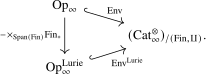
Both diagonal functors are equivalences onto the same essential image. It follows by 2-out-of-3 that the left vertical functor is an equivalence, as desired. □
As a first payoff of the comparison, we can now make precise the passage from classical colored operads to \(\infty \)-operads. In Construction 12.4.1, we discussed informally how to associate an \(\infty \)-operad to every colored operad. We can make this formal without choosing a nerve for the (2,1)-category appearing there by first using Lurie’s model and then applying the comparison from Proposition 17.4.8.
Proposition 17.4.9. Every colored operad \(\Oo \) canonically and functorially determines an \(\infty \)-operad, also denoted \(\Oo \).
Proof. Define a classical 1-category \(\Oo ^{\otimes ,\mathrm {Lurie}}\) as in Construction 12.4.1, with the additional requirement that in the underlying span \(I \xleftarrow {f} K \xrightarrow {g} J\) the finite set \(K\) is an actual subset of \(I\) and \(f\) is its inclusion. Composition is defined as in Construction 12.4.1, taking as the pullback of spans the literal preimage: the composite of \((K \subseteq I, g\colon K \to J)\) with \((M \subseteq J, k\colon M \to L)\) has underlying subset \(g^{-1}(M) \subseteq K \subseteq I\) and underlying map the restriction of \(k \circ g\) to it. This is again a subset inclusion, and the resulting composition is strictly associative: composing with a third morphism \((N \subseteq L, l\colon N \to P)\) in either of the two possible orders yields the subset \(g^{-1}(k^{-1}(N)) \subseteq I\), together with the restriction of \(l \circ k \circ g\). The identity of \(\{x_i\}_{i \in I}\) is given by \(K = I\) and \(g = \id _I\), labeled by identity multimorphisms. On the level of the multimorphism labels, associativity and unitality of this composition are precisely the associativity and unitality axioms of the colored operad \(\Oo \). Thus \(\Oo ^{\otimes ,\mathrm {Lurie}}\) is a classical 1-category. Sending \(\{x_i\}_{i \in I}\) to \(I_+\) and a morphism \((K \subseteq I, g, \{\phi _j\}_{j \in J})\) to the pointed map \(I_+ \to J_+\) that restricts to \(g\) on \(K\) and sends \(I \setminus K\) to the basepoint defines a functor of 1-categories \[ p_{\Oo }\colon \Oo ^{\otimes ,\mathrm {Lurie}} \longrightarrow \Fin _*. \] Its fiber over \(I_+\) consists of the \(I\)-tuples of colors of \(\Oo \) and the \(I\)-tuples of unary multimorphisms between them, i.e. it is the \(I\)-fold power of the category of colors and unary multimorphisms of \(\Oo \). For an inert morphism, the morphism obtained by restricting an \(I\)-tuple of colors and labeling the resulting unary operations by identities is \(p_{\Oo }\)-cocartesian. These cocartesian lifts give the required equivalences from the fiber over \(I_+\) to the product of the fibers over its elements.
It remains to verify the condition on morphism sets. Let \(X=\{x_i\}_{i\in I}\) and \(Y=\{y_j\}_{j\in J}\). For a pointed map \(\alpha \colon I_+\to J_+\), the set of morphisms \(X\to Y\) over \(\alpha \) is, by construction, \[ \prod _{j\in J} \Oo \bigl ((x_i)_{i\in \alpha ^{-1}(j)};y_j\bigr ). \] The \(j\)-th factor is precisely the set of morphisms from \(X\) to \(y_j\) over the composite of \(\alpha \) with the Segal map \(\rho _j\). Consequently the square in condition (2) of Lurie’s definition is a pullback. Thus \(p_{\Oo }\) is an \(\infty \)-operad in Lurie’s sense. A morphism of colored operads acts on tuples and multimorphism labels and thereby induces a functor between the resulting categories over \(\Fin _*\). Applying an inverse to the equivalence in Proposition 17.4.8 therefore produces the claimed functor from colored operads to \(\infty \)-operads over \(\Span (\Fin )\). □
Corollary 17.4.10. The colored operads \(\Assoc \), \(\oLMod \), and \(\oMod \) of Section 12.2, as well as the bimodule operad \(\oBMod \) of Definition 19.2.1, canonically define \(\infty \)-operads. Their multimorphism animae are the discrete animae associated with their classical multimorphism sets.
Proof. Apply Proposition 17.4.9 to each of the indicated colored operads. The comparison with the span model is induced by restriction along \(\Fin _* \hookrightarrow \Span (\Fin )\) and therefore preserves the fibers of hom animae over active maps. The displayed formula in the proof of Proposition 17.4.9 consequently identifies the resulting multimorphism animae with the discrete animae associated with the classical multimorphism sets. □
Corollary 17.4.11. For a colored operad \(\Oo \), the \(\infty \)-categorical envelope of the associated \(\infty \)-operad is equivalent to the category underlying its classical envelope from Definition 12.3.3, compatibly with the symmetric monoidal structures and the maps to \((\Fin ,\amalg )\).
Proof. Both envelopes have the unordered tuples of colors as objects. The description of the classical morphism sets in Definition 12.3.3 agrees with the mapping-anima formula of Lemma 17.3.17, since the latter is discrete for a classical colored operad. These identifications respect composition, and both tensor products are given by concatenation of tuples. □
The envelopes of the operads governing associative algebras and modules are also 1-categories. We record them for later use.
Example 17.4.12 (Envelopes for algebras and modules). All the following categories are symmetric monoidal under disjoint union.
- (1)
-
The envelope \(\Env (\Assoc )\) is the category \(\Fin ^{\Alg }\) whose objects are finite sets and whose morphisms \(S\to T\) are maps of finite sets together with a linear order on every fiber over \(t\in T\).
- (2)
-
The envelope \(\Env (\oLMod )\) is the category \(\Fin ^{\LMod }\) whose objects are pairs \((S_A,S_M)\) of finite sets. A morphism \((S_A,S_M)\to (T_A,T_M)\) is a map \[ f\colon S_A\sqcup S_M\longrightarrow T_A\sqcup T_M \] which restricts to a bijection \(S_M\to T_M\), together with a linear order on \(f^{-1}(t)\cap S_A\) for every \(t\in T_A\sqcup T_M\).
- (3)
-
The envelope \(\Env (\oMod )\) is the category \(\Fin ^{\Mod }\) with the same objects and morphisms as in (2), but without the choices of linear orders.
These descriptions follow immediately from Lemma 17.3.17 and the multimorphism sets of \(\Assoc \), \(\oLMod \), and \(\oMod \).
Exercises
Exercise 17.1 (Basic factorization systems).
- (1)
-
Let \(C\) be an \(\infty \)-category. Show that the pairs \((C,C^{\simeq })\) and \((C^{\simeq },C)\) are factorization systems on \(C\).
- (2)
-
In \(\An \), show that the essentially surjective morphisms and the monomorphisms form a factorization system.
- (3)
-
In \(\Cat _{\infty }\), show that the essentially surjective functors and the fully faithful functors form a factorization system.
Exercise 17.2 (Free cocartesian lifts). Let \((\Ll ,\Rr )\) be a factorization system on \(C\) and let \(p\colon E\to C\) be a functor. In the free \(\Rr \)-cocartesian fibration \(E_{\Rr }(p)\to C\) of Construction 17.2.2, describe the canonical cocartesian lift of a morphism \(r\colon c\to d\) in \(\Rr \) starting at an object represented by \((e,p(e)\to c)\). Verify that the lifts associated with \(r\) and \(r'\colon d\to d'\) compose to the lift associated with \(r'r\).
Exercise 17.3 (The envelope of a trivial operad). Let \(C\) be an \(\infty \)-category and consider its trivial operad \(\Triv _C\). Show that objects of \(\Env (\Triv _C)\) are finite tuples of objects of \(C\), and that a morphism between two tuples consists of a bijection of their indexing sets together with componentwise morphisms in \(C\). Deduce that \(\Env (\Triv _C)\) is the free symmetric monoidal \(\infty \)-category generated by \(C\).
Generated from the authoritative LaTeX source.