Proposition 17.3.18. The induced functor \[ \Env \colon \Op _{\infty } \to (\Cat _{\infty }^{\otimes })_{/(\Fin ,\amalg )} \] is fully faithful. A symmetric monoidal functor \(p\colon C \to (\Fin ,\amalg )\) lies in the essential image if and only if it satisfies the following two conditions:
- (1)
-
For every finite set \(I\), the tensor product in \(C\) defines an equivalence \[ \prod _{i \in I} C_{\{i\}} \iso C_I, \] where \(C_I\) is the fiber of \(p\) over \(I \in \Fin \);
- (2)
-
For every finite collection \((I_j)_{j \in J}\) of finite sets and every collection of objects \(X_j \in p^{-1}(I_j)\) and \(y_j \in p^{-1}(\{j\})\), the commutative square
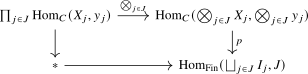
is a pullback square, where the bottom map hits the map \(\bigsqcup _{j \in J} I_j \to \bigsqcup _{j \in J} * = J\) induced by the maps \(I_j \to *\).
Proof. The full faithfulness is an instance of Lemma 17.2.11. To identify the essential image, we first show that the two conditions are always satisfied for \(C = \Env (\Oo )\). Condition (1) follows from the Segal condition on \(\Oo \) and Lemma 17.3.15: the underlying map \(\Env (\Oo ) \to \Fin \) is simply the pullback of the map \(\Oo ^{\otimes } \to \Span (\Fin )\). For condition (2), let us write \(X := \bigotimes _{j\in J} X_j\) and \(Y := \bigotimes _{j \in J} y_j\), where these two tensor products in \(C = \Env (\Oo )\) are computed as unordered concatenations in \(\Oo ^{\otimes }\). Then we have a pullback square

The claim now follows from condition (3) of Definition 17.3.10.
It remains to show that any \(C\) satisfying (1) and (2) is of the form \(\Env (\Oo )\) for some \(\infty \)-operad \(\Oo \). We define \(\Oo \) as the following pullback:
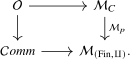
The pullback is formed in \((\Cat _\infty )_{/\Span (\Fin )}\). It is again an \(\infty \)-operad: cocartesian lifts of backwards spans are formed componentwise, the Segal equivalences on fibers are preserved by pullback, and condition (3) is inherited by taking pullbacks of the corresponding squares. Here the bottom map is the unit of the adjunction \(\Env \dashv \Mm \). The projection \(\Oo \to \Mm _C\) induces a composite of symmetric monoidal functors \[ \Env (\Oo ) \longrightarrow \Env (\Mm _C) \longrightarrow C, \] where the second map is the counit of the adjunction. Equivalently, this is the symmetric monoidal functor corresponding under Corollary 17.3.14 to the projection \(\Oo \to \Mm _C\). Naturality of the counit with respect to \(p\) shows that this composite is a functor over \((\Fin ,\amalg )\). We show that it is an equivalence.
The colors of \(\Oo \) are precisely the objects of \(C_{\lra {1}}\). Since every object of \(\Env (\Oo )\) is a tensor product of colors, essential surjectivity follows from condition (1) on \(C\). For full faithfulness, first consider a target color \(y\in C_{\lra {1}}\). We have equivalences: \[ \Hom _{\Env (\Oo )}(\{x_i\},y) \simeq \Oo (\{x_i\};y) \simeq \Hom _C(\bigotimes _{i \in I} x_i, y) \] The first is Lemma 17.3.17. For the second, the pullback defining \(\Oo \) identifies its multimorphism anima with the fiber of \[ \Hom _C(\bigotimes _{i \in I}x_i,y) \longrightarrow \Hom _{\Fin }(I,\lra {1}) \] over the unique map \(I\to \lra {1}\); this fiber is the entire source because the target is contractible.
For a general target \(\{y_j\}_{j\in J}\), Lemma 17.3.17 decomposes the hom anima in \(\Env (\Oo )\) as a coproduct indexed by maps \(f\colon I\to J\), with the fiber over \(f\) equal to \[ \prod _{j\in J} \Hom _C\left (\bigotimes _{i\in f^{-1}(j)}x_i,y_j\right ). \] Condition (2) identifies this product with the fiber over \(f\) of \[ \Hom _C\left (\bigotimes _{i\in I}x_i,\bigotimes _{j\in J}y_j\right ) \longrightarrow \Hom _{\Fin }(I,J). \] Taking the coproduct over all \(f\) proves full faithfulness. □
Generated from the authoritative LaTeX source.