This chapter introduces span categories, which provide the organizing language for the approach to higher algebra taken in this book. They offer a convenient way to encode algebraic structures in settings such as spectral Mackey functors [Barwick (2017)], normed \(\infty \)-categories [Bachmann and Hoyois (2021)], and six-functor formalisms [Scholze (2025); Heyer and Mann (2024)]. Their use in higher algebra is not yet standard, in part because Lurie’s foundational text [Lurie (2017)] takes a different approach, so give a detailed development of their construction.
Let \(C\) be an \(\infty \)-category with pullbacks, and let \(C_L\) and \(C_R\) be collections of morphisms of \(C\) closed under composition and pullback. Then the span category \(\Span _{L,R}(C)\) associated with this triple is an \(\infty \)-category whose objects are the objects of \(C\), while the morphisms from \(X\) to \(Y\) are given by spans

where \(f \in C_L\) and \(g \in C_R\). The identity morphism is the identity span \(X \xleftarrow {\id _X} X \xrightarrow {\id _X} X\). The composition of a span \(X \leftarrow U \rightarrow Y\) with a span \(Y \leftarrow V \rightarrow Z\) is given by forming pullbacks:
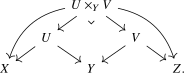
In this chapter, we will give a formal definition of \(\Span _{L,R}(C)\), following the approach of Barwick (2017) and Haugseng et al. (2023). We will further discuss the existence of products and coproducts in \(\Span _{L,R}(C)\).
Sections
Constructing span categories
Span categories of ∞-categories with pullbacks.
Adjunctions of span categories
Natural transformations and adjunctions induced on span categories.
Products and coproducts in span categories
Finite products and coproducts in span categories.
Generated from the authoritative LaTeX source.