Before studying products and coproducts in span categories, we develop a general criterion for an adjunction between adequate triples to induce an adjunction between their span categories.
Construction 13.2.1. Consider adequate triples \((C,C_L,C_R)\) and \((D,D_L,D_R)\) and let \(F,G\colon C \to D\) be morphisms of adequate triples. Let \(\alpha \colon F \Rightarrow G\) be a natural transformation, and assume that the following two conditions are satisfied:
- (1)
-
The morphism \(\alpha (X)\colon F(X) \to G(X)\) lies in \(D_R\) for every object \(X\) of \(C\);
- (2)
-
For every morphism \(l\colon Z \to X\) in \(C_L\) the commutative square
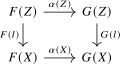
is a pullback square in \(D\).
We will construct a natural transformation \[ \Span ^{\mathrm {R}}(\alpha )\colon \Span (F) \implies \Span (G) \] of functors \(\Span _{L,R}(C) \to \Span _{L,R}(D)\) which is objectwise given by the forward spans \[ F(X) \xleftarrow {=} F(X) \xrightarrow {\alpha (X)} G(X) \] for \(X \in C\). For this, equip \([1]\) with the adequate triple structure \(([1],[1]^{\simeq },[1])\). Then the product \(C \times [1]\) is an adequate triple with backward and forward classes \(C_L \times [1]^{\simeq }\) and \(C_R \times [1]\), respectively. Regarding \(\alpha \) as a functor \(C \times [1] \to D\), conditions (1) and (2) say precisely that it is a morphism of adequate triples. Indeed, the only additional pullback squares to check are sent to pastings of images under \(F\) or \(G\) of adequate pullback squares with the naturality squares from (2). We therefore obtain a functor \[ \Span _{L,R}(C \times [1]) \to \Span _{L,R}(D). \] Using that \(\Span (-)\) preserves products by Proposition 13.1.19 and that \(\Span _{\tiso ,\all }([1]) \simeq [1]\) by Lemma 13.1.16, this functor takes the form \[ \Span _{L,R}(C) \times [1] \to \Span _{L,R}(D). \] The restrictions to \(0\) and \(1\) are precisely \(\Span (F)\) and \(\Span (G)\), so this produces the desired natural transformation \(\Span ^{\mathrm {R}}(\alpha )\).
Remark 13.2.2. The previous construction can be dualized, if we assume instead that the morphism \(\alpha (X)\colon F(X) \to G(X)\) is in \(D_L\) for every \(X \in C\) and that for every morphism \(r\colon Z \to Y\) in \(C_R\) the commutative square
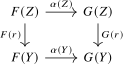
is a pullback square in \(D\). By applying Lemma 13.1.15 to the previous construction, we deduce that \(\alpha \) induces a natural transformation \begin {align*} \Span ^{\mathrm {L}}(\alpha )\colon \Span (G) \implies \Span (F) \end {align*}
of functors \(\Span _{L,R}(C) \to \Span _{L,R}(D)\) given on an object \(X \in C\) by the backwards span \[ G(X) \xleftarrow {\alpha (X)} F(X) \xrightarrow {=} F(X). \]
Lemma 13.2.3. Given a third morphism of adequate triples \(H\colon (C,C_L,C_R) \to (D,D_L,D_R)\), let \(\alpha \colon F \Rightarrow G\) and \(\beta \colon G \Rightarrow H\) be natural transformations satisfying the conditions (1) and (2) from Construction 13.2.1. Then we have natural equivalences \[ \Span ^{\mathrm {R}}(\id _F) \simeq \id _{\Span (F)} \qquadtext {and} \Span ^{\mathrm {R}}(\beta \circ \alpha ) \simeq \Span ^{\mathrm {R}}(\beta ) \circ \Span ^{\mathrm {R}}(\alpha ). \] The construction is also compatible with whiskering: if \(K\colon (B,B_L,B_R) \to (C,C_L,C_R)\) and \(J\colon (D,D_L,D_R) \to (E,E_L,E_R)\) are morphisms of adequate triples, then \[ \Span ^{\mathrm {R}}(\alpha K) \simeq \Span ^{\mathrm {R}}(\alpha ) \circ \Span (K) \qquadtext {and} \Span ^{\mathrm {R}}(J\alpha ) \simeq \Span (J) \circ \Span ^{\mathrm {R}}(\alpha ). \] The dual claims for \(\Span ^{\mathrm {L}}(-)\) also hold.
Proof. Composition and identities of natural transformations are formed using the posets \([n]\) for \(n = 0,2\). Whiskering is given by pre- and postcomposition with morphisms of adequate triples. The claims therefore follow from the naturality in both \([n] \in \simp \) and \((C,C_L,C_R) \in \AdTrip \) of the equivalence \(\Span _{L,R}(C \times [n]) \simeq \Span _{L,R}(C) \times [n]\). □
Corollary 13.2.4. Let \((C,C_L,C_R)\) and \((D,D_L,D_R)\) be adequate triples. Let \(F\colon C \rightleftarrows D \noloc G\) be an adjunction of \(\infty \)-categories and assume that \(F\) and \(G\) are morphisms of adequate triples.
- (1)
-
Assume that the unit map \(\eta _X\colon X \to G(F(X))\) is in \(C_R\) for all \(X \in C\) and the counit map \(\epsilon _Y\colon F(G(Y)) \to Y\) is in \(D_R\) for all \(Y \in D\). Furthermore, assume that for every morphism \(l\colon Z \to X\) in \(C_L\) and every morphism \(l'\colon Z' \to X'\) in \(D_L\), the commutative squares
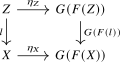
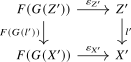
are pullback squares. Then \(F\) and \(G\) induce an adjunction \begin {align*} \Span (F)\colon \Span _{L,R}(C) \mathrel {\substack {\xrightarrow {\rule {25pt}{0cm}} \
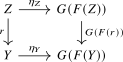
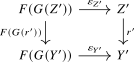
are pullback squares. Then \(F\) and \(G\) induce an adjunction \begin {align*} \Span (G)\colon \Span _{L,R}(D) \mathrel {\substack {\xrightarrow {\rule {25pt}{0cm}} \\[-3.2pt] \xleftarrow {\rule {25pt}{0cm}}}} \Span _{L,R}(C) \noloc \Span (F). \end {align*}
Proof. We prove (1), as (2) is dual. By Construction 13.2.1 and Lemma 13.2.3, the unit \(\eta \colon \id \to GF\) and counit \(\epsilon \colon FG \to \id \) induce transformations \[ \Span ^{\mathrm {R}}(\eta )\colon \Span (\id ) \to \Span (G) \circ \Span (F) \qquadtext {and} \Span ^{\mathrm {R}}(\epsilon ) \colon \Span (F) \circ \Span (G) \to \id . \] Compatibility with vertical composition and whiskering from Lemma 13.2.3 shows that these transformations satisfy the triangle identities. They therefore exhibit the asserted adjunction by Proposition 21.1.2. □
Generated from the authoritative LaTeX source.