Lemma 13.1.15. There is a natural equivalence \(\Span _{L,R}(C)\catop \simeq \Span _{R,L}(C)\), in the sense that the following diagram commutes:
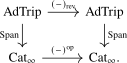
Proof. By definition of \((-)\catop \colon \Cat _{\infty } \to \Cat _{\infty }\), there is a commutative square

where the bottom functor is given by precomposition with \((-)\catop \colon \simp \iso \simp \). We thus need to produce a natural equivalence \(\NSpan _{L,R}(C)\catop \simeq \NSpan _{R,L}(C)\) of simplicial animae. Unwinding definitions, this amounts to producing a natural equivalence \[ \Hom _{\AdTrip }(\Tw ^r([n]\catop ),(C,C_L,C_R)) \simeq \Hom _{\AdTrip }(\Tw ^r([n]),(C,C_R,C_L)), \] natural in \([n] \in \simp \catop \) and \((C,C_L,C_R)\). Equivalently, we must produce a natural equivalence \(\Tw ^r([n]\catop ) \simeq \Tw ^r([n])_{\rev }\). Such an equivalence is given by sending an object \((i \geq j)\) in \(\Tw ^r([n]\catop )\) to the object \((j \leq i)\) in \(\Tw ^r([n])\). □
Generated from the authoritative LaTeX source.