Remark 13.2.2. The previous construction can be dualized, if we assume instead that the morphism \(\alpha (X)\colon F(X) \to G(X)\) is in \(D_L\) for every \(X \in C\) and that for every morphism \(r\colon Z \to Y\) in \(C_R\) the commutative square
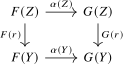
is a pullback square in \(D\). By applying Lemma 13.1.15 to the previous construction, we deduce that \(\alpha \) induces a natural transformation \begin {align*} \Span ^{\mathrm {L}}(\alpha )\colon \Span (G) \implies \Span (F) \end {align*}
of functors \(\Span _{L,R}(C) \to \Span _{L,R}(D)\) given on an object \(X \in C\) by the backwards span \[ G(X) \xleftarrow {\alpha (X)} F(X) \xrightarrow {=} F(X). \]
Generated from the authoritative LaTeX source.