Lemma 14.1.10. Given a functor \(p_{\Oo }\colon \Oo ^{\otimes } \to \Span (\Fin )\) and cocartesian morphisms \(Y \to Y_j\) over the maps \(\rho _j\), these maps exhibit \(Y\) as a product of the \(Y_j\) in \(\Oo ^{\otimes }\) if and only if for every \(X \in \Oo ^{\otimes }_I\) and every \(\alpha \in \Hom _{\Span (\Fin )}(I,J)\) they induce an equivalence \[ \Hom _{\Oo ^{\otimes }}^{\alpha }(X,Y) \to \prod _{j \in J} \Hom _{\Oo ^{\otimes }}^{\rho _j \circ \alpha }(X,Y_j). \]
Proof. The maps \(Y \to Y_j\) exhibit \(Y\) as a product if and only if for every \(X \in \Oo ^{\otimes }_I\) the top map in the following square is an equivalence:
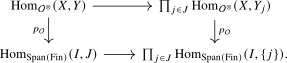
Since the bottom map is an equivalence, this is equivalent to the square being a pullback square, which is in turn equivalent to the condition that the top map induces isomorphisms on all fibers over \(\alpha \in \Hom _{\Span (\Fin )}(I,J)\). □
Generated from the authoritative LaTeX source.