Proposition 6.4.14 (Ext-groups via projective resolutions). Let \(C\) be a stable \(\infty \)-category equipped with a t-structure, and let \(P_{\bullet }\) be a projective resolution of \(M \in C^{\heartsuit }\). Then for every other object \(N \in C^{\heartsuit }\) and every \(n \in \Z \) there is an isomorphism of abelian groups \[ \Ext ^n_C(M,N) \quad \cong \quad H^n(\Hom _{C^{\heartsuit }}(P_{\bullet },N)) \] between the \(n\)-th Ext-group and the \(n\)-th cohomology group of the cochain complex \(\Hom _{C^{\heartsuit }}(P_{\bullet },N)\).
Proof. The claim is clear for \(n < 0\) as both sides are zero: \(\Ext ^n_C(M,N) = \pi _0 \Hom _{C}(M,N[n]) = 0\) since \(M \in C_{\geq 0}\) and \(N[n] \in C_{\leq n} \subseteq C_{\leq -1}\).
For the remaining cases, we break the resolution into short exact sequences and use the vanishing of the higher Ext-groups of the \(P_k\) to splice the resulting long exact sequences together. Define auxiliary objects \(M_{-1} := M\) and \(M_k := \ker (P_k \twoheadrightarrow M_{k-1})\) for \(k \geq 0\). The projective resolution then admits the following factorization in \(C^{\heartsuit }\), where each of the diagonal sequences are exact:
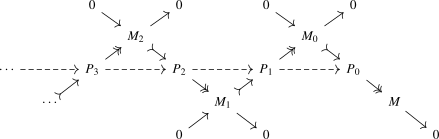
For each of these short exact sequences, we obtain a long exact sequence on Ext-groups from Observation 6.4.10. Since the higher Ext-groups of the t-projective objects \(P_k\) vanish by Proposition 6.4.11, its initial part is \[ \begin {aligned} 0 \to \Hom _{C^{\heartsuit }}(M_{k-1},N) &\to \Hom _{C^{\heartsuit }}(P_k,N) \to \Hom _{C^{\heartsuit }}(M_k,N) \\ &\to \Ext ^1_C(M_{k-1},N) \to 0, \end {aligned} \] and its remaining terms give isomorphisms \[ \Ext ^{i+1}_C(M_{k-1},N) \cong \Ext ^i_C(M_k,N) \qquad (i\geq 1). \]
Since the map \(P_{k+1} \twoheadrightarrow M_k\) is an epimorphism, the induced map \(\Hom _{C^{\heartsuit }}(M_k,N) \hookrightarrow \Hom _{C^{\heartsuit }}(P_{k+1},N)\) is injective, and so the initial part of this sequence provides for each \(k \geq 0\) an isomorphism \[ \Hom _{C^{\heartsuit }}(M_{k-1},N) \quad \cong \quad \ker (\Hom _{C^{\heartsuit }}(P_k,N) \to \Hom _{C^{\heartsuit }}(P_{k+1},N)). \] The next part of the sequence then shows that \(\Ext ^1_C(M_{k-1},N)\) is the cokernel of the map \(\Hom _{C^{\heartsuit }}(P_k,N) \to \Hom _{C^{\heartsuit }}(M_k,N)\). Combining this with the previous identification of \(\Hom _{C^{\heartsuit }}(M_k,N)\) as a kernel, this shows that \[ \Ext ^1_C(M_{k-1},N) \quad \cong \quad \frac {\ker (\Hom _{C^{\heartsuit }}(P_{k+1}, N) \to \Hom _{C^{\heartsuit }}(P_{k+2}, N))}{\im (\Hom _{C^{\heartsuit }}(P_{k}, N) \to \Hom _{C^{\heartsuit }}(P_{k+1}, N))} \quad = \quad H^{k+1}(\Hom _{C^{\heartsuit }}(P_{\bullet }, N)). \] Observe that setting \(k = 0\) in these two isomorphisms proves the statement of the proposition for \(n = 0\) and \(n = 1\). Iterating the displayed dimension-shifting isomorphisms gives \(\Ext ^n_C(M,N) \cong \Ext ^1_C(M_{n-2},N)\) for all \(n \geq 1\). Setting \(k = n-1\) in the previous isomorphism thus gives \[ \Ext ^n_C(M,N) \quad \cong \quad H^{n}(\Hom _{C^{\heartsuit }}(P_{\bullet }, N)) \] for all \(n \geq 1\), finishing the proof. □
Generated from the authoritative LaTeX source.