In classical algebra, projective modules are the ‘well-behaved’ building blocks essential for homological algebra. Their definition makes sense in an arbitrary abelian category \(\Aa \): an object \(P\) is called projective if the Hom functor \(\Hom _{\Aa }(P,-) \colon \Aa \to \Ab \) is an exact functor of abelian categories. This definition has an immediate analogue in an arbitrary t-structure:
Definition 6.4.1. Let \(C\) be a stable \(\infty \)-category equipped with a t-structure. An object \(P \in C\) is called t-projective if the mapping spectrum functor \(\hom _C(P,-)\colon C \to \Sp \) is t-exact.
Observation 6.4.2. Every t-projective object \(P\) is connective. To see this, consider the truncation \(\tau _{\leq -1}P\). By t-exactness, the mapping spectrum \(\hom _C(P,\tau _{\leq -1} P)\) lies in \(\Sp _{\leq -1}\), and it follows that \[ 0 = \pi _0 \hom _C(P,\tau _{\leq -1} P) \cong \pi _0 \Hom _C(\tau _{\leq -1}P, \tau _{\leq -1}P), \] where the last identification holds by adjunction. In particular, the identity on \(\tau _{\leq -1}P\) is homotopic to the zero map, forcing \(\tau _{\leq -1}P = 0\), hence \(P \in C_{\geq 0}\).
Observation 6.4.3. Conversely, if \(P \in C_{\geq 0}\) is a connective object, then \(\hom _C(P,-)\colon C \to \Sp \) is always left t-exact: if \(X \in C_{\leq 0}\), then for \(n > 0\) we have \[ \pi _n(\hom _C(P,X)) \cong \pi _0 \Hom _C(P,X[-n]) = 0, \] since \(P \in C_{\geq 0}\) while \(X[-n] \in C_{\leq -1}\). So \(P\) is t-projective if and only if \(\hom _C(P,-)\) is also right t-exact.
In the case \(C = \D (\Aa )\), this definition does indeed recover the usual notion of projectivity in \(\Aa \):
Lemma 6.4.4. Let \(\Aa \) be an abelian category and let \(M \in \Aa \). Then \(M\) is projective in \(\Aa \) if and only if the complex \(M[0] \in \D (\Aa )\) is t-projective.
Proof. Suppose first that \(M[0]\) is t-projective, so that \(\hom _{\D (\Aa )}(M[0],-)\colon \D (\Aa ) \to \Sp \) is t-exact. By Corollary 6.3.17, this functor restricts to an exact functor on hearts \(\D (\Aa )^{\heartsuit } \to \Sp ^{\heartsuit }\), i.e., \(\Aa \to \Ab \). This restricted functor is \(\Hom _{\Aa }(M,-)\), showing that \(M\) is projective in \(\Aa \).
Conversely, assume that \(\Hom _{\Aa }(M,-)\colon \Aa \to \Ab \) is exact. Just as in Corollary 6.2.9, this implies that for any chain complex \(C_{\bullet }\) in \(\Aa \) we have an isomorphism \[ \pi _n \hom _{\Kk (\Aa )}(M[0], C_{\bullet }) \cong \Hom _{\Aa }(M,H_n(C)). \] In particular, the functor \(\hom _{\Kk (\Aa )}(M[0],-)\colon \Kk (\Aa ) \to \Sp \) inverts quasi-isomorphisms. The same argument as in Lemma 6.2.10 shows that it is corepresented by \(M[0] \in \D (\Aa )\), giving a natural isomorphism \(\hom _{\D (\Aa )}(M[0],-) \cong \hom _{\Kk (\Aa )}(M[0],-)\). It follows that \(\pi _n\hom _{\D (\Aa )}(M[0],X) \cong \Hom _{\Aa }(M,H_n(X))\) for all complexes \(X \in \D (\Aa )\), showing that \(\hom _{\D (\Aa )}(M[0],X)\) is connective whenever \(X\) is. □
Corollary 6.4.5. Let \(\Aa \) be an abelian category and let \(M\in \Aa \) be projective. Then for every \(X\in \D (\Aa )\) and every \(n\in \Z \), there is a natural isomorphism \[ \pi _n\hom _{\D (\Aa )}(M[0],X)\cong \Hom _{\Aa }(M,H_n(X)). \]
Proof. This is the computation in the second half of the proof of Lemma 6.4.4. □
6.4.1 Ext-groups
We will next give a formulation of t-projectivity in terms of the Ext-groups in \(C\).
Definition 6.4.6 (Ext-groups). Let \(C\) be a stable \(\infty \)-category. For objects \(X,Y \in C\) and \(n \in \Z \), we define the \(n\)-th Ext-group to be \[ \Ext ^n_C(X,Y) := \pi _{-n}\hom _C(X,Y) \simeq \pi _0 \Hom _C(X,Y[n]). \]
For objects \(M,N\in \Aa \), regarded as complexes concentrated in degree zero, we abbreviate \(\Ext ^n_{\D (\Aa )}(M,N)\) to \(\Ext ^n_{\Aa }(M,N)\).
Assume now that \(C\) comes equipped with a t-structure. For objects \(M,N \in C^{\heartsuit }\), the Ext-groups \(\Ext ^n_C(M,N)\) admit a direct interpretation in small degrees:
Observation 6.4.7. For \(n < 0\), we have \(\Ext ^n_C(M,N) = 0\), since \(M \in C_{\geq 0}\) while \(N[n] \in C_{\leq n} \subseteq C_{\leq -1}\).
Observation 6.4.8. For \(n = 0\), we have \(\Ext ^0_C(M,N) = \pi _0\Hom _C(M,N) = \Hom _{C^{\heartsuit }}(M,N)\), the set of morphisms in the heart.
The interpretation of \(\Ext ^1_C(M,N)\) in terms of extensions is developed in Chapterexercise 6.5.
Exercise 6.4.9. Assume that \(C^{\heartsuit }\) has enough projectives, meaning that for every object \(M\) there exists an epimorphism \(P \twoheadrightarrow M\) from a projective object \(P\). Show that \(\Ext ^n_C(M,N)\) for \(n \geq 2\) can be described in terms of degree \(n\) Yoneda extensions: exact sequences in \(C^{\heartsuit }\) of the form \[ 0 \to N \to E_n \to E_{n-1} \to \dots \to E_2 \to E_1 \to M \to 0. \] Hint: use Proposition 6.4.14 below.
We now record the fundamental long exact sequences for Ext-groups.
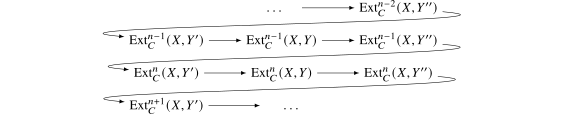
Observation 6.4.10 (Ext long exact sequence). Every exact sequence \(Y' \to Y \to Y''\) in \(C\) induces an exact sequence of mapping spectra \(\hom _C(X,Y') \to \hom _C(X,Y) \to \hom _C(X,Y'')\), thus giving rise to a long exact sequence of homotopy groups of the form
Similarly, every exact sequence \(X' \to X \to X''\) in \(C\) induces a long exact sequence of the form \[ \begin {aligned} \dots \to \Ext ^{n-1}_C(X',Y) \to \Ext ^n_C(X'',Y) \to \Ext ^n_C(X,Y) \to \Ext ^n_C(X',Y) \to \Ext ^{n+1}_C(X'',Y) \to \dots . \end {aligned} \] As a special case, given an object \(N \in C^{\heartsuit }\) and a short exact sequence \(M' \hookrightarrow P \twoheadrightarrow M\) in \(C^{\heartsuit }\), the negative Ext-groups vanish, giving a one-sided long exact sequence of the form \[ \begin {aligned} 0 \to \Hom _{C^{\heartsuit }}(&M,N) \to \Hom _{C^{\heartsuit }}(P,N) \to \Hom _{C^{\heartsuit }}(M',N) \\ &\to \Ext ^1_C(M,N) \to \Ext ^1_C(P,N) \to \Ext ^1_C(M',N) \\ &\to \Ext ^2_C(M,N) \to \dots . \end {aligned} \]
Using Ext-groups, we can give several equivalent characterizations of t-projectivity.
Proposition 6.4.11 ([Lurie (2017), Proposition 7.2.2.6]). Let \(C\) be a stable \(\infty \)-category equipped with a t-structure, and let \(P \in C_{\geq 0}\) be a connective object. Then the following conditions are equivalent:
- (1)
- (2)
-
For every \(Q \in C_{\geq 0}\) and every \(i > 0\), the abelian group \(\Ext ^i_C(P,Q)\) is zero;
- (3)
-
For every \(Q \in C_{\geq 0}\), the abelian group \(\Ext ^1_C(P,Q)\) is zero;
- (4)
-
Given an exact sequence \[ N' \to N \to N'' \] in \(C\) with \(N',N,N'' \in C_{\geq 0}\), the map \(\Ext ^0_C(P,N) \to \Ext ^0_C(P,N'')\) is surjective.
If \(C\) is left complete, this is further equivalent to:
Proof. Recall from Observation 6.4.3 that \(P\) is t-projective if and only if the mapping spectrum functor \(\hom _C(P,-)\colon C \to \Sp \) is right t-exact. By definition, this means that for any object \(Q \in C_{\geq 0}\), the mapping spectrum \(\hom _C(P,Q)\) has vanishing negative homotopy groups \(\pi _{-i}\hom _C(P,Q) = \Ext ^i_C(P,Q)\) for \(i > 0\). This shows the equivalence \(\text{(1)} \Leftrightarrow \text{(2)}\).
It is clear that (2) implies (3), and the implication \(\text{(3)} \Rightarrow \text{(2)}\) follows by replacing \(Q\) by \(Q[i-1]\) for all \(i \geq 1\).
We next show that \(\text{(3)} \Leftrightarrow \text{(4)}\). It is clear that (3) implies (4): the exact sequence \(N' \to N \to N''\) induces a long exact sequence of the form \[ \dots \to \Ext ^0_C(P,N) \to \Ext ^0_C(P,N'') \to \Ext ^1_C(P,N') \to \dots , \] so the vanishing of \(\Ext ^1_C(P,N')\) implies that the first map must be surjective. Assume now that (4) holds. Given a class \(\eta \in \Ext ^1(P,Q) = \pi _0\Hom _C(P,Q[1])\), we obtain an exact sequence \[ P' \to P \xrightarrow {\eta } Q[1] \] and thus a long exact sequence \[ \dots \to \Ext ^0_C(P,P') \to \Ext ^0_C(P,P) \xrightarrow {\eta \circ -} \Ext ^1_C(P,Q) \to \dots \] As \(P,P',Q \in C_{\geq 0}\), the first map is surjective, hence the second map is the zero map. Since it sends \(\id _P\) to \(\eta \), we conclude that \(\eta = 0\). This shows that \(\text{(3)} \Leftrightarrow \text{(4)}\).
Finally, suppose that \(C\) is left complete. It is clear that (2) implies (5). Conversely, assume (5). The exact sequences \[ (\pi _{n+1}Q)[n+1] \to \tau _{\leq n+1}Q \to \tau _{\leq n}Q \] show that the towers of Ext-groups in each positive degree are eventually constant. Since left completeness gives \(Q \simeq \lim _n \tau _{\leq n}Q\), the corresponding tower of mapping spectra computes \(\hom _C(P,Q)\). Eventual constancy in adjacent degrees eliminates the derived-limit term and gives \[ \Ext ^i_C(P,Q) \cong \Ext ^i_C(P,\tau _{\leq 0}Q)=0 \] for \(i>0\). This is the Postnikov-tower argument of [Lurie (2017), Proposition 7.2.2.6]. □
6.4.2 Ext-groups via projective resolutions
As a consequence of Proposition 6.4.11, we may compute Ext-groups in terms of projective resolutions.
Definition 6.4.12. Let \(C\) be a stable \(\infty \)-category equipped with a t-structure, and let \(M \in C^{\heartsuit }\) be an object in the heart of \(C\). A projective resolution of \(M\) is a long exact sequence \[ \dots \to P_2 \to P_1 \to P_0 \twoheadrightarrow M \to 0 \] in \(C^{\heartsuit }\) such that each object \(P_n\) is t-projective.
Remark 6.4.13. When \(C = \D (\Aa )\) is the derived \(\infty \)-category of some abelian category \(\Aa \), this recovers the usual notion of projective resolutions in \(\Aa \) from homological algebra by Lemma 6.4.4.
Proposition 6.4.14 (Ext-groups via projective resolutions). Let \(C\) be a stable \(\infty \)-category equipped with a t-structure, and let \(P_{\bullet }\) be a projective resolution of \(M \in C^{\heartsuit }\). Then for every other object \(N \in C^{\heartsuit }\) and every \(n \in \Z \) there is an isomorphism of abelian groups \[ \Ext ^n_C(M,N) \quad \cong \quad H^n(\Hom _{C^{\heartsuit }}(P_{\bullet },N)) \] between the \(n\)-th Ext-group and the \(n\)-th cohomology group of the cochain complex \(\Hom _{C^{\heartsuit }}(P_{\bullet },N)\).
Proof. The claim is clear for \(n < 0\) as both sides are zero: \(\Ext ^n_C(M,N) = \pi _0 \Hom _{C}(M,N[n]) = 0\) since \(M \in C_{\geq 0}\) and \(N[n] \in C_{\leq n} \subseteq C_{\leq -1}\).
For the remaining cases, we break the resolution into short exact sequences and use the vanishing of the higher Ext-groups of the \(P_k\) to splice the resulting long exact sequences together. Define auxiliary objects \(M_{-1} := M\) and \(M_k := \ker (P_k \twoheadrightarrow M_{k-1})\) for \(k \geq 0\). The projective resolution then admits the following factorization in \(C^{\heartsuit }\), where each of the diagonal sequences are exact:
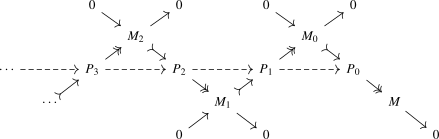
For each of these short exact sequences, we obtain a long exact sequence on Ext-groups from Observation 6.4.10. Since the higher Ext-groups of the t-projective objects \(P_k\) vanish by Proposition 6.4.11, its initial part is \[ \begin {aligned} 0 \to \Hom _{C^{\heartsuit }}(M_{k-1},N) &\to \Hom _{C^{\heartsuit }}(P_k,N) \to \Hom _{C^{\heartsuit }}(M_k,N) \\ &\to \Ext ^1_C(M_{k-1},N) \to 0, \end {aligned} \] and its remaining terms give isomorphisms \[ \Ext ^{i+1}_C(M_{k-1},N) \cong \Ext ^i_C(M_k,N) \qquad (i\geq 1). \]
Since the map \(P_{k+1} \twoheadrightarrow M_k\) is an epimorphism, the induced map \(\Hom _{C^{\heartsuit }}(M_k,N) \hookrightarrow \Hom _{C^{\heartsuit }}(P_{k+1},N)\) is injective, and so the initial part of this sequence provides for each \(k \geq 0\) an isomorphism \[ \Hom _{C^{\heartsuit }}(M_{k-1},N) \quad \cong \quad \ker (\Hom _{C^{\heartsuit }}(P_k,N) \to \Hom _{C^{\heartsuit }}(P_{k+1},N)). \] The next part of the sequence then shows that \(\Ext ^1_C(M_{k-1},N)\) is the cokernel of the map \(\Hom _{C^{\heartsuit }}(P_k,N) \to \Hom _{C^{\heartsuit }}(M_k,N)\). Combining this with the previous identification of \(\Hom _{C^{\heartsuit }}(M_k,N)\) as a kernel, this shows that \[ \Ext ^1_C(M_{k-1},N) \quad \cong \quad \frac {\ker (\Hom _{C^{\heartsuit }}(P_{k+1}, N) \to \Hom _{C^{\heartsuit }}(P_{k+2}, N))}{\im (\Hom _{C^{\heartsuit }}(P_{k}, N) \to \Hom _{C^{\heartsuit }}(P_{k+1}, N))} \quad = \quad H^{k+1}(\Hom _{C^{\heartsuit }}(P_{\bullet }, N)). \] Observe that setting \(k = 0\) in these two isomorphisms proves the statement of the proposition for \(n = 0\) and \(n = 1\). Iterating the displayed dimension-shifting isomorphisms gives \(\Ext ^n_C(M,N) \cong \Ext ^1_C(M_{n-2},N)\) for all \(n \geq 1\). Setting \(k = n-1\) in the previous isomorphism thus gives \[ \Ext ^n_C(M,N) \quad \cong \quad H^{n}(\Hom _{C^{\heartsuit }}(P_{\bullet }, N)) \] for all \(n \geq 1\), finishing the proof. □
Example 6.4.15 (A nontrivial Postnikov extension). Let \(C\) be a stable \(\infty \)-category with a t-structure, and let \(X\in C_{\geq 0}\cap C_{\leq 1}\). Its truncation sequence takes the form \[ \pi _1(X)[1]\longrightarrow X\longrightarrow \pi _0(X) \xrightarrow {\ \kappa _X\ }\pi _1(X)[2]. \] We call the final morphism \[ \kappa _X\in \Ext ^2_C(\pi _0(X),\pi _1(X)) \] the first Postnikov \(k\)-invariant of \(X\). The exact sequence recovers \(X\) as the fiber of \(\kappa _X\). In particular, if \(\kappa _X\) is zero, then \(X\cong \pi _0(X)\oplus \pi _1(X)[1]\). The \(k\)-invariant therefore records how the two homotopy group objects are glued together.
For a concrete nontrivial example, set \(R:=\Z /4\) and \(K:=R/(2)\cong \Z /2\), and consider the complex \[ A_{\bullet }:=\big (0\longrightarrow R\xrightarrow {\ 2\ }R\longrightarrow 0\big ) \] in \(\D (R)\), with the two copies of \(R\) in degrees \(1\) and \(0\). Its only nonzero homology groups are \[ H_1(A_{\bullet })\cong K \qquad \text {and}\qquad H_0(A_{\bullet })\cong K. \] The periodic projective resolution \[ \cdots \xrightarrow {\ 2\ }R\xrightarrow {\ 2\ }R \xrightarrow {\ 2\ }R\twoheadrightarrow K\longrightarrow 0 \] and Proposition 6.4.14 show that \(\Ext ^n_R(K,K)\cong K\) for every \(n\geq 0\): after applying \(\Hom _R(-,K)\), all differentials vanish. In the Yoneda description from Exercise 6.4.9, the first \(k\)-invariant of \(A_{\bullet }\) is represented by the exact \(2\)-extension \[ 0\longrightarrow K\longrightarrow R\xrightarrow {\ 2\ }R \longrightarrow K\longrightarrow 0, \] which is obtained from the first two steps of this resolution and hence represents the nonzero element of \(\Ext ^2_R(K,K)\). Consequently, \[ A_{\bullet }\not \cong K[1]\oplus K[0] \] in \(\D (R)\), although the two sides have isomorphic homology groups in every degree.
6.4.3 Projective objects and geometric realizations
There is a second natural way to generalize the notion of projectivity beyond the abelian setting. An object \(P\) in an abelian category \(\Aa \) is projective if and only if \(\Hom _{\Aa }(P,-)\) preserves epimorphisms. Since epimorphisms in \(\Aa \) are precisely the reflexive coequalizers, this is equivalent to asking that \(\Hom _{\Aa }(P,-)\) preserves reflexive coequalizers. Since the \(\infty \)-categorical analogues of reflexive coequalizers are geometric realizations, this leads to the following definition:
Definition 6.4.16. Let \(D\) be an \(\infty \)-category with geometric realizations. An object \(P \in D\) is called projective if the functor \(\Hom _D(P,-)\colon D \to \An \) preserves geometric realizations.
If \(C\) is a stable \(\infty \)-category with a left complete t-structure, it turns out that an object of \(C\) is t-projective if and only if it is a projective object in the connective part \(C_{\geq 0}\). We start with the following auxiliary result:
Lemma 6.4.17. Assume that the t-structure on \(C\) is left complete. Then \(C_{\geq 0}\) admits geometric realizations. If \(C'\) is another stable \(\infty \)-category with a left complete t-structure, then any exact right t-exact functor \(F\colon C \to C'\) restricts to a functor \(F\colon C_{\geq 0} \to C'_{\geq 0}\) that preserves geometric realizations.
Proof. By [Lurie (2017), Lemma 1.3.3.11(2)], the connective part of a left-complete t-structure admits geometric realizations, and a right exact functor between connective parts preserves them. The restriction of an exact right t-exact functor is right exact, which gives the second claim. □
As a second auxiliary result, we record the following general description of pushouts. Besides its application below, it illustrates why geometric realizations play the role of reflexive coequalizers in the preceding discussion.
Lemma 6.4.18 (Pushouts as geometric realizations). Let \(D\) be an \(\infty \)-category with finite coproducts and geometric realizations. Given a span \(X \xleftarrow {f} A \xrightarrow {g} Y\), there exists a simplicial object \(B_{\bullet }(X,A,Y)\) with \[ B_n(X,A,Y) := X \sqcup A^{\sqcup n} \sqcup Y. \] Its geometric realization is the pushout: \[ \abs {B_{\bullet }(X,A,Y)} \cong X \sqcup _A Y. \]
Proof. TO DO. This is an instance of the Bousfield–Kan formula for colimits. □
Proposition 6.4.19. Let \(C\) be a stable \(\infty \)-category equipped with a left-complete t-structure, and let \(P \in C_{\geq 0}\) be a connective object of \(C\). Then \(P\) is t-projective if and only if it is a projective object in \(C_{\geq 0}\) in the sense of Definition 6.4.16.
Proof. First assume that \(P\) is projective in \(C_{\geq 0}\). We will verify condition (3) from Proposition 6.4.11. Given an object \(Q \in C_{\geq 0}\), apply Lemma 6.4.18 to the span \(0 \leftarrow Q \to 0\). The resulting simplicial object has \(Q^{\oplus n}\) in degree \(n\): its face maps add adjacent summands or omit the first or last summand, and its degeneracy maps insert a zero summand. Thus it begins

Its geometric realization is the pushout \(0 \sqcup _Q 0\). By Lemma 6.3.7, the inclusion \(C_{\geq 0} \hookrightarrow C\) has a right adjoint and therefore preserves this pushout, which in the stable category \(C\) is the suspension \(Q[1]\). Since \(P\) is projective, \(\Hom _C(P,Q[1])\) is therefore the geometric realization of the simplicial anima obtained by mapping out of \(P\). The set of components of a geometric realization is a quotient of the set of components in simplicial degree zero, which here is the singleton \(\pi _0\Hom _C(P,0)=*\). Thus \(\Hom _C(P,Q[1])\) is connected, so \(\Ext ^1_C(P,Q)=0\). This shows that \(P\) is t-projective.
For the converse, assume now that \(P\) is t-projective, giving a t-exact functor \(\hom _C(P,-)\colon C \to \Sp \). We get from Lemma 6.4.17 that the restricted functor \(\hom _C(P,-)\colon C_{\geq 0} \to \Sp _{\geq 0}\) preserves geometric realizations. Since \(\Omega ^{\infty }\colon \Sp _{\geq 0} \iso \CGrp (\An ) \to \An \) preserves geometric realizations as well, it follows that so does \(\Hom _C(P,-)\colon C_{\geq 0} \to \An \), showing that \(P\) is projective in \(C_{\geq 0}\). □
Warning 6.4.20. It is not reasonable to ask for \(P\) to be projective in the stable \(\infty \)-category \(C\) itself, since the only projective objects in \(C\) are the zero objects. To see this, assume that \(P\) is a projective object of \(C\). By Lemma 6.4.18, the shift \(N[1] \cong 0 \sqcup _N 0\) of any object \(N \in C\) is the geometric realization of the simplicial object with \(N^{\oplus n}\) in degree \(n\). We then obtain equivalences \[ \Hom _{C}(P[-1],N) \simeq \Hom _{C}(P,N[1]) \simeq \abs { [n] \mapsto \Hom _{C}(P,N^{\oplus n}) }. \] Since the right-hand side is connected, we see that \(\pi _0\Hom _{C}(P[-1],N) = 0\). Replacing \(N\) by \(N[-k]\) for all \(k \in \N \) then gives that \(\pi _k\Hom _{C}(P[-1],N) = 0\) for all \(k\), hence \(\Hom _{C}(P[-1],N) = 0\), showing that \(P\) is the zero object.
Generated from the authoritative LaTeX source.