A recurring theme of this chapter is the interplay between the stable and the abelian setting. Exactness is better behaved in a stable \(\infty \)-category, while explicit computations are usually easier in an abelian category, and the derived \(\infty \)-category \(\D (\Aa )\) relates the two: it is stable, and it contains \(\Aa \) as its heart. This relation may also be used to study functors on \(\Aa \) itself. Consider a right t-exact functor \(G\colon \D (\Aa ) \to \D (\Bb )\) between derived categories. Given a short exact sequence \[ 0 \to A \rightarrowtail B \twoheadrightarrow C \to 0 \] in \(\Aa \), we showed in Corollary 6.3.16 that this induces an exact sequence \(A \to B \to C\) in \(\D (\Aa )\). Applying \(G\), we obtain an exact sequence \(G(A) \to G(B) \to G(C)\) in \(\D (\Bb )\), which in turn gives rise to a long exact sequence of homology groups: \[ \dots \to G_1(B) \to G_1(C) \to G_0(A) \to G_0(B) \to G_0(C) \to 0, \] where \(G_n := H_n \circ G\colon \Aa \to \Bb \). In particular, the functor \(G_0\colon \Aa \to \Bb \) is right exact, and the long exact sequence provides a powerful computational tool for understanding it.
The goal of derived functors is to reverse this process: given a right exact functor \(F\colon \Aa \to \Bb \), can we obtain it as the zeroth homology of some right t-exact functor \(\D (\Aa ) \to \D (\Bb )\)? One might try to obtain such an extension by simply applying \(F\) degreewise to chain complexes. However, this naive approach fails: the degreewise extension \(\Ch (F)\colon \Ch (\Aa ) \to \Ch (\Bb )\) does not preserve quasi-isomorphisms unless \(F\) is exact. Instead, we could ask: does there exist a universal approximation of \(\Ch (F)\) from the left by a functor that descends to \(\D (\Aa ) \to \D (\Bb )\)?
If \(\Aa \) has enough projectives, we will see that such an approximation exists, at least at the level of bounded below complexes \(\bL F\colon \D ^-(\Aa ) \to \D ^-(\Bb )\). It may be computed on an arbitrary bounded below complex \(C\) by first replacing \(C\) with a quasi-isomorphic projective complex \(P\) and then applying \(F\): we have \(\bL F(C) \simeq F(P)\). Dually, a left exact functor gives rise to right derived functors.
6.6.1 Abstract derived functors
We begin by developing the abstract theory of derived functors in terms of universal properties. The key observation is that a derived functor should be a ‘best approximation’ to a given functor by one that factors through a localization. Our discussion here is inspired by [Dwyer et al. (2004), Sections 39-41], [Riehl (2014), Chapter 2] and [Cisinski (2019), Section 7.5].
Definition 6.6.1. Let \(C\) be an \(\infty \)-category with a collection of morphisms \(W\), and let \(\gamma \colon C \to C[W^{-1}]\) be the localization functor. Let \(F\colon C \to D\) be a functor. A functor \(\bL F\colon C[W^{-1}] \to D\) is called a total left derived functor of \(F\) if it comes equipped with a natural transformation \(\alpha \colon \bL F \circ \gamma \Rightarrow F\) of functors \(C \to D\) that exhibits \(\bL F\) as a right Kan extension of \(F\) along \(\gamma \):
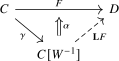
Note that the functor \(\bL F\) is unique whenever it exists.
Dually, a total right derived functor of \(F\) is a total left derived functor of \(F\catop \colon C\catop \to D\catop \), i.e. a functor \(\bR F\colon C[W^{-1}] \to D\) equipped with \(\beta \colon F \Rightarrow \bR F \circ \gamma \) which exhibits \(\bR F\) as a left Kan extension of \(F\) along \(\gamma \).
Observation 6.6.2. A priori, the condition on \(\bL F\) to be a right Kan extension demands that for every functor \(H\colon C[W^{-1}] \to D\), the composite \[ \Nat (H,\bL F) \xrightarrow {\gamma ^*} \Nat (H \circ \gamma , \bL F \circ \gamma ) \xrightarrow {\alpha \circ -} \Nat (H \circ \gamma , F) \] is an equivalence. But since \(\gamma ^*\) is always an equivalence by definition of localizations, this is equivalent to asking the second map to be an equivalence. We conclude that a transformation \(\alpha \colon \bL F \circ \gamma \Rightarrow F\) is a total left derived functor of \(F\) if and only if for every functor \(G\colon C \to D\) that inverts all maps in \(W\), the map \[ \alpha \circ - \colon \Nat (G, \bL F \circ \gamma ) \, \to \, \Nat (G, F) \] is an equivalence.
In practice, total left derived functors can often be computed using cofibrant replacements. The idea is that while \(F\) may not preserve weak equivalences in general, it often does so when restricted to some full subcategory of cofibrant objects. The key ingredient then is the fact that cofibrant objects compute the localization: see Corollary 2.2.9. This turns out to be enough to produce the derived functor, which is the content of the following result of Cisinski (2019). We will use it as a black box.
Proposition 6.6.3 (Cisinski (2019), 7.5.25). Let \((C,W,I)\) be an \(\infty \)-category with weak equivalences and cofibrations, let \(i\colon C_c \hookrightarrow C\) denote the full subcategory of cofibrant objects, and let \(F\colon C \to D\) be a functor such that the restriction \(F\vert _{C_c}\colon C_c \to D\) inverts the weak equivalences between cofibrant objects. Then \(F\) admits a total left derived functor \[ \bL F\colon C[W^{-1}] \to D. \] It is uniquely characterized by the existence of an isomorphism \(\bL F \circ \gamma \circ i \simeq F \circ i\). In particular, if \(q\colon Q \to X\) is any weak equivalence with \(Q\) cofibrant, then \[ \bL F(\gamma X) \simeq F(Q). \] Moreover, the structure transformation \(\bL F\circ \gamma \Rightarrow F\) exhibits \(\bL F\) as an absolute right Kan extension: for every functor \(H\colon D\to E\), the composite \(H\circ \bL F\) is a total left derived functor of \(H\circ F\).
Proof. We give the construction of \(\bL F\), and refer to [Cisinski (2019), 7.5.25] for the verification that it has the required universal property. (The reference treats the dual situation of an \(\infty \)-category with weak equivalences and fibrations, and constructs the total right derived functor of a functor which inverts the weak equivalences between fibrant objects.)
Write \(W_c\) for the weak equivalences between cofibrant objects. The restriction \(F\vert _{C_c}\) descends to a functor \(F_c\colon C_c[W_c^{-1}] \to D\). By part (1) of Corollary 2.2.9, the inclusion induces an equivalence \(\overline i\colon C_c[W_c^{-1}] \xrightarrow {\simeq } C[W^{-1}]\), and we may thus define \[ \bL F \quad := \quad F_c \circ \overline i^{\,-1}\colon \; C[W^{-1}] \to D \] by choosing an inverse of \(\overline i\). By construction, the restriction of \(\bL F\) to the cofibrant objects is isomorphic to \(F\vert _{C_c}\), that is, \(\bL F \circ \gamma \circ i \simeq F \circ i\). Since \(\overline i\) is an equivalence, a functor out of \(C[W^{-1}]\) is determined by its restriction along \(\gamma \circ i\), which gives the asserted uniqueness. Finally, if \(q\colon Q \to X\) is a weak equivalence with \(Q\) cofibrant, then \(\gamma (q)\) is an isomorphism, and hence \[ \bL F(\gamma X) \simeq \bL F(\gamma Q) \simeq F(Q). \] The construction of \(\bL F\) is also compatible with postcomposition: for every \(H\colon D\to E\), the composite \(H\circ \bL F\) is obtained by applying the same construction to \(H\circ F\). Its structure transformation is therefore again a right Kan extension by [Cisinski (2019), (7.5.25.3)], proving absoluteness. □
Remark 6.6.4. Everything in the above proof is formal except for the statement being cited: that the functor \(\bL F\), which by construction only knows about the cofibrant objects, is a right Kan extension of \(F\) along \(\gamma \). The latter is a statement about all objects of \(C\), and it is here that the real work happens: one needs to know that Kan extensions along \(\gamma \) may be computed in terms of the cofibrant objects. This is [Cisinski (2019), Corollary 7.5.17], whose proof rests on the theory of finite direct diagrams and their Reedy fibrant replacements developed in [Cisinski (2019), Section 7.4].
Remark 6.6.5. The situation simplifies considerably when \(C\) admits a functorial cofibrant replacement: a functor \(Q\colon C \to C_c\) together with a natural weak equivalence \(q\colon i \circ Q \Rightarrow \id _C\). Such a replacement exists as soon as \((C,W,I)\) admits functorial factorizations, by factoring the map \(\emptyset \to X\) functorially in \(X\). One may then simply take \(\bL F \circ \gamma \simeq F \circ Q\), with structure map \(F(q)\colon F \circ Q \Rightarrow F\), and the universal property can be deduced directly from the naturality of \(q\), without any of the machinery above. This is the route taken in [Dwyer et al. (2004), Sections 39-41] and [Riehl (2014), Chapter 2], where such data is called a left deformation.
We have avoided this hypothesis because it is genuinely restrictive: while \(\Top \) and \(\Ch (\Aa )\) do admit functorial factorizations, the projective cofibration structure on bounded below chain complexes from Proposition 6.6.15 does not, at least not for an arbitrary abelian category \(\Aa \) with enough projectives: a projective resolution is built from a choice of epimorphism \(P \twoheadrightarrow A\) from a projective object for each \(A \in \Aa \), and such choices cannot in general be made functorially. (For \(\Aa = \Mod _R\) one can of course take the free module on the underlying set of \(A\).)
Exercise 6.6.6. Let \(F\colon C \to D\) be a functor which inverts all morphisms in \(W\). By the universal property of \(C[W^{-1}]\), \(F\) factors through a functor \(\bL F \colon C[W^{-1}] \to D\). Show that \(\bL F\) is a total left derived functor of \(F\).
Lemma 6.6.7 (Products of cofibration structures). Let \((C_i,W_i,I_i)_{i\in K}\) be a finite collection of \(\infty \)-categories with weak equivalences and cofibrations. Then \(\prod _{i\in K}C_i\), equipped with the componentwise weak equivalences and cofibrations, is again an \(\infty \)-category with weak equivalences and cofibrations. Its cofibrant objects are precisely the tuples of cofibrant objects. Consequently, a functor \(F\colon \prod _{i\in K}C_i\to D\) which inverts weak equivalences between cofibrant objects admits a total left derived functor \[ \bL F\colon \prod _{i\in K}C_i[W_i^{-1}]\longrightarrow D. \]
Proof. The axioms for weak equivalences and cofibrations, including the factorization and pushout axioms, hold componentwise in the product, and the description of the cofibrant objects follows from the componentwise initial object. By currying and applying the universal property of localization successively in each variable, the canonical functor identifies the localization of the product with \(\prod _{i\in K}C_i[W_i^{-1}]\). The final assertion now follows from Proposition 6.6.3. □
This is how derived functors of several variables, such as the derived tensor product of Definition 6.6.25, are obtained.
6.6.2 Derived functors between derived categories
We now apply the abstract framework to construct derived functors between derived \(\infty \)-categories. The key observation is that bounded below projective chain complexes play the role of cofibrant objects: quasi-isomorphisms between them are automatically chain homotopy equivalences, so any additive functor preserves such quasi-isomorphisms.
Definition 6.6.8 (Projective chain complex). Let \(\Aa \) be an abelian category. We write \(\Ch ^-(\Aa )\subseteq \Ch (\Aa )\) for the full subcategory of bounded below chain complexes, those \(C_{\bullet }\) for which \(C_n=0\) for all sufficiently small \(n\). A chain complex \(P_{\bullet } \in \Ch (\Aa )\) is called projective if each object \(P_n\) is projective in \(\Aa \), in the sense of Section 6.4.1 We write \(\Ch ^-_{\proj }(\Aa ) \subseteq \Ch ^-(\Aa )\) for the full subcategory of bounded below projective chain complexes.
Remark 6.6.9. The localization functor identifies \[ \Ch ^-(\Aa )[\{\text {quasi-isomorphisms}\}^{-1}] \iso \D ^-(\Aa ), \] where \(\D ^-(\Aa )\) is the full subcategory of bounded below objects from Definition 6.3.33. Indeed, Proposition 6.1.22 identifies the localization of \(\Ch (\Aa )_{\geq m}\) with the full subcategory \(\D (\Aa )_{\geq m}\) of \(\D (\Aa )\) for every \(m\). Taking the union over all \(m\) gives the displayed identification. We use it without further comment.
Lemma 6.6.10. Let \(P_{\bullet }\) be a bounded below projective chain complex with trivial homology, i.e., \(H_n(P) = 0\) for all \(n\). Then \(P_{\bullet }\) is contractible: the identity \(\id _{P_{\bullet }}\) is chain homotopic to zero.
Proof. We construct a contracting homotopy \(s_n\colon P_n \to P_{n+1}\) satisfying \(d_{n+1} s_n + s_{n-1} d_n = \id _{P_n}\) by induction. Say \(P_{\bullet }\) is concentrated in degrees \(\geq m\); we set \(s_n = 0\) for \(n < m\).
For the base case \(n = m\): Since \(P_{m-1} = 0\), the differential \(d_m\colon P_m \to P_{m-1}\) is zero. The condition \(H_m(P) = 0\) then says that \(\ker (d_m)/\im (d_{m+1}) = P_m/\im (d_{m+1}) = 0\), meaning \(d_{m+1}\colon P_{m+1} \to P_m\) is an epimorphism. Since \(P_m\) is projective, the identity \(\id _{P_m}\) lifts along this epimorphism to give \(s_m\colon P_m \to P_{m+1}\) with \(d_{m+1} s_m = \id _{P_m}\). This satisfies our requirement since \(s_{m-1} = 0\).
For the inductive step, suppose we have constructed \(s_k\) for all \(k < n\) satisfying the homotopy relation. Define \[ \alpha _n \quad := \quad \id _{P_n} - s_{n-1} d_n \colon P_n \to P_n. \] We claim that \(\im (\alpha _n) \subseteq \im (d_{n+1})\). Indeed, using the induction hypothesis \(d_n s_{n-1} + s_{n-2} d_{n-1} = \id _{P_{n-1}}\), we compute \[ d_n \circ \alpha _n \,=\, d_n - d_n s_{n-1} d_n \,=\, d_n - (\id _{P_{n-1}} - s_{n-2} d_{n-1}) d_n \,=\, s_{n-2} d_{n-1} d_n \,=\, 0. \] Thus \(\im (\alpha _n) \subseteq \ker (d_n) = \im (d_{n+1})\), where the last equality uses \(H_n(P) = 0\). Since \(P_n\) is projective and \(d_{n+1}\colon P_{n+1} \to \im (d_{n+1})\) is an epimorphism, there exists \(s_n\colon P_n \to P_{n+1}\) with \(d_{n+1} s_n = \alpha _n = \id _{P_n} - s_{n-1} d_n\), as required. □
Proposition 6.6.11. Let \(P_{\bullet }\) and \(Q_{\bullet }\) be bounded below projective chain complexes. Then any quasi-isomorphism \(f\colon P_{\bullet } \to Q_{\bullet }\) is a chain homotopy equivalence.
Proof. The mapping cone \(\Cone (f)\) fits into a short exact sequence \[ 0 \to Q_{\bullet } \to \Cone (f) \to P_{\bullet }[1] \to 0. \] By Lemma 6.1.15, the complex \(\Cone (f)\) is acyclic. It is again bounded below and projective, hence contractible by Lemma 6.6.10. Write the bottom-left component of a contracting homotopy \[ \Cone (f)_n=Q_n\oplus P_{n-1}\longrightarrow Q_{n+1}\oplus P_n=\Cone (f)_{n+1} \] as \(g_n\colon Q_n\to P_n\). The contracting-homotopy equation says that \(g\) is a chain map and that \(fg\) and \(gf\) are chain homotopic to the respective identity maps. Thus \(f\) is a chain homotopy equivalence. □
Corollary 6.6.12. Let \(F\colon \Ch (\Aa ) \to \Ch (\Bb )\) be a functor that preserves chain homotopies (for example, a functor induced by an additive functor \(\Aa \to \Bb \)). Then \(F\) preserves quasi-isomorphisms between bounded below projective chain complexes. □
We now assume that \(\Aa \) has enough projectives, meaning that every object of \(\Aa \) admits an epimorphism from a projective object. This is enough to construct projective resolutions one complex at a time.
Proposition 6.6.13 (Existence of projective resolutions). Let \(\Aa \) be an abelian category with enough projectives. Every bounded below chain complex \(C_{\bullet }\) admits a degreewise epimorphic quasi-isomorphism \[ q\colon P_{\bullet }\xrightarrow {\sim }C_{\bullet } \] from a bounded below projective chain complex \(P_{\bullet }\). Moreover, if \(C_n=0\) for all \(n<m\), then \(P_{\bullet }\) may be chosen with \(P_n=0\) for all \(n<m\).
Proof. This is the standard bounded-below projective-replacement theorem. One construction takes the total complex of a Cartan–Eilenberg projective resolution; it produces a degreewise epimorphic quasi-isomorphism with the stated lower bound. See [Weibel (1994), Theorem 10.4.8 and its proof]. □
Lemma 6.6.14 (Lifting along a projective resolution). Let \(q\colon Q_{\bullet }\to C_{\bullet }\) be a degreewise epimorphic quasi-isomorphism between bounded below chain complexes in an abelian category, and let \(P_{\bullet }\) be a bounded below projective chain complex. Every chain map \(f\colon P_{\bullet }\to C_{\bullet }\) admits a lift \(\widetilde f\colon P_{\bullet }\to Q_{\bullet }\) satisfying \(q\widetilde f=f\). Any two such lifts are chain homotopic through a chain homotopy \(h\) satisfying \(qh=0\).
Proof guide. Set \(K_{\bullet }:=\ker (q)\). The long exact sequence in homology shows that \(K_{\bullet }\) is acyclic. Comparing boundaries, cycles, and homology shows that \(q\colon Z_n(Q)\to Z_n(C)\) is an epimorphism. More generally, the map \[ Q_n\longrightarrow C_n\times _{Z_{n-1}(C)}Z_{n-1}(Q), \qquad x\longmapsto (qx,dx), \] is an epimorphism. Starting below the common lower bound, projectivity of each \(P_n\) now constructs \(\widetilde f_n\) inductively. The difference of two lifts is a chain map \(P_{\bullet }\to K_{\bullet }\), and the same induction, using the acyclicity of \(K_{\bullet }\), constructs the required nullhomotopy. A full proof is given in the online supplementary material.
The projective complexes may now be characterized intrinsically as the cofibrant objects in a cofibration structure on bounded below chain complexes.
Proposition 6.6.15 (The projective cofibration structure). Let \(\Aa \) be an abelian category with enough projectives. Equip \(\Ch ^-(\Aa )\) with the quasi-isomorphisms as weak equivalences and the degreewise split monomorphisms with bounded below projective cokernel as cofibrations. This makes \(\Ch ^-(\Aa )\) into an \(\infty \)-category with weak equivalences and cofibrations. Its cofibrant objects are precisely the bounded below projective chain complexes.
Proof. The 2-out-of-3 property is clear. The stated cofibrations contain the isomorphisms and are closed under composition: the cokernel of a composite is a degreewise split extension of the two projective cokernels. They are closed under pushout, since a pushout is again degreewise split with the same cokernel. This also proves that pushouts of trivial cofibrations are weak equivalences, using Corollary 6.1.18.
It remains to verify the factorization axiom. Let \(f\colon P_{\bullet }\to C_{\bullet }\) be a chain map with \(P_{\bullet }\) cofibrant, i.e. bounded below projective. Choose a degreewise epimorphic projective resolution \(q\colon Q_{\bullet }\xrightarrow {\sim }C_{\bullet }\) using Proposition 6.6.13. Since \(P_{\bullet }\) is bounded below projective and \(q\) is a degreewise epimorphism with acyclic kernel, Lemma 6.6.14 provides a chain map \(\widetilde f\colon P_{\bullet }\to Q_{\bullet }\) with \(q\widetilde f=f\). Now consider the mapping-cylinder factorization of \(\widetilde f\) from the proof of Proposition 6.1.27: \[ P_{\bullet }\lhook \joinrel \longrightarrow \Cyl (\widetilde f)_{\bullet }\xrightarrow {\sim }Q_{\bullet }. \] The first map is degreewise the inclusion \(P_n \hookrightarrow P_n \oplus P_{n-1}\oplus Q_n\), hence a degreewise split monomorphism whose cokernel is degreewise \(P_{n-1}\oplus Q_n\) and thus bounded below projective; so it is a cofibration. The second map is a chain homotopy equivalence, and composing it with \(q\) therefore exhibits \(f\) as a cofibration followed by a quasi-isomorphism.
Finally, \(0\to P_{\bullet }\) is a cofibration precisely when \(P_{\bullet }\) is bounded below projective. □
Proposition 6.6.16. Let \(\Aa \) be an abelian category with enough projectives. Then the inclusion \(\Ch ^-_{\proj }(\Aa ) \hookrightarrow \Ch ^-(\Aa )\) induces an equivalence on localizations: \[ \Kk ^-_{\proj }(\Aa ) := \Ch ^-_{\proj }(\Aa )[\textup {chain homotopy equivalences}^{-1}] \quad \iso \quad \D ^-(\Aa ). \]
Proof. By Proposition 6.6.15 and part (1) of Corollary 2.2.9, the inclusion of the cofibrant objects induces an equivalence after localizing at the quasi-isomorphisms. By Proposition 6.6.11, the quasi-isomorphisms between bounded below projective complexes are precisely the chain homotopy equivalences, which gives the displayed equivalence. □
We can now construct left derived functors between derived categories.
Construction 6.6.17 (Derived functors between derived categories). Let \(\Aa \) and \(\Bb \) be abelian categories, assume that \(\Aa \) has enough projectives, and let \(F\colon \Aa \to \Bb \) be an additive functor. Extending \(F\) degreewise gives a functor \(\Ch ^-(F)\colon \Ch ^-(\Aa ) \to \Ch ^-(\Bb )\) that preserves chain homotopies. By Corollary 6.6.12, the restriction \[ \Ch ^-(F)\vert _{\proj }\colon \Ch ^-_{\proj }(\Aa ) \to \Ch ^-(\Bb ) \] preserves quasi-isomorphisms. Composing with the localization \(\gamma _{\Bb }\colon \Ch ^-(\Bb ) \to \D ^-(\Bb )\), we obtain a functor that inverts quasi-isomorphisms between the cofibrant objects of the projective cofibration structure on \(\Ch ^-(\Aa )\). By Proposition 6.6.3, it therefore admits a total left derived functor \[ \bL F \colon \D ^-(\Aa ) \to \D ^-(\Bb ) \] If \(q\colon P_{\bullet }\xrightarrow {\sim }C_{\bullet }\) is any projective resolution, then \[ \bL F(C_{\bullet })\simeq F(P_{\bullet }). \]
Exercise 6.6.18. Let \(P_{\bullet } \to C_{\bullet }\) be a quasi-isomorphism in \(\Ch (\Aa )_{\geq 0}\), with \(P_{\bullet }\) projective. Show that \(\bL F(C_{\bullet }) \simeq F(P_{\bullet })\) in \(\D ^-(\Bb )\). If \(F\) is right exact, conclude that \(\pi _0 \bL F(A) \cong F(A)\) for all \(A \in \Aa \).
Lemma 6.6.19. In the situation of Construction 6.6.17, the functor \(\bL F\colon \D ^-(\Aa ) \to \D ^-(\Bb )\) is exact and right t-exact.
Proof. For right t-exactness, let \(C_{\bullet }\) be concentrated in degrees \(\geq 0\). The construction in Proposition 6.6.13 gives a projective resolution \(P_{\bullet }\to C_{\bullet }\) which is also concentrated in degrees \(\geq 0\). Hence \(\bL F(C_{\bullet })\simeq F(P_{\bullet })\) is connective.
For exactness, it suffices to show that \(\bL F\) preserves cofiber sequences. Every morphism in \(\D ^-(\Aa )\) can be represented by a chain map \(f\colon P_{\bullet } \to Q_{\bullet }\) between bounded below projective complexes (by first replacing both source and target with projective resolutions). The cofiber in \(\D ^-(\Aa )\) is represented by the mapping cone \(\Cone (f)\), which is again a bounded below projective complex. Since \(F\) is additive, it preserves mapping cones: \(F(\Cone (f)) \cong \Cone (F(f))\). We then compute \[ \bL F(\cofib (f)) \,\simeq \, F(\Cone (f)) \,\cong \, \Cone (F(f)) \,\simeq \, \cofib (\bL F(f)), \] showing that \(\bL F\) preserves cofiber sequences. □
Remark 6.6.20. Let \(F\colon \Aa \to \Bb \) be a right exact functor between abelian categories. For an object \(A \in \Aa \), viewed as a complex concentrated in degree zero, we may define functors \(\bL ^nF \colon \Aa \to \Bb \) by \[ \bL ^nF(A) \quad := \quad H_n(\bL F(A)) \] for \(n \geq 0\). They may be computed as the homology groups of \(F(P_{\bullet })\), where \(P_\bullet \to A\) is any choice of projective resolution of \(A\). Moreover, applying \(\bL F\) to a short exact sequence \(0 \to A \hookrightarrow B \twoheadrightarrow C \to 0\) in \(\Aa \) yields a cofiber sequence \(\bL F(A) \to \bL F(B) \to \bL F(C)\) in \(\D ^-(\Bb )\) by Lemma 6.6.19; its long exact sequence on homology is the classical long exact sequence relating the derived functors \(\bL ^n F\), and in particular the connecting homomorphisms of the latter arise precisely from the exactness of \(\bL F\). In classical treatments of homological algebra, one often merely considers the functors \(\bL ^nF\) rather than the entire derived functor \(\bL F\).
Lemma 6.6.21. Assume that \(\Aa \) and \(\Bb \) satisfy \((AB3)\) and \((AB4)\), and that \(F\colon \Aa \to \Bb \) preserves arbitrary coproducts. Then \(\bL F\colon \D ^-(\Aa ) \to \D ^-(\Bb )\) preserves coproducts of uniformly bounded below families.
Proof. A uniformly bounded below family of complexes has a coproduct in \(\Ch ^-(\Aa )\), formed degreewise. The assumptions \((AB3)\) and \((AB4)\) imply that this coproduct preserves quasi-isomorphisms, and \(F\) commutes with it degreewise. The claim therefore follows by localization. □
The construction of derived functors can be generalized by replacing the target \(\D ^-(\Bb )\) with an arbitrary left complete t-structure on a stable \(\infty \)-category \(C\): any right exact functor \(F\colon \Aa \to C^{\heartsuit }\) extends uniquely to a right t-exact functor \(\D ^-(\Aa ) \to C\) which sends the projective objects of \(\Aa \) into the heart of \(C\). In fact, this property completely characterizes the bounded below derived category:
Theorem 6.6.22 (Universal property of the bounded below derived category). Let \(\Aa \) be an abelian category with enough projectives and let \(C\) be a stable \(\infty \)-category with a left complete t-structure. Then restriction along the inclusion \(\Aa \hookrightarrow \D ^-(\Aa )\) induces an equivalence of \(\infty \)-categories \begin {align*} \Fun '(\D ^-(\Aa ), C) \xrightarrow {\simeq } \Fun ^{\rex }(\Aa , C^\heartsuit ), \end {align*}
where the left-hand side denotes the full subcategory of exact functors \(\D ^-(\Aa ) \to C\) that are right t-exact and send projective objects of \(\Aa \) into the heart \(C^{\heartsuit }\).
Proof. We refer to Lurie (2017), Theorem 1.3.3.2. □
Given a right exact functor \(F\colon \Aa \to C^{\heartsuit }\), its unique extension obtained by the theorem is denoted \(\bL F\colon \D ^-(\Aa ) \to C\), and referred to as the left derived functor of \(F\). Note that when \(C = \D ^-(\Bb )\) for some abelian category \(\Bb \), this agrees with the functor \(\bL F\) from Construction 6.6.17 by uniqueness: the latter is exact and right t-exact by Lemma 6.6.19, and it sends a projective object \(P \in \Aa \) to \(F(P) \in \Bb \), which lies in the heart of \(\D ^-(\Bb )\).
6.6.3 Derived tensor product and derived hom
We now apply the derived functor formalism to construct the derived tensor product and derived hom. Throughout this subsection, let \(\Aa \) be a closed symmetric monoidal abelian category with enough projectives, with tensor product \(\otimes \colon \Aa \times \Aa \to \Aa \) and internal hom \([-,-]\colon \Aa \catop \times \Aa \to \Aa \). These conditions are satisfied, for example, when \(\Aa = \RMod _R\) for a commutative ring \(R\).
Definition 6.6.23 (Tensor product of chain complexes). The tensor product of chain complexes \(C_{\bullet }, C'_{\bullet } \in \Ch (\Aa )\) is the chain complex \((C \otimes C')_{\bullet }\) defined by \[ (C \otimes C')_n \,:=\, \bigoplus _{p + q = n} C_p \otimes C'_q \] whose differential acts on the summand \(C_p \otimes C'_q\) as the sum \(d^C \otimes \id _{C'} + (-1)^p \id _C \otimes d^{C'}\) of the two canonical composite maps. This makes \(\Ch (\Aa )\) into a symmetric monoidal category. Moreover, tensor products preserve chain homotopies: if \(f \simeq g\colon C_{\bullet } \to D_{\bullet }\) via a homotopy \(h\), then \(f \otimes \id _{C'} \simeq g \otimes \id _{C'}\) via \(h \otimes \id _{C'}\).
The tensor product of chain complexes does not preserve quasi-isomorphisms in general:
Example 6.6.24. Let \(\Aa = \Ab \) and consider the quasi-isomorphism \(f\colon C_{\bullet } \to D_{\bullet }\) where \(C_{\bullet }\) is the complex \(\Z \xrightarrow {\cdot 2} \Z \) concentrated in degrees \(1\) and \(0\), and \(D_{\bullet } = \Z /2\) concentrated in degree \(0\). Then \(\Z /2 \otimes f\) is the map \[ (\Z /2 \xrightarrow {0} \Z /2) \,\longrightarrow \, (0 \to \Z /2), \] which is not a quasi-isomorphism: the left-hand side has \(H_1 = \Z /2\), while the right-hand side has \(H_1 = 0\).
Definition 6.6.25 (Derived tensor product). We define the derived tensor product \[ - \otimes ^{\bL } - \colon \D ^-(\Aa ) \times \D ^-(\Aa ) \to \D ^-(\Aa ) \] as the total left derived functor of the composite \[ \Ch ^-(\Aa )\times \Ch ^-(\Aa )\xrightarrow {-\otimes -}\Ch ^-(\Aa )\longrightarrow \D ^-(\Aa ), \] where the source is equipped with the product of the projective cofibration structures of Proposition 6.6.15, Lemma 6.6.7. Indeed, on pairs of bounded below projective complexes, tensor product preserves quasi-isomorphisms, since these are chain homotopy equivalences and tensor product preserves chain homotopies in each variable. Consequently, if \(P\to C\) and \(Q\to D\) are any projective resolutions, then \[ C\otimes ^{\bL }D\simeq P\otimes Q. \] As in Lemma 6.6.19, this functor is exact in both variables, and restricts to \(\D (\Aa )_{\geq 0} \times \D (\Aa )_{\geq 0} \to \D (\Aa )_{\geq 0}\). If \(\Aa \) satisfies \((AB3)\) and \((AB4)\), then it also preserves coproducts of uniformly bounded below families in both variables.
For objects \(M,N\in \Aa \), regarded as complexes concentrated in degree zero, we abbreviate \[ \Tor _n^{\Aa }(M,N):=H_n(M\otimes ^{\bL }N)=\Tor _n^{\otimes ^{\bL }}(M,N). \]
Remark 6.6.26. Suppose in addition that the monoidal unit of \(\Aa \) is projective and that the tensor product of two projective objects is again projective. Then the derived tensor product equips \(\D ^-(\Aa )\) with a symmetric monoidal structure. The construction, including the coherent symmetric monoidal structure and the identification of its tensor product with \(-\otimes ^{\bL }-\), is given in Example 20.1.7.
In practice, it usually suffices to resolve only one of the two variables by a projective complex. This is a consequence of the following lemma.
An object \(F\in \Aa \) is called flat if the functor \(F\otimes (-)\colon \Aa \to \Aa \) is exact.
Lemma 6.6.27. Let \(F_{\bullet }\) be a bounded below chain complex such that each object \(F_i\) is flat. Then the functor \[ F_{\bullet } \otimes - \colon \Ch ^-(\Aa ) \to \Ch ^-(\Aa ) \] preserves quasi-isomorphisms.
Proof. Given a quasi-isomorphism \(f\colon C \to D\), we need to show that the map \(F_{\bullet } \otimes f\) is again a quasi-isomorphism. To this end, filter \(F_{\bullet }\) by the subcomplexes \(F^{\leq n}\), where \((F^{\leq n})_k = F_k\) for \(k \leq n\) and \(0\) otherwise. We have degreewise split short exact sequences \(0 \to F^{\leq n-1} \to F^{\leq n} \to F_n[n] \to 0\). The map \(F_n[n] \otimes f\) is a quasi-isomorphism since \(F_n\) is flat. By induction on \(n\) and the five lemma, each \(F^{\leq n} \otimes f\) is a quasi-isomorphism. Since \(F_{\bullet }, C_{\bullet }\) and \(D_{\bullet }\) are all bounded below, the sequence \((F^{\leq n} \otimes C)_k\) is eventually constant with value \((F \otimes C)_k\) in every degree \(k\), and similarly for \(D\). The map \(F_{\bullet } \otimes f\) is therefore a degreewise colimit of the maps \(F^{\leq n} \otimes f\) along which homology is eventually constant, and so it is a quasi-isomorphism. □
Corollary 6.6.28. Assume that all projective objects in \(\Aa \) are flat.
- (1)
-
The derived tensor product may be computed by resolving only one variable: for any projective resolutions \(P\to C\) and \(Q\to D\), there are isomorphisms \[ C \otimes ^{\bL } D \simeq P\otimes D \simeq C\otimes Q \] in \(\D ^-(\Aa )\).
- (2)
-
Tor groups in \(\Aa \) may be computed by resolving one variable: given objects \(M, N \in \Aa \), we have \[ \Tor _n^{\Aa }(M, N) \; \cong \; H_n(P_{\bullet } \otimes N) \] for any projective resolution \(P_{\bullet } \to M\).
- (3)
-
For a flat object \(F \in \Aa \), the complex \(F[0]\) is a t-flat object of \(\D ^-(\Aa )\).
Proof. Part (1) is immediate from Lemma 6.6.27, as \(P\) and \(Q\) are bounded below flat chain complexes. Part (2) then follows, as \(\Tor _n^{\Aa }(M, N)\) is defined as the \(n\)-th homology group of \(M \otimes ^{\bL } N\). Part (3) also follows, as the derived tensor \(F \otimes ^{\bL } -\) is quasi-isomorphic to the underived tensor \(F \otimes -\), which preserves both connective and coconnective complexes. □
We now turn to the derived internal hom.
For the explicit construction below, we assume in addition that countable products in \(\Aa \) are exact, that tensor products of projective objects are projective, and that projective objects are flat. These hypotheses ensure that bounded below projective complexes are K-projective and that tensoring with such a complex preserves quasi-isomorphisms. They hold, in particular, for modules over a commutative ring.
Definition 6.6.29 (Internal hom of chain complexes). The internal hom of chain complexes \(C_{\bullet }, D_{\bullet } \in \Ch (\Aa )\) is the chain complex \(\uHom (C, D)_{\bullet }\) defined by \[ \uHom (C, D)_n \,:=\, \prod _{p \in \Z } [C_p, D_{p+n}] \] with differential \((d\phi )_p = d \circ \phi _p - (-1)^n \phi _{p-1} \circ d\) for \(\phi = (\phi _p)_p \in \uHom (C, D)_n\).
Lemma 6.6.30 (Tensor–hom adjunction for chain complexes). For chain complexes \(A,B,C\in \Ch (\Aa )\), there is a natural isomorphism of chain complexes \[ \uHom (A\otimes B,C) \cong \uHom (A,\uHom (B,C)), \] which induces the tensor-hom adjunction \[ \Hom _{\Ch (\Aa )}(A \otimes B, C) \,\cong \, \Hom _{\Ch (\Aa )}(A, \uHom (B, C)). \]
Proof. A proof is given in the standalone supplementary material. □
Lemma 6.6.31. If \(P_{\bullet }\) is a bounded below projective chain complex, then the functor \[ \uHom (P,-)\colon \Ch (\Aa )\to \Ch (\Aa ) \] preserves quasi-isomorphisms.
Proof. First observe that \([P_n,-]\colon \Aa \to \Aa \) is exact for every \(n\). Indeed, exactness may be tested by mapping out of projective objects, and for projective objects \(Q\) we have \[ \Hom _{\Aa }(Q,[P_n,-])\cong \Hom _{\Aa }(Q\otimes P_n,-), \] which is exact because \(Q\otimes P_n\) is projective. It follows that \(\uHom (P,A)\) is acyclic whenever \(A\) is acyclic: filter \(P\) by its bounded truncations and apply the preceding exactness degreewise. The transition maps between the resulting internal hom complexes are degreewise split epimorphisms, so exactness of countable products allows us to pass to their inverse limit. Applying this to the cone of a quasi-isomorphism proves the claim. □
Lemma 6.6.32. Let \(P_{\bullet }\) be a bounded below projective chain complex and let \(X_{\bullet }\) be any chain complex. Then the localization functor induces an isomorphism \[ \Hom _{\Kk (\Aa )}(P_{\bullet },X_{\bullet }) \iso \Hom _{\D (\Aa )}(P_{\bullet },X_{\bullet }). \]
Proof. By Lemma 6.6.31, the functor \(\uHom (P_{\bullet },-)\) preserves quasi-isomorphisms. Since \[ \pi _k\Hom _{\Kk (\Aa )}(P_{\bullet },X_{\bullet }) \cong H_k(\uHom (P_{\bullet },X_{\bullet })) \] for every \(k\geq 0\), the functor \(\Hom _{\Kk (\Aa )}(P_{\bullet },-)\) also preserves quasi-isomorphisms. Viewing \(\D (\Aa )\) as the localization of \(\Kk (\Aa )\) at the quasi-isomorphisms, the claim follows from Lemma 6.2.10. □
Definition 6.6.33 (Derived hom). Let \(\Ch ^-_{\proj }(\Aa )\) denote the full subcategory of bounded below projective chain complexes. The internal hom restricts to a functor \[ \uHom (-,-)\colon \Ch ^-_{\proj }(\Aa )\catop \times \Ch (\Aa )\to \Ch (\Aa ). \] It preserves quasi-isomorphisms in both variables: in the first variable this follows from Proposition 6.6.11, while in the second it follows from Lemma 6.6.31. Consequently, localization and Proposition 6.6.16 produce a functor \[ \bR \uHom (-,-)\colon \D ^-(\Aa )\catop \times \D (\Aa ) \to \D (\Aa ). \] For any projective resolution \(P\to C\), it is computed by \[ \bR \uHom (C,D)\simeq \uHom (P,D). \]
Just as the derived tensor product computes Tor-groups, the derived hom computes Ext-groups, which ties the present discussion back to Section 6.4:
Observation 6.6.34. Let \(R\) be a commutative ring and let \(M,N \in \RMod _R\), regarded as complexes concentrated in degree \(0\). Choosing a projective resolution \(P_{\bullet } \to M\), the complex \(\uHom (P,N)\) has \(\uHom (P,N)_{-n} = [P_n,N]\) with the differential induced by that of \(P_{\bullet }\); it is thus the cochain complex \(\Hom _R(P_{\bullet },N)\), placed in non-positive degrees. Taking homology, we obtain \[ H_{-n}\bigl (\bR \uHom _R(M,N)\bigr ) \; \cong \; H^n\bigl (\Hom _R(P_{\bullet },N)\bigr ) \; \cong \; \Ext ^n_R(M,N), \] where the second isomorphism is Proposition 6.4.14. In particular \(\bR \uHom _R(M,N)\) is coconnective, with \(H_0 = \Hom _R(M,N)\).
The key relationship between the derived tensor product and derived hom is that they remain adjoint:
Proposition 6.6.35 (Derived tensor-hom adjunction). For \(C, D \in \D ^-(\Aa )\) and \(E \in \D (\Aa )\), there is a natural equivalence \[ \Hom _{\D (\Aa )}(C \otimes ^{\bL } D, E) \,\simeq \, \Hom _{\D (\Aa )}(C, \bR \uHom (D, E)). \]
Proof. Choose a chain complex representing \(E\). By Proposition 6.6.16, the \(\infty \)-category \(\D ^-(\Aa )\) is equivalent to the localization of \(\Ch ^-_{\proj }(\Aa )\) at chain homotopy equivalences. It therefore suffices to establish the adjunction for bounded below projective complexes \(P_{\bullet }\) and \(Q_{\bullet }\). In this case, we have \[ P \otimes ^{\bL } Q \,\simeq \, P \otimes Q \qquadtext { and } \bR \uHom (Q, E) \,\simeq \, \uHom (Q, E). \] The complex \(P\otimes Q\) is again bounded below projective. Using Lemma 6.6.32 and the internal tensor-hom adjunction of Lemma 6.6.30, we obtain \[ \Hom _{\D (\Aa )}(P\otimes Q,E) \iso \Hom _{\Kk (\Aa )}(P\otimes Q,E) \iso \Hom _{\Kk (\Aa )}(P,\uHom (Q,E)) \iso \Hom _{\D (\Aa )}(P,\uHom (Q,E)), \] as required. The middle isomorphism is an isomorphism of mapping animae because its \(k\)-th homotopy group is the \(k\)-th homology of the internal tensor-hom isomorphism from Lemma 6.6.30. □
Corollary 6.6.36. Assume in addition that \(\Aa \) satisfies \((AB3)\), \((AB4)\), \((AB3^*)\), and \((AB4^*)\). For every \(C \in \D ^-(\Aa )\), the functor \(\bR \uHom (C,-)\colon \D (\Aa ) \to \D (\Aa )\) preserves all small limits. For every \(E \in \D (\Aa )\), the functor \(\bR \uHom (-,E)\) sends colimits of uniformly bounded below diagrams in \(\D ^-(\Aa )\) to limits.
Proof. The functor \(\bR \uHom (C,-) \simeq \uHom (P,-)\), for \(P\) a projective resolution of \(C\), is exact and satisfies \(\uHom (P, \prod _i E_i) \cong \prod _i \uHom (P, E_i)\) degreewise. It therefore preserves all limits.
In the first variable, the functor is exact and sends coproducts of uniformly bounded below families to products: if \(P^i\) is a projective resolution of \(C^i\), chosen with a common lower bound, then \(\bigoplus _i P^i\) is a projective resolution of \(\bigoplus _i C^i\), and \[ \uHom \Bigl (\bigoplus _i P^i, E\Bigr ) \; \cong \; \prod _i \uHom (P^i,E) \] degreewise. Together with exactness, this gives the assertion for uniformly bounded below colimits. □
Notes
1This is weaker than \(P_{\bullet }\) being a projective object of the abelian category \(\Ch (\Aa )\): the latter are exactly the contractible complexes that are degreewise projective. Throughout, ‘projective chain complex’ always refers to the degreewise condition; some authors instead say degreewise projective or complex of projectives.
Generated from the authoritative LaTeX source.