Definition 6.6.1. Let \(C\) be an \(\infty \)-category with a collection of morphisms \(W\), and let \(\gamma \colon C \to C[W^{-1}]\) be the localization functor. Let \(F\colon C \to D\) be a functor. A functor \(\bL F\colon C[W^{-1}] \to D\) is called a total left derived functor of \(F\) if it comes equipped with a natural transformation \(\alpha \colon \bL F \circ \gamma \Rightarrow F\) of functors \(C \to D\) that exhibits \(\bL F\) as a right Kan extension of \(F\) along \(\gamma \):
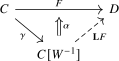
Note that the functor \(\bL F\) is unique whenever it exists.
Dually, a total right derived functor of \(F\) is a total left derived functor of \(F\catop \colon C\catop \to D\catop \), i.e. a functor \(\bR F\colon C[W^{-1}] \to D\) equipped with \(\beta \colon F \Rightarrow \bR F \circ \gamma \) which exhibits \(\bR F\) as a left Kan extension of \(F\) along \(\gamma \).
Generated from the authoritative LaTeX source.