Lemma 14.1.6. Let \(\alpha \colon I \xleftarrow {u} K \xrightarrow {v} J\) be a span of finite sets, and let \(\{x_i\}_{i\in I}\) and \(\{y_j\}_{j\in J}\) be objects of \(\Oo ^{\otimes }\). Then there is a pullback square
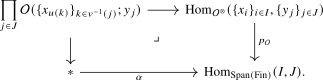
The top map combines the multimorphisms into a morphism with source \(\{x_{u(k)}\}_{k\in K}\) and then precomposes with the projection-induced inert morphism from \(\{x_i\}_{i\in I}\). This square is natural in morphisms of \(\infty \)-operads.
Proof. Set \(X:=\{x_i\}_{i\in I}\), \(X_K:=\{x_{u(k)}\}_{k\in K}\) and \(Y:=\{y_j\}_{j\in J}\), and factor \(\alpha \) as the backwards span \(I\xleftarrow {u}K\xrightarrow {=}K\) followed by the active span \(\gamma \colon K\xleftarrow {=}K\xrightarrow {v}J\). By condition (3) of Definition 14.1.1, the projection-induced map \(X\to X_K\) is \(p_{\Oo }\)-cocartesian. Its universal property gives an equivalence \[ \Hom _{\Oo ^{\otimes }}^{\alpha }(X,Y) \simeq \Hom _{\Oo ^{\otimes }}^{\gamma }(X_K,Y). \] Since \(Y=\prod _{j\in J}y_j\) and \(p_{\Oo }\) preserves products, the right-hand side is equivalent to \[ \prod _{j\in J}\Hom _{\Oo ^{\otimes }}^{\rho _j\circ \gamma }(X_K,y_j), \] where \(\rho _j\colon J\hookleftarrow \{j\}\xrightarrow {=}\{j\}\) is the corresponding projection. The composite \(\rho _j\circ \gamma \) is represented by the span \(K\hookleftarrow v^{-1}(j)\to \{j\}\). A second application of condition (3), now to \(v^{-1}(j)\hookrightarrow K\), therefore identifies its \(j\)-th factor with \[ \Oo (\{x_{u(k)}\}_{k\in v^{-1}(j)};y_j). \] The resulting equivalence is induced by the top map in the displayed square, so that square is a pullback. Every map used in its construction is induced by products and their projections, and is therefore preserved by morphisms of \(\infty \)-operads. This proves naturality. □
Generated from the authoritative LaTeX source.