Terminology 14.1.4. We refer to the fiber \(\Oo _{\lra {1}} := p^{-1}_{\Oo }(\lra {1})\) over the 1-element set \(\lra {1} := \{1\}\) as the underlying \(\infty \)-category of the \(\infty \)-operad \(\Oo \). We denote its groupoid core by \[ \Oo ^{\simeq } \quad := \quad (\Oo _{\lra {1}})^{\simeq } \] and refer to it as the anima of colors of \(\Oo \). In the classical notation of Definition 12.2.1, \(\Oo ^{\simeq }\) denoted only the set of colors; here it also remembers the invertible unary morphisms between them. For a finite set \(I\), condition (2) guarantees that every object in \(\Oo ^{\otimes }_I\) may be uniquely written as a product \(\prod _{i \in I} x_i\) for some colors \(x_i \in \Oo ^{\simeq }\). In analogy with the classical case, we may also denote such a product as an unordered tuple \(\{x_i\}_{i \in I}\). Given another color \(y \in \Oo ^{\simeq }\), we define the anima of multimorphisms in \(\Oo \) from \(\{x_i\}_{i \in I}\) to \(y\) as the anima of morphisms in \(\Oo ^{\otimes }\) that map to the span \(I \xleftarrow {=} I \to \lra {1}\):
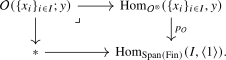
A morphism \(\phi \colon X \to Y\) in \(\Oo ^{\otimes }\) whose image in \(\Span (\Fin )\) is a forward map \(I \xleftarrow {=} I \xrightarrow {g} J\) is called an active morphism. We say \(\phi \) is an inert morphism if it is \(p_{\Oo }\)-cocartesian and its image in \(\Span (\Fin )\) is a backwards map \(I \xleftarrow {f} J \xrightarrow {=} J\). We want to think of the active morphisms as the ones that encode the operad structure, and of the inert morphisms as merely capturing the product structure in \(\Oo ^{\otimes }\).
Generated from the authoritative LaTeX source.