Lemma 14.3.4 (Unit formulation of relative adjunctions). Let \(L \in \Fun _{/B}(C,D)\) and \(R \in \Fun _{/B}(D,C)\). The following data are equivalent:
- (1)
-
A morphism \(\epsilon \colon LR \to \id _D\) in \(\Fun _{/B}(D,D)\) which exhibits \(R\) as a right adjoint to \(L\) after forgetting to \(\Fun (D,D)\).
- (2)
-
A morphism \(\eta \colon \id _C \to RL\) in \(\Fun _{/B}(C,C)\) which exhibits \(L\) as a left adjoint to \(R\) after forgetting to \(\Fun (C,C)\).
Proof. Suppose first that the data in (1) are given. By Proposition 21.1.2, composition with the counit gives an equivalence \[ \Nat (\id _C,RL) \xrightarrow {\simeq } \Nat (L,L), \qquad \alpha \longmapsto (\epsilon L)(L\alpha ). \] Under the specified identifications over \(B\), the fact that \(\epsilon \) is a morphism in \(\Fun _{/B}(D,D)\) gives a commutative square
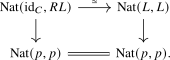
It therefore restricts to an equivalence on the fibers over \(\id _p\), which are the hom animae \[ \Hom _{\Fun _{/B}(C,C)}(\id _C,RL) \xrightarrow {\simeq } \Hom _{\Fun _{/B}(C,D)}(L,L). \] The preimage of \(\id _L\) gives a morphism \(\eta \colon \id _C \to RL\) over \(B\), together with an identification \((\epsilon L)(L\eta ) \simeq \id _L\) in \(\Fun _{/B}(C,D)\). After forgetting the maps to \(B\), this is the unit corresponding to \(\epsilon \) under Proposition 21.1.2, so it gives the data in (2).
Conversely, starting from (2), composition with the unit gives an equivalence \[ \Nat (LR,\id _D) \xrightarrow {\simeq } \Nat (R,R), \qquad \beta \longmapsto (R\beta )(\eta R). \] It likewise restricts to the fibers over the identity transformation of \(q\), and the preimage of \(\id _R\) supplies the counit in (1), together with the other triangle identification over \(B\). These constructions are inverse because they are the usual equivalence between unit and counit data from Proposition 21.1.2, restricted to the indicated fibers. □
Generated from the authoritative LaTeX source.