Proposition 15.2.13. Let \(C\) be an \(\infty \)-category.
- (1)
-
If \(E\) is an \(\infty \)-category with finite products, restriction along \(\iota \) induces an equivalence \[ \Fun ^{\times }(C^{\amalg }, E) \iso \Fun (C,\CMon (E)). \]
- (2)
-
If \(\Oo \) is an \(\infty \)-operad, we obtain an equivalence \[ \Fun _{\Op _{\infty }}(\OpCocart _C, \Oo ) \simeq \Fun (C, \CAlg (\Oo )). \]
- (3)
-
If \(D\) is a symmetric monoidal \(\infty \)-category, we obtain an equivalence \[ \Alg _{\OpCocart _C}(D) \simeq \Fun (C,\CAlg (D)). \]
Proof. Part (3) is an instance of (2) by taking \(\Oo = \Mm _D\) to be the multimorphism operad of \(D\). Part (2) follows by applying Part (1) to \(E = \Oo ^{\otimes }\) and \(E = \Span (\Fin )\), and passing to horizontal fibers:

It thus remains to prove part (1). For this, recall from Construction 15.2.4 that \(C^{\amalg }\) is semiadditive. The left vertical map in the following commutative diagram is an equivalence by Corollary 5.3.24. The right vertical map is an equivalence by Proposition 5.3.17, since \(\CMon (E)\) is semiadditive:
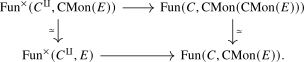
Showing that the bottom functor in this square is an equivalence thus reduces to showing that the top functor is an equivalence. Since a functor between semiadditive \(\infty \)-categories preserves finite products if and only if it preserves finite coproducts, this top functor may be rewritten as the restriction functor \[ \iota ^*\colon \Fun ^{\amalg }(C^{\amalg }, \CMon (E)) \to \Fun ^{\amalg , -}(\Span (\Fin ) \times C,\CMon (E)) \simeq \Fun (C, \Fun ^{\amalg }(\Span (\Fin ), \CMon (E))). \] This is an equivalence by Lemma 15.2.12. □
Generated from the authoritative LaTeX source.