Example 5.2.6 (Universality of coproducts). Consider \(I = * \sqcup *\), so that \(I^{\triangleright } \simeq \,\,\pullback \). The transformation \(\overline {\alpha }\) will thus be a diagram of the form
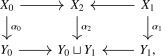
where in the bottom we get a coproduct, reflecting the condition that \(\overline {G}\) is a colimit diagram. The theorem then expresses that the following two conditions are equivalent:
- The two squares in the diagram are both pullback squares;
- The functor \(X_0 \sqcup X_1 \to X_2\) is an isomorphism.
The fact that these two conditions are equivalent is precisely an instance of the universality of coproducts from Axiom C.3, with the two parts of the axiom corresponding to the two implications.
Proof of Theorem 5.2.1. We start with (2): the fact that \(\bB M\) is connected for any monoid object \(M\) in \(\An \). By definition, \(\bB M\) is connected if and only if its set of path components \(\pi _0(\bB M)\) is a single point. Since \(\pi _0\colon \An \to \Set \) is a left adjoint, it preserves colimits (see Lemma 21.2.6), and thus \(\pi _0(\bB M)\) is a colimit in sets of the following simplicial diagram:

The colimit of a simplicial object in sets is the coequalizer of its two face maps in degrees \(1\) and \(0\). Hence the canonical map \(\pi _0(M_0) \to \colim _{[n]} \pi _0(M_n)\) is surjective. Since \(M_0 \cong *\), it follows that \(\pi _0(\bB M)\) has a single element.
Let us assume (1) for a moment and use it to deduce (3), the fact that the counit \(\epsilon _X\colon \bB \bOmega X \to X\) is the inclusion of the path component \(X_0\) of the basepoint of \(X\). Since \(\bB \bOmega X\) is connected, the counit map certainly lands in \(X_0\) and we need to show that the resulting map \(\bB \bOmega X \to X_0\) is an isomorphism of animae. Since both sides are connected pointed animae, it suffices by Corollary 2.4.23 to show that the map \(\bOmega (\epsilon _X)\colon \bOmega (\bB \bOmega X) \to \bOmega (X_0) \simeq \bOmega (X)\) is an isomorphism. By the triangle identities for the adjunction, there is a commutative triangle of the form
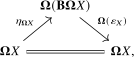
and so \(\bOmega (\epsilon _X)\) is an isomorphism if and only if \(\eta _{\bOmega }\colon \bOmega X \to \bOmega (\bB \bOmega X)\) is an isomorphism. But since \(\bOmega X\) is a group object, this is an instance of part (1).
It remains to prove part (1), i.e. that \(M\) is a group if and only if the map \(\eta _M\colon M \to \bOmega \bB M\) is an isomorphism of monoids. One direction is clear: \(\bOmega \bB M\) is a group, so if this map is an isomorphism then also \(M\) is a group. For the other direction, assume that \(M\) is a group. To show that \(\eta _M\colon M \to \bOmega \bB M\) is an isomorphism, it suffices to show that the map \((\eta _M)_1\colon M_1 \to (\bOmega \bB M)_1 = \Omega \bB M\) on underlying animae is an isomorphism: since \(M_n \simeq M_1^{\times n}\) and \((\bOmega \bB M)_n \simeq ((\bOmega \bB M)_1)^{\times n}\) we then get that it is an isomorphism at every level. The map \(M_1 \to \Omega \bB M\) is induced by the commutative square
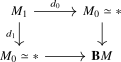
and so is an isomorphism if and only if this is a pullback square of animae. We will deduce this as an instance of Theorem 5.2.5. To this end, consider the diagram \(\overline {M}\colon (\simp _+)\catop \to \An \) that extends \(M\) with its colimit \(\overline {M}_{-1} := \bB M = \colim _{[n] \in \simp \catop } M_n\). Also consider the functor \[ \overline {PM}\colon (\simp _+)\catop \to \An , \qquad [n] \mapsto \overline {M}_{n+1}, \] and consider the natural transformation \(\overline {\alpha }\colon \overline {PM} \to \overline {M}\) whose components are the maps \(d_{n+1}\colon M_{n+1} \to M_n\). Let us spell out why these maps assemble functorially. The successor functor \(P\colon \simp _+ \to \simp _+\), obtained by adjoining a new final element, admits a natural transformation \(\id \to P\) whose component at \([n]\) is the final coface \(d^{n+1}\colon [n] \to [n+1]\). Precomposition with \(\overline M\colon (\simp _+)\catop \to \An \) therefore gives \(\overline \alpha \colon P^*\overline M=\overline {PM}\to \overline M\); at \([-1]\) its component is the augmentation \(M_0\to \bB M\). This is the usual décalage construction. The successor functor is the composite \(\simp _+ \xrightarrow {(+1)} \simp ^{\deg } \hookrightarrow \simp _+\) from Definition 5.2.3. Thus \(\overline {PM}\) is the underlying augmented simplicial object of \(\overline M\vert _{(\simp ^{\deg })\catop }\) and admits extra degeneracies. It is therefore a colimit diagram by Lemma 5.2.4, so that \(\colim _{[n] \in \simp \catop } \overline {PM}_n \simeq \overline {PM}_{-1} = M_0\). The pullback square we wish to prove now takes the form
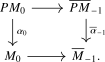
By Theorem 5.2.5, it thus remains to show that \(\alpha \) is a cartesian natural transformation. In other words, we need to show that for every morphism \(\phi \colon [n] \to [m]\) the square
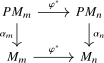
is a pullback square. We will prove this claim in increasingly general cases:
Step 1: We start with the case of the map \(\phi = d^1 \colon [0] \to [1]\). In this case, the square (5.3) reduces to the following:

This square is a pullback square if and only if the shear map \((\pr _1,m)\colon M_1 \times M_1 \to M_1 \times M_1\) is an isomorphism, which holds by assumption since \(M\) is a group.
Step 2: We will now prove the claim for \(\phi = d^i\colon [n] \to [n+1]\), where \(n \geq 0\) and \(0 \leq i \leq n+1\). We use the identifications \(M_k \cong M_1^k\) coming from the Segal condition. For \(i=0\), the square (5.3) is the square which drops the first coordinate horizontally and the last coordinate vertically. It is a pullback because a pair of \((n+1)\)-tuples with the same middle \(n\) coordinates glues uniquely to an \((n+2)\)-tuple. For \(0<i<n+1\), the horizontal maps multiply the \(i\)-th and \((i+1)\)-st coordinates, while the vertical maps drop the last coordinate. Since the multiplication does not involve the last coordinate, this square is the product with \(M_1\) of a degenerate pullback square, and is therefore again a pullback.
It remains to consider the final coface \(i=n+1\). Here the multiplication involves the coordinate which is forgotten by the vertical maps, and the square takes the form

None of the maps affect the first \(n\) coordinates, and on the last two coordinates this is precisely the square (5.4). Hence it is the product of a degenerate pullback square with the pullback square from Step 1. This proves the claim for all coface maps \(d^i\).
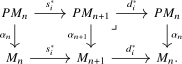
Step 3: Next, assume that \(\phi \) is a codegeneracy map of the form \(s^i\colon [n+1] \to [n]\). Since \(s^i\) has a section of the form \(d^i\colon [n] \to [n+1]\), it follows from the pasting law of pullback squares that the square (5.3) is a pullback square:
Step 4: We have now shown the claim when \(\phi \) is either a coface map \(d^i\) or a codegeneracy map \(s^i\). Since every map \(\phi \colon [n] \to [m]\) is an iterated composite of coface maps and codegeneracy maps, we then get the claim for general \(\phi \) by using the pasting law of pullback squares again. This finishes the proof of the theorem. □
Generated from the authoritative LaTeX source.