Let \(C\) be a category with filtered colimits. Then the following are equivalent:
There exists a small category \(C_0\) such that \(C\) is a retract of \(\Ind(C_0)\) in \(\Cat^{\omega}\) (the category of categories with filtered colimits).
There exists a small category \(C_0\) such that there exists an adjunction \(C \rightleftarrows \Ind(C_0)\) in \(\Cat^{\omega}\) such that \(C \hookrightarrow \Ind(C_0)\) is fully faithful.
\(C\) is accessible, and the “colimit functor” \(\colim\colon \Ind(C) \to C\) (defined as the left adjoint to \(y\colon C \hookrightarrow \Ind(C)\)) admits a further left adjoint \(y'\colon C \hookrightarrow \Ind(C)\).
Proof
Note that (2) clearly implies (1), since the unit of the adjunction exhibits the map \(\Ind(C_0) \to C\) as a retraction of \(C \hookrightarrow \Ind(C_0)\).For (3) \(\implies\) (2), we write \(\Ind(C) = \bigcup_{\lambda > \kappa} \Ind(C^{\lambda})\), where \(C\) is \(\kappa\)-accessible. Since \(C^{\kappa}\) is small, we have \(y'(C^{\kappa}) \subseteq \Ind(C^{\lambda})\) for some \(\lambda\). Since \(C\) is generated under colimits by \(C^{\kappa}\) and \(y'\) preserves colimits, this implies that \(y'(C) \subseteq \Ind(C^{\lambda})\). But then the functor \(y'\colon C \to \Ind(C^{\lambda})\) is a left adjoint to \(\colim\colon \Ind(C^{\lambda}) \to C\), giving (2).Finally, we prove that (1) \(\implies\) (3). The assumption gives us functors
\[C \xrightarrow{u} \Ind(C_0) \xrightarrow{v} C\]
satisfying \(vu = \id_C\). We may now consider the idempotent \(uv\colon \Ind(C_0) \to \Ind(C_0)\). We may then write
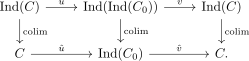
and in particular \(C\) is a limit of accessible categories, hence itself accessible. Consider the following diagram The middle vertical map admits a left adjoint \(y'\colon \Ind(C_0) \hookrightarrow \Ind(\Ind(C_0))\).Now, we show that the left adjoint \(y'\colon C \hookrightarrow \Ind(C)\) exists. We may do this pointwise, so consider some \(X \in C\). The map \(\Hom(X,\colim(-))\) is a retract of the representable copresheaf \(\Hom(\hat{v}y'u(X),-)\) in \(\Fun(\Ind(C),\An)\). Since \(\Ind(C)\) is idempotent complete, this means that \(\Hom(X,\colim(-))\) is representable. Hence there exists some \(y'(X) \in \Ind(C)\), which then provides the desired left adjoint object to \(X\).