6.10. Compactly assembled categories and exponentiability
In this section we characterize the exponentiable topoi, i.e. those topoi \(T\) for which the exponential \(S^T\) exists for all topoi \(S\). The answer is provided by the notion of compactly assembled categories: a topos is exponentiable if and only if it is compactly assembled as a presentable category. We begin by studying finitary functors as an auxiliary notion, then introduce compactly assembled categories and establish their connection to classifying topoi, before proving the characterization of exponentiable topoi.
6.10.1. Finitary functor topoi
We write \(\Fun^{\kappa}(C,T) \subseteq \Fun(C,T)\) for the full subcategory of \(\kappa\)-filtered-colimit-preserving functors. We write \(\Cat^{\acc,\kappa}\) for the category of accessible categories admitting \(\kappa\)-filtered colimits and functors preserving those colimits.
Let \(C\) be an accessible category with \(\kappa\)-filtered colimits, let \(T\) be a topos. Then \(\Fun^{\kappa}(C,T)\) is a topos.
Proof
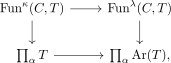
The category \(\Fun^{\kappa}(C,T)\) has a universal property: for every topos \(S\), there is a natural equivalence
Both sides are naturally a full subcategory of \(\Fun(C \times S, T)\), and one can check that in both cases we precisely get those functors \(C \times S \to T\) that preserve \(\kappa\)-filtered colimits in the left variable, and preserve finite limits and colimits in the second variable.
The functor \(\Pt\colon \Topos \to \Cat^{\acc, \kappa}\) admits a (\(2\)-categorical) left adjoint
6.10.2. Compactly assembled categories
We now introduce the central notion of this section. A category is called compactly assembled if it satisfies certain retract conditions with respect to ind-categories. The following proposition provides three equivalent characterizations.
Let \(C\) be a category with filtered colimits. Then the following are equivalent:
There exists a small category \(C_0\) such that \(C\) is a retract of \(\Ind(C_0)\) in \(\Cat^{\omega}\) (the category of categories with filtered colimits).
There exists a small category \(C_0\) such that there exists an adjunction \(C \rightleftarrows \Ind(C_0)\) in \(\Cat^{\omega}\) such that \(C \hookrightarrow \Ind(C_0)\) is fully faithful.
\(C\) is accessible, and the “colimit functor” \(\colim\colon \Ind(C) \to C\) (defined as the left adjoint to \(y\colon C \hookrightarrow \Ind(C)\)) admits a further left adjoint \(y'\colon C \hookrightarrow \Ind(C)\).
A category satisfying the equivalent conditions of Proposition 6.142 is called compactly assembled. We write \(\Cat^{\mathrm{ca}}\) for the category of compactly assembled categories and filtered-colimit-preserving functors.
Proof
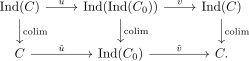
Let \(C\) be a presentable category. Then \(C\) is compactly assembled if and only if it is a retract in \(\PrL\) of a compactly generated category.
6.10.3. Classifying topoi
The key property of compactly assembled categories is that they admit classifying topoi for sheaves valued in them. We establish this through an equivalence relating functors out of \(\Fun^{\omega}(C,\An)\) to functors from \(C^{\op}\).
Let \(C\) be compactly assembled, and let \(D\) be presentable. Then there is an equivalence
where the RHS means those functors that preserve cofiltered limits.
Proof sketch
- \(F\) is left Kan extended from \(\Fun^{\rep}\) if and only if \(F\vert_{\Fun^{\omega}}\) preserves colimits.
- \(F\) is right Kan extended from \(\Fun^{\omega}\) if and only if \(F\vert_{\Fun^{\rep}}\) preserves cofiltered limits.
- \(F\) is left Kan extended from \(\Fun^{\rep}\) and \(F\vert_{\Fun^{\rep}}\) preserves cofiltered limits.
- \(F\) is right Kan extended from \(\Fun^{\omega}\) and \(F\vert_{\Fun^{\omega}}\) preserves colimits.
Let \(T\) be a topos and \(C\) a presentable category which is compactly assembled. Then the equivalence
restricts to an equivalence
Recall that the category \(\FunR(C\catop,T)\) is the Lurie tensor product \(C \otimes T\) in \(\PrL\), which in turn may be written as \(\FunR(T\catop,C)\). We denote this category by \(\Shv_C(T)\) and call it the category of \(C\)-valued sheaves on \(T\). Keeping track of the functoriality in \(T\) shows that the topos \(\Fun^{\omega}(C,\An)\) classifies \(C\)-valued sheaves.
We have thus shown that if \(C\) is compactly assembled, then a classifying topos for \(C\)-valued sheaves exists. It turns out that the converse is also true:
Let \(C\) be a presentable category. Then a classifying topos for \(C\)-valued sheaves exists if and only if \(C\) is compactly assembled.
Proof
Let \(C\) be a compactly assembled category. Then there is an equivalence
under which \(X \in C\) corresponds to the evaluation functor \(\ev_X\colon \Fun^{\omega}(C,\An) \to \An\).
The functor \(\Cat^{\mathrm{ca}} \to \Topos\) given by \(C \mapsto \Fun^{\omega}(C,\An)\) is a fully faithful \(2\)-functor.
Proof
6.10.4. Exponentiable topoi
Having established that compactly assembled categories have classifying topoi, we now turn to the main application: characterizing exponentiable topoi. Recall that the exponential \(S^T\) in \(\Topos\), if it exists, represents the functor \(U \mapsto \Hom_{\Topos}(U \otimes T, S)\).
Let \(S\) and \(T\) be topoi. If the exponential (internal hom) in \(\Topos\) exists, it will be denoted \(S^T\). In other words, this is a topos \(S^T\) equipped with a morphism of topoi \(S^T \otimes T \to S\) which induces an equivalence
If \(S^T\) exists, it is automatically a \(2\)-categorical exponential. Indeed, for every topos \(U\), the arrow topos \(\Ar(U)\) represents arrows between geometric morphisms out of \(U\), and \begin{align*} \Hom_{\Cat}([1],\Geom(U,S^T)) &\iso \Hom_{\Topos}(\Ar(U),S^T) \\ &\iso \Hom_{\Topos}(\Ar(U) \otimes T, S) \\ &\iso \Hom_{\Topos}(\Ar(U \otimes T),S) \\ &\iso \Hom_{\Cat}([1],\Geom(U \otimes T,S)). \end{align*} Together with the original universal property on objects, this identifies the entire Hom categories. Equivalently, one may repeat the same argument with the topos of \([n]\)-diagrams for every \(n\) and use the complete Segal description of a category.
We have \(\Pt(S^T) \simeq \Geom(T,S)\).
We say that a topos \(T\) is exponentiable if \(S^T\) exists for all \(S\).
If \(C\) is compactly assembled and \(D\) is compactly generated, then \(C\otimes D\) is compactly assembled.
Proof
Every topos is a pullback in \(\Topos\) of a diagram of presheaf topoi \(\PSh(D)\) with \(D\) admitting finite limits.
Proof sketch
A topos \(T\) is exponentiable if and only if it is compactly assembled.
Proof

References
- Mathieu Anel, Damien Lejay. Exponentiable higher toposes. 2018.