6.11. Topoi of parametrized objects

The Grothendieck construction \(\int_{\An}C\) organizes families of objects of \(C\) parametrized by animae. Its universal property separates arbitrary colimits into anima-indexed colimits and weakly contractible colimits, and this makes the van Kampen condition particularly transparent. The main result characterizes those accessible categories \(C\) for which \(\int_T C\) is a topos for every topos \(T\): these are the loci, the categories whose weakly contractible colimits are van Kampen. This also identifies stable categories and categories of \(\infty\)-connected objects as two manifestations of the same construction. The section is logically independent of the later chapters, but the results provide a useful application of descent and may also be found in [Hoyois 2019].

6.11.1. Categories of \(\An\)-parametrized objects

Definition 6.157.

Let \(C\) be a category, not necessarily small. We define the functor \(\pi\colon \int_{\An}C \to \An\) as the cartesian unstraightening of the functor

\[\Fun(-,C)\colon \An\catop \to \Cat, \qquad A \mapsto \Fun(A,C).\]

We refer to \(\int_{\An}C\) as the category of \(\An\)-parametrized objects of \(C\). Note that an object of \(\int_{\An}C\) is a pair \((A,X)\), where \(A \in \An\) is an anima and \(X\colon A \to C\) is an \(A\)-indexed family of objects of \(C\). A morphism \((A,X) \to (B,Y)\) consists of a morphism of animae \(f\colon A \to B\) and a map \(X \to f^*Y\) in \(\Fun(A,C)\), where \(f^*Y := Y \circ f\colon A \to C\).

The fiber of \(\int_{\An}C\) over \(A \in \An\) is \(\Fun(A,C)\). By taking \(A = *\), we in particular obtain an inclusion \(C \hookrightarrow \int_{\An}C\). Note that this is fully faithful, since \(\{*\} \hookrightarrow \An\) is fully faithful.

While we gave an explicit construction of \(\int_{\An}C\), we will show next that it can also be characterized via the following two universal properties:

  1. For arbitrary \(C\), the category \(\int_{\An}C\) is obtained from \(C\) by freely adding anima-indexed colimits;

  2. If \(C\) admits weakly contractible colimits, then \(\int_{\An}C\) admits all small colimits, the inclusion \(C \hookrightarrow \int_{\An}C\) preserves weakly contractible colimits, and \(\int_{\An}C\) is the free category with a functor from \(C\) satisfying these two properties.

We start with property (a), which is relatively straightforward to prove.

Lemma 6.158.

The category \(\int_{\An}C\) admits anima-indexed colimits, and the functor \(\pi\colon \int_{\An}C \to \An\) preserves anima-indexed colimits.

Proof

Consider a functor \(F = (A_{\bullet},X_{\bullet})\colon I \to \int_{\An} C\) for which we wish to construct a colimit, where \(I\) is an anima. Consider the colimit \(A := \colim_{i \in I} A_i\) of the underlying animae, thus extending \(A_{\bullet}\) to a colimit cocone \(\overline{A}_{\bullet}\colon I^{\triangleright} \to \An\). Denote by \(f_i\colon A_i \to A\) the maps in the colimit cocone. The diagram \(F\) is a lift of \(A_{\bullet}\colon I \to \An\), corresponding to a section of the cartesian fibration \(I \times_{\An} \int_{\An} C \to I\). Since \(I\) is an anima, this section is automatically a cartesian section, and it thus defines an object of the category
\[\Gamma_I^{\mathrm{cart}}(I \times_{\An} \int_{\An} C \to I) \quad \simeq \quad \lim_{i \in I\catop} \Fun(A_i, C) \quad \simeq \quad \Fun(\colim_i A_i, C) \quad \simeq \quad \Fun(A,C).\]
This defines an object \(X \in \Fun(A,C)\), hence an object \((A,X) \in \int_{\An}C\). Applying a similar reasoning to the diagram \(\overline{A}_{\bullet}\colon I^{\triangleright} \to \An\), we see that
\[\Gamma_{I^{\triangleright}}^{\mathrm{cart}}(I^{\triangleright} \times_{\An} \int_{\An} C \to I^{\triangleright}) \quad \simeq \quad \lim_{i \in (I^{\triangleright})\catop} \Fun(A_i,C) = \Fun(A,C),\]
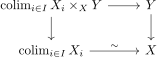
so that the object \(X\) gives rise to a cartesian section \((\overline{A}_{\bullet},\overline{X}_{\bullet})\colon I^{\triangleright} \to \int_{\An}C\) lifting \(\overline{A}_{\bullet}\), which essentially by construction extends \(X_{\bullet}\). We will show that this is a colimit cocone in \(\int_{\An}C\), which simultaneously establishes both claims of the lemma.To this end, consider another object \((B,Y) \in \int_{\An}C\). We need to show that top map in the following commutative diagram is an equivalence:
Commutative diagram generated from the LaTeX source
The bottom map in this diagram is an equivalence by definition of \(A\) as a colimit. Therefore, it suffices to check that the square induces equivalences on vertical fibers over every map of animae \(f\colon A \to B\). Letting \(f_i \colon A_i \to A \xrightarrow{f} B\) denote the composite maps for all \(i\), this map on fibers takes the following form:
\[\Hom_{\Fun(A,C)}(X,f^*Y) \to \lim_{i \in I\catop} \Hom_{\Fun(A_i,C)}(X_i, f_i^*Y).\]
But this map is an isomorphism, since the pullback functors along the maps \(A_i \to A\) induce an equivalence \(\Fun(A,C) \iso \lim_{i \in I\catop} \Fun(A_i,C)\), and the restriction of \(X\) to \(A_i\) is \(X_i\) by construction. This finishes the proof.

Lemma 6.159.

Let \(D\) be a category admitting anima-indexed colimits. Then the inclusion \(D \hookrightarrow \int_{\An}D\) admits a left adjoint \(\colim \colon \int_{\An} D \to D\), given on objects by sending \((A,X)\) to \(\colim_{a \in A} X_a\).

Proof
Since left adjoints may be constructed objectwise, it will suffice to show that for every \(Y \in D\) there is a natural equivalence
\[\Hom_{\int_{\An}D}((A,X), (*,Y)) \iso \Hom_{D}(\colim_{a \in A} X_a,Y).\]
But this is clear: since there is a unique map \(A \to *\) in \(\An\), the left-hand side simplifies to \(\Hom_{\Fun(A,D)}(X, \const_Y)\), which by the very definition of colimits in \(D\) is also the right-hand side.

Lemma 6.160.

Let \(\Cat^{\An\text{-}\colim}\) denote the subcategory of \(\Cat\) consisting of the categories with anima-indexed colimits and functors preserving anima-indexed colimits. Then the construction \(C \mapsto \int_{\An}C\) defines a left adjoint to the inclusion \(\Cat^{\An\text{-}\colim} \hookrightarrow \Cat\), with unit and counit given by the functors

\[i\colon C \hookrightarrow\int_{\An}C \qquadtext{ and } \colim\colon \int_{\An}D \to D,\]

respectively.

Proof
We check that the two triangle identities are satisfied. The first one takes the form
Commutative diagram generated from the LaTeX source
This commutes via the counit map \(\colim \circ i \to \id_D\), which is an isomorphism as \(i\) is fully faithful. The second triangle identity amounts to the claim that for every object \((A,X) \in \int_{\An} C\), the canonical map \(\colim_{a \in A} (\{a\}, X_a) \to (A,X)\) in \(\int_{\An}C\) is an isomorphism, which as observed before is an immediate consequence of the computation of colimits in \(\int_{\An}C\).

We may now deduce the first claimed universal property of \(\int_{\An}C\):

Proposition 6.161.

Let \(C\) and \(D\) be categories and assume that \(D\) admits anima-indexed colimits. Then restriction along \(i\colon C \hookrightarrow \int_{\An}C\) induces an equivalence

\[\Fun^{\An\text{-}\colim}(\int_{\An}C,D) \iso \Fun(C,D).\]
Proof
By the Yoneda lemma, we may check this after applying \(\Hom_{\Cat}(E,-)\) for all \(E \in \Cat\). Observe that \(\Fun(E,D)\) still admits anima-indexed colimits, which are computed pointwise in \(D\). Under currying-uncurrying, the map in question then translates to the map
\[\Hom_{\Cat^{\An\text{-}\colim}}(\int_{\An}C, \Fun(E,D)) \to \Hom_{\Cat}(C,\Fun(E,D))\]
given by restriction along \(i \colon C \hookrightarrow \int_{\An}C\). This is an isomorphism by the adjunction from the previous lemma.

6.11.2. Weakly contractible colimits and free cocompletion

We now move on to the second universal property of \(\int_{\An}C\), which is more subtle; Marc said that he has not seen this formulation in the literature. For the proof, we use the category \(\PSh^{\mathrm{small}}(C)\) of small presheaves on \(C\), i.e. the full subcategory of \(\PSh(C)\) generated by the representable presheaves under small colimits. The inclusion \(C \hookrightarrow \PSh^{\mathrm{small}}(C)\) is the universal functor from \(C\) into a category with small colimits. Recall that \(\PSh^{\mathrm{small}}(C) = \PSh(C)\) whenever \(C\) is small, but not for arbitrary \(C\). The small presheaves may be characterized as those \(\Ff\) for which the category of elements \(\El(\Ff) = C_{/\Ff} \subseteq \PSh(C)_{/\Ff}\) admits a final functor from a small category.

Proposition 6.162.

Let \(C\) be a category admitting small weakly contractible colimits.

  1. The inclusion \(C \hookrightarrow \int_{\An}C\) preserves weakly contractible colimits.

  2. The inclusion \(C \hookrightarrow \int_{\An} C\) uniquely extends to a left adjoint \(L\colon \PSh^{\mathrm{small}}(C) \to \int_{\An} C\).

  3. The right adjoint \(R\colon \int_{\An} C \hookrightarrow \PSh^{\mathrm{small}}(C)\) is fully faithful, exhibiting \(\int_{\An}C\) as a Bousfield localization of \(\PSh^{\mathrm{small}}(C)\). In particular, \(\int_{\An} C\) admits small colimits.

  4. For a category \(D\) with small colimits, a colimit-preserving functor \(F\colon \PSh^{\mathrm{small}}(C) \to D\) inverts \(L\)-local maps if and only if its restriction \(C \to D\) preserves weakly contractible colimits.

Proof
(1) Consider a functor \(X_{\bullet}\colon I \to C\), where \(I\) is weakly contractible, and set \(X := \colim_{i \in I} X_i\). We have to show that the colimit of this diagram in \(\int_{\An}C\) is \((*, x)\). This amounts to the claim that for every object \((B,Y) \in \int_{\An} C\), the canonical map
\[\Hom_{\int_{\An}C}((*,X), (B,Y)) \to \lim_{i \in I\catop} \Hom_{\int_{\An}C}((*,X_i),(B,Y))\]
is an isomorphism. Since this map lives over \(\Hom_{\An}(*,B) = B\), it suffices to show that the induced map on fibers over each \(b \in B\) is an isomorphism. But this map on fibers is the map \(\Hom_C(X,Y_b) \to \lim_{i \in I\catop} \Hom_C(X_i, Y_b)\), which is an isomorphism by construction of \(X\).(2) We will show that the left Kan extension of the inclusion \(C \hookrightarrow \int_{\An} C\) along the Yoneda embedding \(C \hookrightarrow \PSh^{\mathrm{small}}(C)\) exists. Given a small presheaf \(\Ff\), the pointwise formula for left Kan extensions tells us that it suffices to show that in \(\int_{\An}C\) we may form the colimit of the functor
\[\El(\Ff) = C_{/\Ff} \xrightarrow{\fgt} C \hookrightarrow \int_{\An} C.\]
By assumption on \(\Ff\), the category \(\El(\Ff)\) comes with a final functor \(I \to \El(\Ff)\) from some small category \(I\). It will thus suffice to show that for any small category \(I\) and any functor \(X\colon I \to C\) the colimit of \(I \to \int_{\An}C\) exists. We do this in two steps:
  • Consider the map \(p\colon I \to \abs{I}\) to the geometric realization of \(I\). We will show that the Kan extension of \(X\) along \(p\) exists in \(\int_{\An}C\). Since \(p\) is a cofinal functor, its relative slices are weakly contractible by Quillen's Theorem A. By part (1), this means that the Kan extension of \(X\) along \(p\) exists in \(C\), and that it is preserved by the inclusion \(C \hookrightarrow \int_{\An}C\).
  • The colimit \(\colim_i X_i\) in \(\int_{\An}C\) is now computed as the colimit of the left Kan extension \(p_!X\colon \abs{I} \to \int_{\An}C\), which exists since \(\abs{I}\) is an anima and we established the existence of anima-indexed colimits in Lemma 6.158.
By general nonsense, it follows that the left Kan extension \(L\colon \PSh^{\mathrm{small}}(C) \to \int_{\An}C\) preserves all colimits. A right adjoint \(R\) to \(L\) is given explicitly as follows:
\[R\colon \int_{\An} C \to \PSh^{\mathrm{small}}(C), \qquad R((A,X))(Y) := \Hom_{\int_{\An}C}((*,Y), (A,X)).\]
The functor \(\pi\colon \int_{\An} C \to \An\) induces a map \(\Hom_{\int_{\An}C}((*,Y), (A,X)) \to \Hom_{\An}(*,A) \cong A\), whose fiber over \(a \in A\) is \(\Hom_C(Y,X_a)\), so we obtain isomorphisms
\[R((A,X))(Y) \; \cong \; \colim_{a \in A} \Hom_C(Y,X_a) \; \cong \; \colim_{a \in A} y(X_a)(Y).\]
In particular, we see that \(R((A,X)) \simeq \colim_{a \in A} y(X_a)\) is a small colimit of representables, so that it is indeed contained in \(\PSh^{\mathrm{small}}(C)\).(3) To show that \(R\) is fully faithful, we must show that for every object \((A,X) \in \int_{\An}C\), the counit \(LR(A,X) \to (A,X)\) is an isomorphism. But this is clear from the computation \(R(A,X) \cong \colim_{a \in A} y(X_a)\) from before, and the fact that \((A,X) \cong \colim_{a \in A} (*,X_a)\) by the explicit description of anima indexed colimits from Lemma 6.158.(4) If \(F\) inverts all \(L\)-local maps, then \(F\) in particular inverts the canonical map \(\colim_{i \in I} y(X_i) \to y(\colim_{i \in I} X_i)\) for every weakly contractible diagram \(X\colon I \to C\), so that \(F(y(\colim_i X_i)) \simeq \colim_i F(y(X_i))\). Conversely, assume \(F \circ y\colon C \to D\) preserves weakly contractible colimits. It will suffice to show that \(F\) inverts the unit map \(\Ff \to RL(\Ff)\) for all \(\Ff \in \PSh^{\mathrm{small}}(C)\). Choose a final map \(I \to \El(\Ff)\) from a small category. Writing \(\Ff\) as the associated colimit of representables and left Kan extending along \(p\colon I \to \abs{I}\) expresses \(\Ff\) as an \(\abs{I}\)-indexed colimit of objects \(\colim_{i \in I_x}y(X_i)\), where \(I_x=\fib_x(I\to\abs I)\) is weakly contractible. The same construction in \(C\) expresses \(RL(\Ff)\) as the corresponding \(\abs I\)-indexed colimit of \(y(\colim_{i\in I_x}X_i)\). Thus the unit \(\Ff\to RL(\Ff)\) is an \(\abs I\)-indexed colimit of the canonical maps which \(F\) inverts by assumption. Since \(F\) preserves colimits, it inverts the unit.

Lemma 6.163.

A category \(C\) admits small colimits if and only if it admits anima-indexed colimits and weakly contractible colimits. Similarly, if \(C\) and \(D\) are categories with small colimits, then a functor \(F\colon C \to D\) preserves small colimits if and only if it preserves both anima-indexed colimits and weakly contractible colimits.

Proof
Assume that \(C\) admits anima-indexed colimits and weakly contractible colimits. We need to show that it admits a colimit for an arbitrary diagram \(X\colon I \to C\), where \(I\) is a small category. To this end, consider the localization functor \(p\colon I \to \abs{I}\) inverting all morphisms in \(I\). As discussed before, the finality of \(p\) implies that the relative slices of \(p\) are weakly contractible, so that the left Kan extension \(p_!X \colon \abs{I} \to C\) of \(X\) along \(p\) exists in \(C\). Moreover, the colimit of \(p_!X\) exists in \(C\) since \(\abs{I}\) is an anima. Since Kan extensions compose, we conclude that the colimit of \(X\) exists in \(C\).The argument for preservation of colimits is entirely analogous.

We are now ready to establish the second universal property of \(\int_{\An}C\). To formulate this precisely, let us denote by \(\Cat^{\wccolim}\) the subcategory of \(\Cat\) spanned by the categories admitting weakly contractible colimits and those functors that preserve weakly contractible colimits. Note that it contains the category \(\Cat^{\colim}\) of categories with colimits and colimit-preserving functors.

Proposition 6.164.

The adjunction \(\Cat \rightleftarrows \Cat^{\An\text{-}\colim}\) from Lemma 6.160 restricts to an adjunction

\[\Cat^{\wccolim} \rightleftarrows \Cat^{\colim}.\]

In particular, if \(C\) is a category with small weakly contractible colimits and \(D\) is a category with small colimits, then restriction along the inclusion \(C \hookrightarrow \int_{\An}C\) induces an equivalence

\[\Fun^{\colim}(\int_{\An}C, D) \iso \Fun^{\wccolim}(C,D).\]
Proof
We saw in Proposition 6.161 that restriction along the inclusion induces an equivalence
\[\Fun^{\An\text{-}\colim}(\int_{\An}C, D) \iso \Fun(C,D).\]
By part (1) of Proposition 6.162, this restriction functor restricts to a fully faithful functor
\[\Fun^{\colim}(\int_{\An}C, D) \hookrightarrow \Fun^{\wccolim}(C,D).\]
For essential surjectivity, let \(F\colon C \to D\) be a functor preserving weakly contractible colimits, and consider its colimit-preserving extension \(\PSh^{\mathrm{small}}(C) \to D\). By part (4) of Proposition 6.162, this inverts the \(L\)-local maps in \(\PSh^{\mathrm{small}}(C)\), and so descends to a colimit-preserving functor \(\int_{\An}C \to D\) extending \(F\). This finishes the proof.

6.11.3. Categories of objects parametrized by topoi

The construction of \(\int_{\An}C\) may be generalized, replacing \(\An\) by an arbitrary topos.

Definition 6.165.

Let \(T\) be a cocomplete category and let \(C\) be a category admitting weakly contractible colimits. We define the category of \(T\)-parametrized objects of \(C\) as the tensor product

\[\int_T C \quad := \quad T \otimes \int_{\An} C\]

in the category \(\Cat^{\colim}\) of cocomplete categories (using that \(\int_{\An}C\) admits colimits by Proposition 6.162).

Corollary 6.166.

The functor \(T \times C \hookrightarrow T \times \int_{\An} C \to \int_T C\) is universal among functors \(F\colon T \times C \to D\) into a cocomplete category \(D\) which preserve all colimits in the first variable and weakly contractible colimits in the second variable.

Proof
By definition, the tensor product \(\int_TC = T \otimes \int_{\An} C\) comes equipped with a functor from \(T \times \int_{\An}C\) satisfying the universal property that for every other cocomplete category \(D\), precomposition with this functor defines an equivalence
\[\Fun^{\colim}(\int_TC, D) \iso \Fun^{\colim,\colim}(T \times \int_{\An} C,D) \iso \Fun^{\colim}(T, \Fun^{\colim}(\int_{\An}C,D)).\]
The claimed universal property for \(\int_T C\) thus follows immediately from the universal property of \(\int_{\An}C\) established in Proposition 6.164.

The projection \(\pi\colon \int_{\An} C \to \An\) preserves all colimits. Indeed, its restriction to \(C\) is the constant functor with value \(*\), which preserves weakly contractible colimits, and its colimit-preserving extension under Proposition 6.164 sends \((A,X)\) to \(\colim_A*=A\). Hence it is precisely \(\pi\). Tensoring with \(T\) in \(\Cat^{\colim}\) gives an analogous functor \(\pi_T\colon \int_TC \to T\). We will now identify the fiber of \(\pi_T\) over \(A \in T\) with the category of \(A\)-parametrized objects of \(C\).

Proposition 6.167.

Let \(T\) and \(C\) be presentable categories. Then the functor \(\pi_T\colon \int_T C \to T\) is a bicartesian fibration, which is classified by both of the following functors:

\[T \to \Cat, \qquad A \mapsto T_{/A} \otimes C,\]

and

\[T\catop \to \Cat, \qquad A \mapsto \Fun^{\lim}(T_{/A}\catop, C).\]
Proof sketch
Note that the first functor takes the form \(T \to \PrL\), hence its cocartesian unstraightening is always a bicartesian fibration whose cartesian straightening is the corresponding functor \(T\catop \to \PrR\) obtained by passing to right adjoints, which by Lurie's explicit formula for tensor products in \(\PrL\) is given by \(A \mapsto \Fun^{\lim}(T\catop_{/A},C)\). It thus suffices to prove the first claim.Since \(T\) is presentable, write it as an accessible localization of a presheaf category \(\PSh(D)\). Both constructions in the statement commute with such localizations, so it suffices to treat \(T=\PSh(D)\). In this case
\[\PSh(D)\otimes\int_{\An}C\simeq\Fun(D\catop,\int_{\An}C),\]
and the projection to \(\PSh(D)\) is computed pointwise. Its fiber over a presheaf \(A\colon D\catop\to\An\) is therefore the category of compatible \(C\)-valued families indexed contravariantly by the category of elements \(\El(A)\), namely \(\Fun(\El(A)\catop,C)\). On the other hand, \(\PSh(D)_{/A}\simeq\PSh(\El(A))\), so
\[\PSh(D)_{/A}\otimes C\simeq\Fun(\El(A)\catop,C).\]
These identifications are natural in \(A\) and identify the cocartesian transport. Passing to right adjoints identifies the cartesian straightening with \(A\mapsto\Fun^{\lim}(T_{/A}\catop,C)\), as claimed.

6.11.4. Loci

We now turn to the problem of characterizing when parametrized objects form a topos.

Question 6.168.

Given a topos \(T\) and a category \(C\), when is the \(T\)-parametrization \(\int_T C\) a topos?

This is interesting because of examples like \(\int_T \Sp = \Exc^1(\An^{\fin}_*,T)\), which is a topos. To answer this, we introduce the concept of a locus.

Definition 6.169.

A locus is an accessible category with pullbacks and van Kampen weakly contractible colimits.

Lemma 6.170.

Let \(C\) and \(C'\) be accessible categories with pullbacks and weakly contractible colimits, and let \(G\colon C' \to C\) be a conservative functor which preserves pullbacks and weakly contractible colimits. If \(C\) is a locus, then also \(C'\) is a locus.

Proof
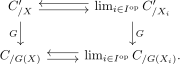
Consider a diagram \(X_{\bullet}\colon I \to C'\), with \(I\) weakly contractible, and set \(X := \colim_{i \in I} X_i\). We need to show that the top adjunction in the following diagram is an adjoint equivalence:
Commutative diagram generated from the LaTeX source
By assumption, the bottom adjunction is an adjoint equivalence. Moreover, since \(G\) preserves pullbacks and weakly contractible colimits, the vertical maps (are defined and) commute with both of the adjoint functors. It then follows from conservativity of \(G\) that both the unit and counit of the top adjunction are isomorphisms, proving the claim.

Corollary 6.171.

If \(C\) and \(C'\) are loci, and \(F\colon C' \to C\) is accessible and preserves pullbacks and weakly contractible colimits, then also the fibers of \(F\) are loci.

Proof
For an object \(c \in C\), the fiber \(F^{-1}(c)\) is the pullback of \(C' \xrightarrow{F} C \leftarrow *\). Since \(F\) is accessible, this pullback is an accessible category. Pullbacks and weakly contractible colimits in the fiber are computed in \(C'\), since both \(F\) and the inclusion \(c\colon * \to C\) preserve them. The functor \(F^{-1}(c) \to C'\) is conservative, so the claim follows from the previous lemma.

Corollary 6.172.

If \(C\) is a locus, then all slices \(C_{/X}\) and \(C_{X/}\) are loci.

Proof
Note that \(\Ar(C)\) is a locus, so the claim follows from the previous corollary.

Example 6.173.

Let \(C\) be a locus with a final object, and let \(A\) be a small category with finite colimits and a final object. Then the subcategory

\[\Exc^{[m,n]}(A,C) \subseteq \Fun(A,C)\]

of \(n\)-reduced \(m\)-excisive functors is a locus. Indeed, it is the fiber of the functor

\[P_{n-1}\colon \Exc^{m}(A,C) \longrightarrow \Exc^{n-1}(A,C).\]

For example, we have \(\Exc^{[n,1]}(A,C) = \Exc^n_*(A,C)\).

Lemma 6.174.

Every topos is a locus. Conversely, a locus \(T\) is a topos if and only if it admits a strictly initial object.

Proof
It is clear that every topos is a locus admitting a strictly initial object. Conversely, if \(T\) is a locus admitting a strictly initial object, then it in particular admits colimits, so \(T\) is presentable. Moreover, the functor \(T\catop \to \Cat, X \mapsto T_{/X}\) preserves weakly contractible limits (\(T\) a locus) and the terminal object (as \(\emptyset \in T\) strictly initial, see Example 2.11), hence all limits.

Lemma 6.175.

Let \(C\) be an accessible category with weakly contractible colimits. If \(C\) is stable, then it is a locus.

Proof
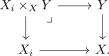
Let \(C\) be a stable accessible category with weakly contractible colimits. It has all finite limits, so in particular pullbacks. First, weakly contractible colimits are universal. Given a map \(Y \to X = \colim_{i \in I} X_i\), form the pullback squares
Commutative diagram generated from the LaTeX source
Since pullback squares agree with pushout squares, they are closed under colimits, so the induced square
Commutative diagram generated from the LaTeX source
is still a pullback square. In particular, the top map is an isomorphism.It remains to verify the full van Kampen condition. Let \(X\colon I\to C\) with \(I\) weakly contractible. A cartesian transformation \(Y\to X\) determines cofiber sequences
\[Y_i\longrightarrow X_i\longrightarrow K_i.\]
Since every naturality square is a pullback and hence also a pushout, every map \(K_i\to K_j\) is an isomorphism. Thus \(K\colon I\to C\) factors through the maximal anima of \(C\). Since \(\abs I\) is contractible, \(K\) is uniquely equivalent to a constant diagram. Consequently, cartesian transformations \(Y\to X\) are equivalently pairs consisting of an object \(K\in C\) and a map \(X\to\const_K\). Taking colimits identifies these with pairs \((K,\colim_I X\to K)\), which in turn are equivalent, by taking fibers, to objects of \(C_{/\colim_I X}\). Hence
\[C_{/\colim_I X}\simeq\lim_{i\in I\catop}C_{/X_i},\]
so the colimit is van Kampen. Compare [Hoyois 2019, Example 7].

Lemma 6.176.

Let \(T\) be a topos. Then \(T^{\geq \infty}\) is a locus in which every map is an effective epimorphism.

Proof
The subcategory \(T^{\geq \infty}\) of \(T\) spanned by \(\infty\)-connected objects is closed under colimits and finite limits in \(T\) by Proposition 3.39. Since weakly contractible colimits in \(T\) are van Kampen, \(T^{\geq \infty}\) inherits this condition.For any \(X \in T^{\geq \infty}\), the map \(X \to *\) is \(\infty\)-connected by definition. It follows from left cancellation that any map \(X \to Y\) is \(\infty\)-connected, so in particular an effective epimorphism in \(T\). Since \(T^{\geq \infty}\) is closed under finite limits and geometric realizations, it is then also an effective epimorphism in \(T^{\geq \infty}\).

The following is our main theorem of this section:

Theorem 6.177.

Let \(C\) be a category with pullbacks and weakly contractible colimits. Then the following conditions are equivalent:

  1. The category \(C\) is a locus;

  2. The category \(\int_{\An} C\) is a topos;

  3. For every topos \(T\), the category \(\int_T C\) is a topos.

Moreover, the following conditions are equivalent to each other:

  1. The category \(C\) is a locus in which every map is an effective epimorphism;

  2. There exists a topos \(T\) such that \(C = T^{\geq \infty}\).

  3. There exists a topos \(T\) such that \(T_{\leq \infty} = \An\) and \(T^{\geq \infty} = C\).

Remark 6.178.

We may think of the categories in (4-6) as “nilpotent thickenings of the point”. They include all stable categories.

Proof
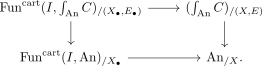
We momentarily assume the equivalence between (1)–(3) and deduce the equivalence between (4)–(6). It is clear that (6) implies (5), while (5) implies (4) by Lemma 6.176. Assume (4), and set \(T=\int_{\An}C\), which is a topos by (2). The terminal object of \(T\) lies over \(*\in\An\), and therefore determines a terminal object \(*\in C\). Since every map in \(C\) is an effective epimorphism, every truncated object of \(C\) is terminal. Indeed, for a \(0\)-truncated object the diagonal is both a monomorphism and an effective epimorphism, hence an isomorphism, and the claim follows; the general case follows inductively by applying the same argument to iterated diagonals.The projection \(\pi\colon T\to\An\) has a fully faithful right adjoint \(r(A)=(A,\const_*)\). For every \((A,X)\in T\), the map \((A,X)\to r(A)\) is \(\infty\)-connected: its iterated diagonals are computed in \(C\), where every map is an effective epimorphism. Hence \(r(A)\) is the hypercompletion of \((A,X)\). It follows that \(T_{\leq\infty}\simeq\An\). Moreover, \((A,X)\) is \(\infty\)-connected precisely when \(A\simeq *\), so the fiber \(C\) over \(*\) identifies with \(T^{\geq\infty}\). This proves (6).For the equivalence of (1)–(3), first note that (2) is equivalent to (3), since \(\int_T C = T \otimes \int_{\An} C\), where the right-hand side is the product of topoi if \(\int_{\An}C\) is a topos. For (2) \(\implies\) (1), the projection \(\int_{\An}C\to\An\) is an accessible functor between presentable categories and \(C\) is its fiber over \(*\). Thus Corollary 6.171 applies. It remains to show that (1) implies (2).Choose a regular cardinal \(\kappa\) for which \(C\) is \(\kappa\)-accessible and its weakly contractible colimit operations are accessible. The usual accessibility argument for Grothendieck constructions shows that \(\int_{\An}C\) is generated under \(\kappa\)-filtered colimits by pairs \((A,X)\) with \(A\) \(\kappa\)-compact and \(X\) taking values in a small subcategory of \(\kappa\)-compact objects of \(C\). Hence \(\int_{\An}C\) is accessible. It has all colimits by Proposition 6.162, so it is presentable. It remains to show that its colimits are van Kampen.Consider a diagram \((X_{\bullet}, E_{\bullet}) \colon I \to \int_{\An}C\), where \(X_i \in \An\) and \(E_i \in \Fun(X_i, C)\). We need to show that the functor \(\colim \colon \Fun^{\cart}(I,\int_{\An}C)_{/(X_{\bullet}, E_{\bullet})} \to (\int_{\An}C)_{/(X,E)}\) is an equivalence. Note that this functor fits in a commutative diagram as follows:
Commutative diagram generated from the LaTeX source
The vertical two maps are cartesian fibrations and the bottom map is an equivalence, so it will suffice to show that the top map induces equivalences on fibers.Note that \((\int_{\An}C)_{/(X,E)} \simeq \lim_{x \in X} (\int_{\An}C)_{/(*,E_x)}\), so it will suffice to prove the claim when \(X = *\). In that case \(\An_{/X} \simeq \An\). Given \(Y \in \An\), the map on fibers over \(Y\) is identified with a limit over \(y \in Y\) of copies of the following map
\[\lim_{i \in I\catop} \Fun(X_i, C)_{/E_i} \to C_{/E},\]
and it remains to show this is an equivalence. Rewriting the left-hand side as a limit over the category of elements \(\El(X_{\bullet})\), the map becomes
\[\lim_{x \in \El(X_{\bullet})\catop} C_{/E_x} \longrightarrow C_{/E}.\]
The realization of \(\El(X_{\bullet})\) is \(X\simeq *\), so this indexing category is weakly contractible. The map is therefore an equivalence by the van Kampen condition in \(C\). This proves (1)–(3); compare [Hoyois 2019, Corollary 5].

6.11.5. Further questions on relative cocompletions

The category \(\int_{\An}C\) is a special case of a relative free-cocompletion construction \(\Pp^{K'}_K(C)\). This viewpoint explains why anima-indexed and weakly contractible colimits occur together, and suggests a broader question about when relative cocompletions are topoi. We first record the formal statements that follow from the universal properties, then separate the cases presently known from the open ones. Some of this discussion is related to [Rezk 2025].

Notation 6.179.

Let \(K \subseteq K'\) be two classes of small categories. Given a category \(C\) with \(K\)-indexed colimits, we may form a functor

\[C \to \Pp^{K'}_K(C)\]

which is universal among \(K\)-colimit preserving functors into a category with \(K'\)-indexed colimits.

Remark 6.180.

Assume for simplicity that \(C\) is small. If \(K'\) consists of all small categories and \(K\) of none, \(\Pp^{\all}(C) = \PSh(C)\) is simply the presheaf category. For arbitrary \(K\) (but still \(K'=\mathrm{all}\)), we may identify \(\Pp^{\all}_K(C)\) with the localization of \(\PSh(C)\) at the class of maps

\[\{\alpha_X\colon \colim_{i \in I} y(X_i) \to y(\colim_{i \in I} X_i) \mid I \in K, X \colon I \to C\}:\]

for every cocomplete category \(D\), a colimit-preserving functor \(\PSh(C)\to D\) is determined by its restriction to \(C\), and it factors through the localization if and only if it inverts each \(\alpha_X\), which is exactly the condition that the restriction preserve \(K\)-indexed colimits.

It follows from Yoneda that we may identify \(\Pp^{\all}_{K}(C)\) with the full subcategory of \(\PSh(C)\) consisting of those presheaves \(F\colon C\catop \to \An\) which send \(K\)-indexed colimits in \(C\) to limits in \(\An\).

Example 6.181.

Let \(K'\) be the class of all small categories and let \(K\) be the class of the weakly contractible categories. If \(C\) is a category with weakly contractible colimits, the category \(\Pp^{\all}_{\mathrm{wc}}(C)\) is universal among functors \(C \to C'\) into a cocomplete category \(C'\) which preserve weakly contractible colimits. Since this is also precisely the universal property of the category \(\int_{\An} C\) established in Proposition 6.164, we obtain an equivalence

\[\int_{\An}C \iso \Pp^{\all}_{\mathrm{wc}}(C).\]

Together with Proposition 6.161, the preceding example gives

\[\Pp^{\mathrm{animae}}(C)\simeq\Pp^{\all}_{\mathrm{wc}}(C).\]

Thus freely adjoining anima-indexed colimits is the same as freely adjoining all colimits while preserving the weakly contractible colimits already present in \(C\). This motivates the following terminology.

Notation 6.182.

Let \(K\) and \(K'\) be two classes of small categories. We write \(K \perp K'\), and say that \(K\) is complementary to \(K'\), if for every category \(C\) with \(K'\)-indexed colimits, the categories \(\Pp^K(C)\) and \(\Pp^{\all}_{K'}(C)\) define the same full subcategory of \(\PSh(C)\) (or of the category of small presheaves, if \(C\) is large), under the identifications from Remark 6.180.

Equivalently, the unique \(K\)-colimit-preserving extension

\[\Pp^K(C) \to \Pp^{\all}_{K'}(C)\]

of \(C \to \Pp^{\all}_{K'}(C)\) is an equivalence.

Warning 6.183.

This relation is not symmetric: \(K\) being complementary to \(K'\) does not imply that \(K'\) is complementary to \(K\).

Lemma 6.184.

If \(K \perp K'\), then the following two conditions are satisfied:

  1. For every category \(D\), the unique \((K \cup K')\)-colimit-preserving extension \(\Pp^{K \cup K'}(D) \to \Pp^{\all}(D)\) of \(D \to \Pp^{\all}(D)\) is an equivalence. Equivalently, \(\PSh(D)\) is generated by representables under \(K\)-colimits and \(K'\)-colimits.

  2. In \(\An\), \(K\)-indexed colimits commute with \(K'\)-indexed limits.

Proof
For (1), take \(C=\Pp^{K'}(D)\) in the definition of complementarity. The relative completion \(\Pp^{\all}_{K'}(\Pp^{K'}(D))\) is \(\Pp^{\all}(D)\) by the two universal properties. Hence every presheaf on \(D\) is obtained from representables by first forming \(K'\)-indexed colimits and then \(K\)-indexed colimits. In particular, the subcategory generated under both classes is all of \(\PSh(D)\).For (2), let \(I \in K'\), \(J \in K\), and let \(X\colon I \times J \to \An\) be a diagram. We must show that the canonical map \(\colim_{j \in J}\lim_{i \in I} X_{i,j} \to \lim_{i \in I}\colim_{j \in J} X_{i,j}\) is an isomorphism. Let \(C := \PSh(I\catop)\), and for each \(j \in J\) let \(d_j \in C\) be the presheaf \(i \mapsto X_{i,j}\). Also let
\[u := \colim_{i \in I\catop} y(i) \qin C \qquadtext{ and } F := \colim_{j \in J} y(d_j) \qin \PSh(C).\]
By the large-\(C\) variant of Remark 6.180 (using small presheaves), \(\Pp^{\all}_{K'}(C)\) is a full subcategory of \(\PSh(C)\). Using the assumption \(K \perp K'\), this full subcategory agrees with \(\Pp^K(C) \subseteq \PSh(C)\), hence is closed under \(K\)-indexed colimits. Since each \(y(d_j)\) belongs to it, it follows that \(F \in \Pp^{\all}_{K'}(C)\), and thus \(F\) sends the \(I\catop\)-indexed colimit \(u=\colim_{i \in I\catop} y(i)\) in \(C\) to an \(I\)-indexed limit in \(\An\):
\[F(u) \simeq \lim_{i \in I} F(y(i)).\]
Now compute both sides using pointwise colimits and Yoneda:
\[F(u) \simeq \colim_{j \in J}\Hom_C(u,d_j) \simeq \colim_{j \in J}\lim_{i \in I}\Hom_C(y(i),d_j) \simeq \colim_{j \in J}\lim_{i \in I} X_{i,j},\]
while
\[\lim_{i \in I}F(y(i)) \simeq \lim_{i \in I}\colim_{j \in J}\Hom_C(y(i),d_j) \simeq \lim_{i \in I}\colim_{j \in J} X_{i,j}.\]
This proves (2).

Example 6.185.

The following are examples of complementary classes:

  • Filtered categories are complementary to finite categories.

  • Sifted categories are complementary to finite sets.

  • Weakly contractible categories are complementary to the empty category.

  • All small categories are complementary to the empty class.

  • Animae are complementary to weakly contractible categories, by Proposition 6.164.

The question about \(\int_{\An}C\) being a topos now has the following natural generalization:

Question 6.186.

Let \(K \perp K'\) be complementary and let \(C\) be a category which has \(K'\)-indexed colimits which are van Kampen. Is \(\Pp^K(C) = \Pp^{\all}_{K'}(C)\) necessarily a topos?

Marc says he doesn't know whether this is true in general. But it is true when \(K\) is one of the following classes of categories:

It is natural to ask whether the same conclusion holds for \(n\)-groupoids paired with weakly \(n\)-connected indexing categories. We do not record this as an established case. However, it seems to Marc that this is not true when \(K= \{\text{Filtered categories}\}\). You would need to show that if \(C\) is a category with finite colimits which are van Kampen, then \(\Ind(C)\) is a topos. Although Marc does not know an explicit counterexample, he expects this to fail in general.

References

  1. Marc Hoyois. Topoi of parametrized objects. Theory Appl. Categ., 34, 243–248. 2019.
  2. Charles Rezk. Free colimit completion in ∞-categories. Homology Homotopy Appl., 27 (1), 275–292. 2025.
  3. Tom Bachmann, Marc Hoyois. Norms in motivic homotopy theory. Astérisque 425, Paris: Société Mathématique de France (SMF). 2021.