6.2. Groupoid actions and principal bundles
In this section, we discuss actions of groupoid objects in a topos \(T\) and prove that the category of such actions is equivalent to the slice over the classifying object. We then characterize principal bundles as regular actions with effective-epimorphic atlas and show that they are classified by maps into the classifying object. Our treatment is based on [Nikolaus et al. 2015] and [Sati and Schreiber 2021, Section 3.2], where the analogous situation for group actions is discussed.
Throughout this section, we fix a topos \(T\) and a groupoid object \(\Gg\colon \simp\catop \to T\).
6.2.1. Actions by groupoid objects
We introduce the notion of an action of a groupoid object, generalizing the treatment of group actions in [Sati and Schreiber 2021].
Let \(\Gg\) be a groupoid object in \(T\), and let \(X \in T\) be an object. An action of \(\Gg\) on \(X\) consists of the following data:
A groupoid object \(\Gg \ltimes X\) in \(T\);
An isomorphism \((\Gg \ltimes X)_0 \simeq X\);
A cartesian natural transformation \(c\colon \Gg \ltimes X \to \Gg\) of simplicial objects in \(T\).
We let \(\Act_{\Gg}(T) \subseteq \Grpd(T)_{/\Gg}\) denote the full subcategory spanned by the \(\Gg\)-actions in \(T\).
Let \(\Gg \ltimes X\) be an action of \(\Gg\) on \(X\). Since \((\Gg \ltimes X)_0 \simeq X\), the map \(c\colon \Gg \ltimes X \to \Gg\) induces a structure map \(c_0\colon X \to \Gg_0\). Since \(c\) is a cartesian natural transformation, there are cartesian squares
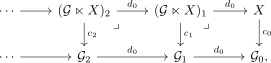
and in particular we obtain isomorphisms \begin{align*} (\Gg \ltimes X)_1 &\simeq \Gg_1 \times_{\Gg_0} X, \\ (\Gg \ltimes X)_2 &\simeq \Gg_2 \times_{\Gg_0} X \simeq \Gg_1 \times_{\Gg_0} \Gg_1 \times_{\Gg_0} X, \end{align*} and so on. Under these isomorphisms, the map \(d_1\colon (\Gg \ltimes X)_1 \to (\Gg \ltimes X)_0\) corresponds to a map \(a\colon \Gg_1 \times_{\Gg_0} X \to X\), which we think of as the action map. The rest of the simplicial diagram \(\Gg \ltimes X\) encodes the data witnessing that this action is unital and associative up to coherent homotopy.
For a groupoid object \(\Gg\), we define its classifying object as the geometric realization \(\bB \Gg := \abs{\Gg}\).
If \(\Gg \ltimes X\) is an action of a groupoid object \(\Gg\) on an object \(X \in T\), we define the quotient \(X \quot \Gg\) as the geometric realization of \(\Gg \ltimes X\):
The cartesian transformation \(\Gg \ltimes X \to \Gg\) induces a map \(X \quot \Gg \to \abs{\Gg} = \bB\Gg\) on geometric realizations, and this defines a functor
The following result shows that groupoid actions are classified by the classifying object:
Proposition 6.30. (Classification of groupoid actions)
The quotient functor is an equivalence of categories:
Proof

6.2.2. Free and transitive actions
Given a \(\Gg\)-action in \(T\), one can define when the action is free or transitive. Actions which are both free and transitive will correspond to principal \(\Gg\)-bundles.
Definition 6.31. (Shear maps)
Let \(\Gg \ltimes X\) be an action of a groupoid object \(\Gg\) on an object \(X\) in \(T\). We define the shear map of \(\Gg \ltimes X\) as the map
where \(a\colon \Gg_1 \times_{\Gg_0} X \to X\) is the action map and \(\pr_X\) is the projection onto \(X\).
More generally, we define the higher shear maps as follows. The atlas \(X\to X\quot\Gg\) is an effective epimorphism, and the equivalence of Lemma 2.33 identifies the action groupoid \(\Gg\ltimes X\) with its Čech nerve \(\check{C}(X\to X\quot\Gg)\). Consider now the commutative square

Regarding this as a morphism from \(X \twoheadrightarrow X\quot\Gg\) to \(X \to *\) in \(\Ar(T)\) and passing to Čech nerves, we obtain a morphism of groupoid objects
Under the identifications of Remark 6.28, this may be displayed as follows:

Definition 6.32. (Free, transitive and regular actions)
Let \(\Gg \ltimes X\) be an action of a groupoid object \(\Gg\) on an object \(X \in T\). We say that this action is
Free if its shear map \(\shear_1\) is a monomorphism;
Transitive if its shear map \(\shear_1\) is an effective epimorphism;
Regular if its shear map \(\shear_1\) is an isomorphism.
Note that \(\Gg \ltimes X\) is regular if and only if it is both free and transitive.
In case the morphism \(X \to *\) is an effective epimorphism in \(T\), regularity of \(\Gg \ltimes X\) can be expressed as the triviality of the quotient:
Let \(X \in T\) be an object such that \(X \to *\) is an effective epimorphism. Let \(\Gg \ltimes X\) be an action of a groupoid object on \(X\). Then the action is regular if and only if the quotient \(X\quot\Gg\) is the terminal object of \(T\).
Proof
6.2.3. Principal bundles
Given a groupoid object \(\Gg\) in \(T\) and an object \(B \in T\), we obtain a notion of principal \(\Gg\)-bundles over \(B\) by applying the definition of regular actions to the slice topos \(T_{/B}\). Observe that \(\Gg\) gives rise to a groupoid \(\Gg \times B\) in the slice \(T_{/B}\) by applying the pullback functor \(B \times -\colon T \to T_{/B}\). For every object \(P \in T_{/B}\), there is an isomorphism
and thus a \((\Gg \times B)\)-action on \(P\) is the same as a \(\Gg\)-action on the underlying object of \(P\) for which the map \(P\to B\) is invariant. For this reason, we will refer to a \((\Gg \times B)\)-action in the slice \(T_{/B}\) simply as a \(\Gg\)-action over \(B\).
Definition 6.34. (Principal bundles)
Let \(B \in T\) be an object and let \(\Gg\) be a groupoid object in \(T\).
Let \(p\colon P \to B\) be an object of \(T_{/B}\) equipped with a \(\Gg\)-action over \(B\). We say that \(p\) is a formally principal \(\Gg\)-bundle over \(B\) if this action is regular as a \((\Gg \times B)\)-action in the slice \(T_{/B}\), i.e. if the shear map
\[\shear_{1}\colon \Gg_1 \times_{\Gg_0} P \iso P \times_B P\]is an isomorphism.
A formally principal \(\Gg\)-bundle \(p\colon P \to B\) is called a principal \(\Gg\)-bundle if \(p\) is an effective epimorphism.
We write
\[\Bun_{\Gg}(B) \quad \subseteq \quad \Act_{\Gg\times B}(T_{/B})\]for the full subcategory of principal \(\Gg\)-bundles over \(B\).
For any morphism \(f\colon B' \to B\) in \(T\), the pullback functor \(f^*\colon T_{/B} \to T_{/B'}\) preserves principal \(\Gg\)-bundles.
Let \(p\colon P \twoheadrightarrow B\) be an effective epimorphism equipped with a \(\Gg\)-action over \(B\), and let \(P\quot\Gg \in T_{/B}\) denote the quotient. Then \(p\) is a principal \(\Gg\)-bundle if and only if the canonical map \(P\quot\Gg \to B\) is an isomorphism.
Proof
It follows from Lemma 6.36 that the forgetful functor from principal \(\Gg\)-bundles over \(B\) to \(\Gg\)-actions in \(T\) lands in the fiber over \(B\) of the composite
The forgetful functor induces an equivalence of categories
Proof
We are now ready to state the main classification result:
Theorem 6.38. (Classification of principal bundles)
Let \(\Gg\) be a groupoid object in \(T\) and let \(B \in T\) be an object. There is an equivalence of categories
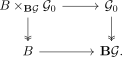
given on objects by sending a morphism \(c\colon B \to \bB\Gg\) to the principal \(\Gg\)-bundle \(P \to B\) defined by the pullback square

Proof
For every groupoid object \(\Gg\) in \(T\) and every object \(B \in T\), the category \(\Bun_{\Gg}(B)\) is an anima.
References
- Thomas Nikolaus, Urs Schreiber, Danny Stevenson. Principal \(\infty \)-bundles: general theory. J. Homotopy Relat. Struct., 10 (4), 749–801. 2015.
- Hisham Sati, Urs Schreiber. Equivariant principal infinity-bundles. arXiv preprint arXiv:2112.13654. 2021.