Remark 6.28.
Let \(\Gg \ltimes X\) be an action of \(\Gg\) on \(X\). Since \((\Gg \ltimes X)_0 \simeq X\), the map \(c\colon \Gg \ltimes X \to \Gg\) induces a structure map \(c_0\colon X \to \Gg_0\). Since \(c\) is a cartesian natural transformation, there are cartesian squares
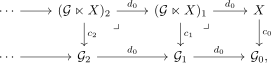
and in particular we obtain isomorphisms \begin{align*} (\Gg \ltimes X)_1 &\simeq \Gg_1 \times_{\Gg_0} X, \\ (\Gg \ltimes X)_2 &\simeq \Gg_2 \times_{\Gg_0} X \simeq \Gg_1 \times_{\Gg_0} \Gg_1 \times_{\Gg_0} X, \end{align*} and so on. Under these isomorphisms, the map \(d_1\colon (\Gg \ltimes X)_1 \to (\Gg \ltimes X)_0\) corresponds to a map \(a\colon \Gg_1 \times_{\Gg_0} X \to X\), which we think of as the action map. The rest of the simplicial diagram \(\Gg \ltimes X\) encodes the data witnessing that this action is unital and associative up to coherent homotopy.