6.1. Sheaf topoi

Sheaves on Grothendieck sites provide one of the fundamental constructions of topoi. We begin by showing that localization at any pullback-stable set of sieves is left exact. We then relate Grothendieck topologies on a small category to intrinsic Grothendieck topologies and monogenic congruences on its presheaf topos. Finally, we describe the resulting sheaves by Čech descent, characterize effective epimorphisms by local sections, and discuss the functoriality induced by continuous and cocontinuous morphisms of sites.

Definition 6.1.

Let \(C\) be a category. A sieve on an object \(X \in C\) is a subfunctor \(U \hookrightarrow y(X)\) of the representable presheaf \(y(X) = \Hom_C(-,X)\). Equivalently, it is a collection of morphisms with codomain \(X\) that is closed under precomposition.

Theorem 6.2. ([Lurie 2009, Proposition 6.2.2.7])

Let \(C\) be a small category, and let \(\tau\) be a collection of sieves on \(C\) stable under pullbacks. Let

\[\Shv_{\tau}(C) \quad \subseteq \quad \PSh(C)\]

be the full subcategory spanned by the \(\tau\)-local objects. Then \(\Shv_{\tau}(C)\) is a left exact localization of \(\PSh(C)\). In particular, \(\Shv_{\tau}(C)\) is a topos.

The standard proof of this result (as found for example in [Lurie 2009]) involves a detailed analysis of the “plus-construction”, which is fairly intricate. However, using the machinery of modalities and congruences established in Section 5.3, we can give a much simpler and more conceptual proof. We will freely use the notations introduced in that section.

Proof
We know from Proposition A.15 that the inclusion admits an accessible left adjoint \(L\colon \PSh(C) \to \Shv_{\tau}(C)\). We need to show that \(L\) is left exact. By Corollary 4.16, it suffices to show that the class of morphisms \(K\) inverted by \(L\) is a congruence.The class \(K\) is precisely the strong saturation \(\tau^{ss}\) of \(\tau\). We claim that it agrees with \(\tau^c\). Since \(\tau\) consists of monomorphisms, it follows from Corollary 5.43 that \(\tau^c = \tau^m\). Choose the representable presheaves as a set of generators of \(\PSh(C)\). In the notation of Proposition 5.32, the set \(\tau^{bc}\) then consists of the pullbacks of the sieves in \(\tau\) along maps from representable presheaves. It agrees with \(\tau\): one inclusion follows from pullback stability, while the other follows by taking the identity map of the codomain of each sieve. Hence Proposition 5.32 gives \(\tau^m = (\tau^{bc})^s = \tau^s\). All in all, we see that \(\tau^{ss} \subseteq \tau^c = \tau^m = \tau^s \subseteq \tau^{ss}\), and thus all four classes agree. In particular \(\tau^{ss}\) is a congruence, finishing the proof.

6.1.1. Grothendieck sites

While not necessary for the definition of \(\Shv_{\tau}(C)\), the collection \(\tau\) in the previous theorem is usually taken to be a Grothendieck topology. We first formulate an intrinsic, accessible version of this notion in an arbitrary topos:

Definition 6.3. ([Anel et al. 2024, Definition 3.1.2])

An accessible Grothendieck topology on a topos \(T\) is a class \(\tau\) of monomorphisms in \(T\), called the covering monomorphisms, such that:

  1. The class \(\tau\) contains all isomorphisms, and its saturation \(\tau^s\) is of small generation;

  2. The class \(\tau\) is a local class, in the sense of Definition 2.46;

  3. Covering monomorphisms are closed under composition;

  4. Given monomorphisms \(f\colon X \hookrightarrow Y\) and \(g\colon Y \hookrightarrow Z\) in \(T\), if \(g \circ f\) is a covering monomorphism, then so is \(g\).

We refer to a \(\tau\)-local object as a \(\tau\)-sheaf and denote the full subcategory of \(\tau\)-sheaves by

\[\Shv_{\tau}(T) \quad \subseteq \quad T.\]

Remark 1.4.

The small-generation condition is not part of the unrestricted notion of an extended Grothendieck topology in [Anel et al. 2024, Definition 3.1.2]. We impose it here so that localization at the covering monomorphisms is accessible. In the remainder of these notes, “Grothendieck topology on a topos” will always mean an accessible Grothendieck topology in this sense.

The argument from Theorem 6.2 goes through, showing that the localization functor \(L_{\tau}\colon T \to \Shv_{\tau}(T)\) is left exact.

Remark 6.5.

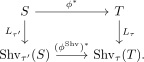
Let \((T,\tau)\) and \((S,\tau')\) be topoi equipped with Grothendieck topologies. A morphism of topoi \(\phi_*\colon T \to S\) restricts to a functor \(\phi^{\Shv}\colon \Shv_{\tau}(T) \to \Shv_{\tau'}(S)\) if and only if its associated logos morphism \(\phi^*\colon S \to T\) preserves covering monomorphisms. Indeed, by adjunction the restriction exists precisely when \(\phi^*\) sends every \(\tau'\)-covering monomorphism to a \(\tau\)-local equivalence. Since \(\phi^*\) is left exact, these images are monomorphisms, and Proposition 6.9 identifies the \(\tau\)-local equivalences which are monic with the \(\tau\)-covering monomorphisms. In this case, the functor \(\phi^{\Shv}\) is automatically a morphism of topoi. By passing to left adjoints, we see that \(\phi^*\) commutes with sheafification:
Commutative diagram generated from the LaTeX source

When specializing Definition 6.3 to presheaf topoi, we recover the usual notion of a Grothendieck site.

Notation 6.6.

Let \(f\colon X \to Y\) be a morphism in some category \(C\). For every sieve \(U \hookrightarrow y(Y)\), we denote by \(f^*U \hookrightarrow y(X)\) the sieve obtained by pullback along \(y(f)\colon y(X) \to y(Y)\). Note that it consists of those morphisms \(g\colon Z \to X\) such that the composite \(f \circ g\) is in the sieve \(U\).

Definition 6.7. (Grothendieck topology, [Lurie 2009, Definition 6.2.2.1])

A Grothendieck topology on a category \(C\) consists of a specification, for each object \(X\) of \(C\), of a collection of sieves on \(C\) which we will refer to as covering sieves. The collections of covering sieves are required to satisfy the following properties:

  1. For every object \(X\) of \(C\), the identity \(y(X) \to y(X)\) is a covering sieve;

  2. For every morphism \(f\colon X \to Y\) in \(C\) and every covering sieve \(U \hookrightarrow y(Y)\) on \(Y\), the pullback sieve \(f^*U \hookrightarrow y(X)\) is a covering sieve on \(X\);

  3. Let \(X\) be an object of \(C\), \(U \hookrightarrow y(X)\) a covering sieve on \(X\), and \(V \hookrightarrow y(X)\) an arbitrary sieve on \(X\). Suppose that, for every morphism \(f \colon Y \to X\) belonging to \(U\), the pullback sieve \(f^*V\) is a covering sieve on \(Y\). Then \(V\) is a covering sieve on \(X\).

A Grothendieck site is a category \(C\) equipped with a Grothendieck topology.

Lemma 6.8.

Let \(C\) be a small category. Then there is a bijection between Grothendieck topologies on \(C\) in the sense of Definition 6.7 and Grothendieck topologies on \(\PSh(C)\) in the sense of Definition 6.3.

Proof
If \(\tau\) is a Grothendieck topology on \(\PSh(C)\), we declare a sieve \(U \hookrightarrow y(X)\) to be covering if it is a covering monomorphism in \(\PSh(C)\), i.e. if it belongs to \(\tau\). Conditions (1) and (2) follow from (a) and base-change stability. For (3), let \(i\colon U \hookrightarrow y(X)\) be a covering sieve and let \(j\colon V \hookrightarrow y(X)\) be a sieve such that for every map \(f\colon y(Y) \to U\) from a representable the projection \(y(Y) \times_{y(X)} V \hookrightarrow y(Y)\) is a covering monomorphism. Since \(\tau\) is local, it follows by descent that \(U \times_{y(X)} V \to U\) is a covering monomorphism. Its composite with \(U \hookrightarrow y(X)\) is covering by (c), and hence \(V \hookrightarrow y(X)\) is covering by (d).Conversely, given a Grothendieck topology on \(C\), we define a monomorphism \(U \hookrightarrow X\) in \(\PSh(C)\) to be covering if its pullback along every map \(y(Y) \to X\) from a representable is a covering sieve. We verify properties (a)–(d).For (a), all isomorphisms are covering. Moreover, the saturation \(\tau^s\) is generated by the set of covering sieves on representables. Indeed, every monomorphism \(U \hookrightarrow X\) is the colimit in \(\Ar(\PSh(C))\) of its pullbacks along maps \(y(Y) \to X\), by the density of the Yoneda embedding. Hence every covering monomorphism belongs to the saturation of the covering sieves.For (b), stability under base change follows directly from the definition, and closure under coproducts follows because every map from a representable into a coproduct factors through one of its summands. For descent, consider a pullback square as in Definition 2.46 in which the bottom map is an effective epimorphism and the upper vertical map is covering. After pulling back along a map from a representable, the bottom effective epimorphism admits a section: this follows by evaluating it at the object representing its target. The corresponding pullback of the lower vertical map is therefore a base change of the upper vertical map and hence is covering.For (c), let \(V \hookrightarrow U\) and \(U \hookrightarrow X\) be covering monomorphisms. To show that \(V \hookrightarrow X\) is covering, we may pull back along a map from a representable and thus assume that \(X = y(X')\). Then \(U \hookrightarrow y(X')\) is a covering sieve. By axiom (3), it suffices to show that for every \(f\colon Y \to X'\) in \(U\), the pullback sieve \(f^*V \hookrightarrow y(Y)\) is covering. This map is a base change of \(V \hookrightarrow U\), so it is covering by assumption.For (d), consider monomorphisms \(V \xhookrightarrow{f} U \xhookrightarrow{g} X\) such that \(gf \in \tau\). We may again assume that \(X = y(X')\) is representable. Then \(V \hookrightarrow y(X')\) is a covering sieve. By axiom (3), it suffices to show that for every \(h\colon Y \to X'\) in \(V\), the pullback \(h^*U \hookrightarrow y(Y)\) is covering. Since \(h\) factors through \(V \hookrightarrow U\), this pullback is the identity of \(y(Y)\) and hence is covering.It is immediate from the construction that these two assignments are inverse to each other, finishing the proof.

Proposition 6.9. ([Anel et al. 2024, Proposition 3.1.10])

Let \(T\) be a topos. There is a bijection

\[\left\{\textup{Grothendieck topologies on }T\right\} \xleftrightarrow[\;K \cap \Mono \mathrel{\rotatebox[origin=c]{180}{$\mapsto$}} K\;]{\;\tau \mapsto \tau^c\;} \left\{\textup{monogenic congruences of small generation on }T\right\}.\]
Proof
First let \(\tau\) be a Grothendieck topology on \(T\). The congruence \(\tau^c\) is monogenic, since \(\tau \subseteq \Mono\) gives \(\tau^c = \tau^m = (\tau \cap \Mono)^m\), where the first equality uses Corollary 5.43. Moreover, the saturation \(\tau^s\) is stable under base change: base-change functors preserve colimits, and a base change of a composite of covering monomorphisms is again such a composite. Hence \(\tau^m=\tau^s\), and therefore \(\tau^c=\tau^s\). In particular, \(\tau^c\) is of small generation. We claim that \(\tau^c \cap \Mono = \tau\). Since \(\tau\) consists of monomorphisms, it suffices to show \(\tau^c \cap \Mono \subseteq \tau\). Let
\[E := \{f \in \Ar(T)\mid \im(f)\in\tau\}\]
be the class of \(\tau\)-coverings (cf. [Anel et al. 2024, Proposition 3.1.10]). We claim that \(E\) is saturated and contains \(\tau\), hence \(\tau^s\subseteq E\). Clearly \(E\) contains all isomorphisms, and \(\tau \subseteq E\) since \(\im(m) = m\) for every monomorphism \(m\). Let us verify the remaining conditions.Base change. Since the epi-mono factorization is stable under base change and \(\tau\) is closed under base change, \(E\) is closed under base change.Composition. Let \(f\colon X \to Y\) and \(g\colon Y \to Z\) be morphisms in \(E\), with epi-mono factorizations
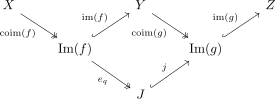
\[X \overset{\coim(f)}{\twoheadrightarrow} \Im(f) \xhookrightarrow{\im(f)} Y \overset{\coim(g)}{\twoheadrightarrow} \Im(g) \xhookrightarrow{\im(g)} Z,\]
so that \(\im(f), \im(g) \in \tau\). Let \(q\colon \Im(f) \to \Im(g)\) be the composite \(\coim(g) \circ \im(f)\), with epi-mono factorization \(q = j \circ e_q\) through some \(J\):
Commutative diagram generated from the LaTeX source
Then \(\im(gf) = \im(g) \circ j\), so it suffices to show \(j \in \tau\). Pull back \(j\) along the effective epimorphism \(\coim(g)\colon Y \twoheadrightarrow \Im(g)\) to obtain \(\pi\colon M := Y \times_{\Im(g)} J \hookrightarrow Y\). Since \(\im(f)\) factors through \(\pi\) (via the map \(\Im(f) \to J\) and the inclusion \(\Im(f) \hookrightarrow Y\)), the composite \(\Im(f) \hookrightarrow M \xhookrightarrow{\pi} Y\) equals \(\im(f) \in \tau\). By axiom (d), it follows that \(\pi \in \tau\). Since \(\pi\) is the pullback of \(j\) along an effective epimorphism and \(\tau\) is a local class, we conclude \(j \in \tau\). Finally, \(\im(gf) = \im(g) \circ j \in \tau\) by axiom (c).Colimits. First, \(E\) is closed under coproducts: since images commute with coproducts (as both the class of monomorphisms and the class of effective epimorphisms are closed under coproducts), we have \(\im(\coprod f_i) = \coprod \im(f_i)\), and \(\tau\) is closed under coproducts by locality. For a general colimit \(f'\colon A' \to B'\) of a diagram \(\{f_i\colon A_i \to B_i\}_{i \in I}\) in \(\Ar(T)\), let \(f\colon A \to B\) be the coproduct \(\coprod_{i \in I} f_i\), so that \(f \in E\). The canonical maps \(a\colon A \twoheadrightarrow A'\) and \(b\colon B \twoheadrightarrow B'\) are effective epimorphisms, and \(f'a = bf\). Since \(b\) is an effective epimorphism (hence in \(E\)) and \(f \in E\), the composition \(bf = f'a\) lies in \(E\) by the above. Since \(a\) is an effective epimorphism, \(\im(f'a) = \im(f')\), so \(f' \in E\).This establishes that \(E\) is saturated. If \(m\in\tau^s\cap\Mono\), then \(m\in E\), so \(\im(m)=m\) lies in \(\tau\). Thus \(\tau^c\cap\Mono = \tau^s\cap\Mono\subseteq\tau\).Conversely, let \(K\) be a monogenic congruence of small generation and set \(\tau_K := K \cap \Mono\). The congruence generated by \(\tau_K\) is
\[\tau_K^c = \tau_K^m = (K \cap \Mono)^m = K,\]
where the first equality uses Corollary 5.43, and the last is the monogenicity of \(K\). We now verify that \(\tau_K\) is a Grothendieck topology.(a) The class \(\tau_K\) contains all isomorphisms. Since \(K\) is monogenic and of small generation, Lemma 5.56 provides a set \(\Sigma\subseteq\tau_K\) of monomorphisms which generates \(K\) as an acyclic class. Choose a set of generators of \(T\) and let \(\Sigma^{bc}\) be the corresponding set of base changes. Since \(\tau_K\) is closed under base change, we have \(\Sigma^{bc}\subseteq\tau_K\). Hence
\[K=\Sigma^m=(\Sigma^{bc})^s\subseteq\tau_K^s\subseteq K,\]
where the second equality is Proposition 5.32. Thus \(\tau_K^s=K\), so \(\tau_K^s\) is of small generation.(b) The class \(\tau_K\) is local:
  • Closure under base change is immediate from base-change stability of \(K\) and \(\Mono\).
  • Closure under small coproducts follows since \(K\) is saturated (hence closed under coproducts in \(\Ar(T)\)), and coproducts of monomorphisms are monomorphisms in a topos.
  • For descent along effective epimorphisms, consider a pullback square as in Definition 2.46 with \(f' \in \tau_K\). Then \(f' \in K\), so \(f \in K\) by locality of \(K\). Also, since pullback along an effective epimorphism is conservative and preserves monomorphisms, \(f\) is monic. Hence \(f \in K \cap \Mono = \tau_K\).
(c) If \(f,g \in \tau_K\), then \(f,g \in K\) and \(f,g\) are monomorphisms. Since \(K\) is saturated, \(gf \in K\), and since monomorphisms are closed under composition, \(gf \in \Mono\). Thus \(gf \in \tau_K\).(d) Let \(V \xhookrightarrow{f} U \xhookrightarrow{g} X\) be monomorphisms with \(gf\in\tau_K\). Since \(gf\in K\), the image of \(gf\) in the quotient \(q\colon T\to T/K\) is an isomorphism, and thus \(q(g)\) admits a section. As \(q\) is left exact, \(q(g)\) is a monomorphism, hence an isomorphism, so \(g \in K\). Since \(g\) is monic, \(g\in K\cap\Mono=\tau_K\).Hence \(\tau_K\) is a Grothendieck topology. Together with \(\tau_K^c=K\) and \(\tau^c \cap\Mono=\tau\), this shows the two assignments are inverse.

6.1.2. Sheaves and Čech descent

We now introduce the category of sheaves on a Grothendieck site, and formulate its objects in terms of Čech descent.

Definition 6.10. (Sheaf category, [Lurie 2009, Definition 6.2.2.6])

Let \(C\) be a category equipped with a Grothendieck topology \(\tau\). We denote by

\[\Shv_{\tau}(C) \quad \subseteq \quad \PSh(C)\]

the full subcategory of \(\tau\)-sheaves. We denote the left exact left adjoint by

\[L_{\tau}\colon \PSh(C) \to \Shv_{\tau}(C).\]

The functor \(L_{\tau}\) is known as the sheafification functor.

Example 6.11.

Let \(X\) be a topological space. Then the poset \(\Open(X)\) of open subsets admits a Grothendieck topology, called the open covering topology, for which the covering sieves of some \(U \in \Open(X)\) are those sieves generated by open coverings \(U = \bigcup_{i \in I} U_i\). We denote the resulting topos by

\[\Shv(X) \quad := \quad \Shv_{\open}(\Open(X)).\]

Definition 6.12.

The sheafified Yoneda functor \(y_{\tau}\) is the composite

\[C \xhookrightarrow{y} \PSh(C) \xrightarrow{L_{\tau}} \Shv_{\tau}(C).\]

Notation 6.13.

Let \(\Uu = \{U_i \to X\}_{i\in I}\) be a collection of morphisms in a category \(C\). The morphism \(\bigsqcup_{i \in I} y(U_i) \to y(X)\) in \(\PSh(C)\) factors as an effective epimorphism followed by a monomorphism:

\[\bigsqcup_{i \in I} y(U_i) \twoheadrightarrow U \hookrightarrow y(X).\]

We refer to the sieve \(U \hookrightarrow y(X)\) as the sieve generated by \(\Uu\).

Since limits and colimits in \(\PSh(C)\) are computed pointwise, we see that this epi-mono factorization is also computed pointwise: for every \(Z \in C\), the subanima

\[U(Z) \subseteq y(X)(Z) = \Hom_C(Z,X)\]

consists of those morphisms \(Z \to X\) in \(C\) that factor through \(U_i \to X\) for some \(i \in I\).

If \(C\) carries a Grothendieck topology \(\tau\), we say that \(\Uu\) is a covering family if the sieve it generates is a covering sieve.

Sheaves on \(C\) may equivalently be described in terms of Čech descent.

Definition 6.14. (Čech descent)

Let \(C\) be a category and let \(\Uu = \{U_i \to X\}_{i\in I}\) be a collection of morphisms. We will denote by \(\check{C}_{\bullet}(\Uu)\) the Čech nerve of the morphism

\[\bigsqcup_{i \in I} y(U_i) \to y(X)\]

in \(\PSh(C)\). A presheaf \(\Ff \in \PSh(C)\) is said to satisfy Čech descent with respect to \(\Uu\) if the map

\[\Ff(X) = \Hom_{\PSh(C)}(y(X),\Ff) \to \lim_{[n] \in \simp} \Hom_{\PSh(C)}(\check{C}_n(\Uu),\Ff)\]

is an equivalence. More concretely, if the relevant iterated fiber products of the \(U_i\) over \(X\) exist in \(C\), then \(\Ff\) satisfies Čech descent with respect to \(\Uu\) if the diagram

Commutative diagram generated from the LaTeX source

is a limit diagram.

Proposition 6.15. ({cf. [Lurie 2009, Lemma 6.2.3.18]})

Let \(\Uu = \{U_i \to X\}_{i\in I}\) be a collection of morphisms in a category \(C\) and let \(U \hookrightarrow y(X)\) be the sieve generated by \(\Uu\). Then a presheaf \(\Ff\) on \(C\) satisfies Čech descent with respect to \(\Uu\) if and only if it is local with respect to \(U \hookrightarrow y(X)\).

Proof
By definition, \(U \hookrightarrow y(X)\) is obtained from the epi-mono factorization \(\bigsqcup_{i \in I} y(U_i) \twoheadrightarrow U \hookrightarrow y(X)\). It follows that \(U\) is equivalent to the colimit of the Čech nerve \(\check{C}(\Uu)\) of \(\Uu\), and we obtain for every \(\Ff \in \PSh(C)\) an equivalence
\[\Hom_{\PSh(C)}(U,\Ff) \simeq \Hom_{\PSh(C)}(\colim_{[n] \in \simp\catop} \check{C}_n(\Uu),\Ff) \simeq \lim_{[n] \in \simp}\Hom_{\PSh(C)}(\check{C}_n(\Uu),\Ff).\]
The claim now follows immediately.

6.1.3. Effective epimorphisms in sheaf topoi

The effective epimorphisms in a sheaf topos \(\Shv_{\tau}(C)\) can be characterized as those morphisms which admit local sections, in the following sense:

Definition 6.16.

Let \(C\) be a category equipped with a Grothendieck topology \(\tau\). Let \(f\colon X \to Y\) be a morphism in \(\Shv_{\tau}(C)\) and assume that \(Y = y_{\tau}(Y')\) lies in the image of the sheafified Yoneda functor. We say that \(f\) admits local sections if there exists a covering family \(\{U_i \to Y'\}_{i \in I}\) of \(Y'\) such that the base change

\[X \times_{y_{\tau}(Y')} y_{\tau}(U_i) \to y_{\tau}(U_i)\]

admits a section for every \(i \in I\).

If \(f\colon X \to Y\) is an arbitrary morphism in \(\Shv_{\tau}(C)\), we say that \(f\) admits local sections if its base change along every map \(y_{\tau}(Y') \to Y\) from a sheafified representable admits local sections.

Lemma 6.17.

A morphism \(f\colon X \to Y\) in \(\Shv_{\tau}(C)\) is an effective epimorphism if and only if it admits local sections.

Proof
Suppose first that \(f\) admits local sections. If \(Y=y_{\tau}(Y')\), choose a covering family \(\{U_i\to Y'\}_{i\in I}\) over which \(f\) admits sections. The induced map
\[\coprod_{i\in I}y_{\tau}(U_i)\longrightarrow y_{\tau}(Y')\]
is an effective epimorphism. After base change along this map, \(f\) is a coproduct of morphisms admitting sections and hence is an effective epimorphism by Lemma 2.38. Since effective epimorphisms form a local class, \(f\) is an effective epimorphism. For arbitrary \(Y\), the same argument applies after choosing an effective epimorphism from a coproduct of sheafified representables to \(Y\).Conversely, assume that \(f\colon X \to Y\) is an effective epimorphism. Since effective epimorphisms are stable under base change, it suffices to treat the case \(Y=y_{\tau}(Y')\). Let \(i\colon\Shv_{\tau}(C)\hookrightarrow\PSh(C)\) denote the inclusion and form the pullback
\[\widetilde X:=i(X)\times_{i(y_{\tau}(Y'))}y(Y')\]
along the unit \(y(Y')\to i(y_{\tau}(Y'))\). Consider the epi–mono factorization in \(\PSh(C)\):
\[\widetilde X \twoheadrightarrow U_f \hookrightarrow y(Y').\]
Applying sheafification \(L_{\tau}\colon \PSh(C)\to \Shv_{\tau}(C)\) gives a factorization
\[X\twoheadrightarrow L_{\tau}(U_f)\longrightarrow y_{\tau}(Y'),\]
where we have used left exactness of \(L_{\tau}\) to identify \(L_{\tau}(\widetilde X)\) with \(X\). The composite is \(f\), so right cancellation for effective epimorphisms shows that the map \(L_{\tau}(U_f)\to y_{\tau}(Y')\) is an effective epimorphism. It is also a monomorphism, since \(L_{\tau}\) is left exact, and hence it is an isomorphism.Therefore the monomorphism \(U_f\hookrightarrow y(Y')\) is inverted by \(L_{\tau}\). By Theorem 6.2, the class of morphisms inverted by \(L_{\tau}\) is the congruence \(\tau^c\). Thus \(U_f \hookrightarrow y(Y')\) lies in \(\tau^c \cap \Mono = \tau\) by Proposition 6.9, i.e. it is a covering sieve on \(Y'\). By construction, a morphism \(U\to Y'\) belongs to \(U_f\) precisely when the corresponding map \(y_{\tau}(U)\to y_{\tau}(Y')\) admits a lift to \(X\). Taking all morphisms in \(U_f\) as a covering family therefore shows that \(f\) admits local sections.

6.1.4. Morphisms of sites

Given a functor \(u\colon C \to D\) between two Grothendieck sites, we may ask under what conditions \(u\) induces a topos morphism between the sheaf categories of \(C\) and \(D\). There are two natural candidates for such a notion, called continuous and cocontinuous morphisms of sites.

Definition 6.18. (Continuous morphism)

Let \((C,\tau)\) and \((D,\tau')\) be Grothendieck sites. A functor \(u\colon C \to D\) is called continuous if the restriction functor \(u^*\colon \PSh(D) \to \PSh(C)\) preserves sheaves, i.e. restricts to a functor

\[u^*\colon \Shv_{\tau'}(D) \to \Shv_{\tau}(C).\]

We say that \(u\) is a continuous morphism of sites if this restriction is a morphism of topoi, i.e. its left adjoint is left exact. We denote the category of Grothendieck sites and continuous morphisms of sites by \(\Site^{\cont}\). By definition, the assignment \((C,\tau) \mapsto \Shv_{\tau}(C) \subseteq \PSh(C)\) determines a contravariant functor

\[\Shv(-)\colon (\Site^{\cont})\catop \to \Topos,\]

obtained by restricting the precomposition functoriality of the presheaf construction \(\PSh(-)\colon \Cat\catop \to \PrL\).

Remark 6.19.

The left adjoint of the restriction of \(u^*\) is given by the composite

\[\Shv_{\tau}(C) \hookrightarrow \PSh(C) \xrightarrow{u_!} \PSh(D) \xrightarrow{L_{\tau'}} \Shv_{\tau'}(D),\]

where \(u_!\) is left Kan extension along \(u\). In particular, any continuous functor \(u\) for which the left Kan extension functor \(u_!\) is left exact is a continuous morphism of sites.

Note that \(u_!\) is left exact whenever \(u\) admits a left adjoint, since then \(u_!\) is given by restriction along that left adjoint.

The following criterion is often useful for checking continuity:

Lemma 6.20.

Let \((C,\tau)\) and \((D,\tau')\) be Grothendieck sites, and let \(u\colon C \to D\) be a functor. Assume that every covering sieve \(U \hookrightarrow y(X)\) of \(X \in C\) is generated by a collection of morphisms \(\{f_i\colon U_i \to X\}_{i \in I}\) in \(C\) satisfying the following conditions:

  • Pullbacks along \(f_i\) exist in \(C\) and are preserved by \(u\colon C \to D\);

  • The sieve on \(y(u(X))\) in \(D\) generated by the maps \(u(f_i)\) is a covering sieve.

Then \(u\) is a continuous functor.

Proof
Let \(\Ff\) be a \(\tau'\)-sheaf on \(D\). We need to show that \(u^*\Ff\) is a \(\tau\)-sheaf on \(C\). For a covering sieve \(U \hookrightarrow y(X)\), let \(\Uu = \{f_i \colon U_i \to X\}_{i \in I}\) be a collection of morphisms in \(C\) generating it satisfying the two conditions. Using Proposition 6.15 and the adjunction \(u_! \dashv u^*\), we may equivalently show that the map
\[(u^*\Ff)(X) \simeq \Hom_{\PSh(D)}(y(u(X)), \Ff) \to \lim_{[n] \in \simp} \Hom_{\PSh(D)}(u_!(\check{C}_n(\Uu)), \Ff)\]
is an isomorphism. The first assumption on \(\Uu\) guarantees that the simplicial object \(u_!(\check{C}_n(\Uu))\) in \(\PSh(D)\) agrees with the Čech nerve of the map \(\bigsqcup_{i \in I} y(u(U_i)) \to y(u(X))\). The second assumption says that the associated sieve is a covering sieve. So a second application of Proposition 6.15 implies the claim.

Corollary 6.21.

Let \((C,\tau)\) and \((D,\tau')\) be Grothendieck sites, and assume that the following two conditions are satisfied:

  • The category \(C\) admits finite limits, and \(u\colon C \to D\) preserves finite limits;

  • The functor \(u\) preserves covering families.

Then \(u\) is a continuous morphism of sites.

Proof
The left Kan extension functor \(u_!\colon \PSh(C) \to \PSh(D)\) is left exact by Proposition 2.43, as it is the colimit extension of the left exact functor \(C \xrightarrow{u} D \hookrightarrow \PSh(D)\). Since \(u\) is a continuous functor by Lemma 6.20, the claim follows from Remark 6.19.

Example 6.22.

Let \(f\colon X \to Y\) be a continuous map of topological spaces. Then the preimage functor \(f^{-1}\colon \Open(Y) \to \Open(X)\) preserves finite limits and preserves coverings, hence is a continuous morphism of sites. This gives rise to a functor \(\Open(-)\colon \Top\catop \to \Site^{\cont}\). Composing it with the sheaf functor \((\Site^{\cont})\catop \to \Topos\), we obtain a functor

\[\Shv\colon \Top \to \Topos.\]

We now discuss a second mechanism by which a functor between Grothendieck sites induces a morphism of topoi, namely cocontinuity.

Definition 6.23. (Cocontinuous morphism)

Let \((C,\tau)\) and \((D,\tau')\) be Grothendieck sites. A functor \(u\colon C \to D\) is called a cocontinuous morphism of sites if the right Kan extension functor restricts to a functor

\[u_*\colon \Shv_{\tau}(C) \to \Shv_{\tau'}(D).\]

In particular, \(u_*\) is a morphism of topoi, with left exact left adjoint given by the composite

\[\Shv_{\tau'}(D) \hookrightarrow \PSh(D) \xrightarrow{u^*} \PSh(C) \xrightarrow{L_{\tau}} \Shv_{\tau}(C).\]

If we denote by \(\Site^{\cocont}\) the category of Grothendieck sites and cocontinuous morphisms, then the assignment \((C,\tau) \mapsto \Shv_{\tau}(C)\) defines a functor

\[\Site^{\cocont} \to \Topos,\]

obtained by restricting the right Kan extension functoriality of the presheaf construction \(\PSh\colon \Cat \to \PrR\).

Let us make the cocontinuity condition on \(u\) more concrete.

Notation 6.24.

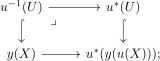
Given an object \(X \in C\) and a sieve \(U \hookrightarrow y(u(X))\) of \(u(X)\) in \(D\), we define its pullback along \(u\) as the sieve \(u^{-1}(U) \hookrightarrow y(X)\) of \(X\) obtained by forming the following pullback square in \(\PSh(C)\):
Commutative diagram generated from the LaTeX source

here the bottom map is the unit map \(y(X) \to u^*u_!y(X) = u^*(y(u(X)))\). Note that \(u^{-1}(U)\) consists of those morphisms \(Z \to X\) in \(C\) for which the map \(u(Z) \to u(X)\) lies in the sieve \(U\).

Lemma 6.25.

A functor \(u\colon C \to D\) is a cocontinuous morphism of sites if and only if for every \(X \in C\) and every covering sieve \(U \hookrightarrow y(u(X))\) of \(u(X)\) in \(D\), the pullback sieve \(u^{-1}(U) \hookrightarrow y(X)\) is a covering sieve in \(C\).

Proof
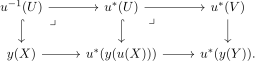
By definition, \(u\) is a cocontinuous morphism if and only if the restriction functor \(u^*\colon \PSh(D) \to \PSh(C)\) preserves the covering monomorphisms, or equivalently if for every covering sieve \(V \hookrightarrow y(Y)\) in \(D\) the map \(u^*(V) \hookrightarrow u^*y(Y)\) is a covering monomorphism in \(\PSh(C)\). The latter condition means that for any map \(f\colon y(X) \to u^*y(Y)\) in \(\PSh(C)\) from a representable, the base change \(u^*(V) \times_{u^*y(Y)} y(X) \hookrightarrow y(X)\) is a covering sieve. The map \(f\) corresponds to a map \(u(X) \to Y\) in \(D\), and pulling back the covering sieve \(V \hookrightarrow y(Y)\) gives a covering sieve \(U \hookrightarrow y(u(X))\). The claim now follows, since we have a pullback square
Commutative diagram generated from the LaTeX source

Corollary 6.26.

Let \(v\colon (C,\tau) \to (D,\tau')\) be a functor between sites and assume that \(v\) admits a right adjoint \(u\colon D \to C\). Then \(v\) is a cocontinuous morphism of sites if and only if \(u\) is a continuous morphism of sites. In this case, we have \(v_* \simeq u^*\).

Proof
The adjunction \(v \dashv u\) induces an adjunction \(v^* \dashv u^*\) on presheaf categories, showing that \(v_* \simeq u^*\). By definition, \(v\) is a cocontinuous morphism of sites if and only if \(v_*\) preserves sheaves, while it follows from Remark 6.19 that \(u\) is a continuous morphism of sites if and only if \(u^*\) preserves sheaves, showing the claim.

References

  1. Jacob Lurie. Higher topos theory. Ann. Math. Stud. 170, Princeton, NJ: Princeton University Press. 2009.
  2. Mathieu Anel, Georg Biedermann, Eric Finster, André Joyal. Left-exact localizations of ∞-topoi. II: Grothendieck topologies. J. Pure Appl. Algebra, 228 (3), 63. 2024.