A functor \(u\colon C \to D\) is a cocontinuous morphism of sites if and only if for every \(X \in C\) and every covering sieve \(U \hookrightarrow y(u(X))\) of \(u(X)\) in \(D\), the pullback sieve \(u^{-1}(U) \hookrightarrow y(X)\) is a covering sieve in \(C\).
Proof
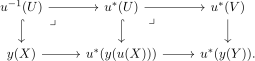
By definition, \(u\) is a cocontinuous morphism if and only if the restriction functor \(u^*\colon \PSh(D) \to \PSh(C)\) preserves the covering monomorphisms, or equivalently if for every covering sieve \(V \hookrightarrow y(Y)\) in \(D\) the map \(u^*(V) \hookrightarrow u^*y(Y)\) is a covering monomorphism in \(\PSh(C)\). The latter condition means that for any map \(f\colon y(X) \to u^*y(Y)\) in \(\PSh(C)\) from a representable, the base change \(u^*(V) \times_{u^*y(Y)} y(X) \hookrightarrow y(X)\) is a covering sieve. The map \(f\) corresponds to a map \(u(X) \to Y\) in \(D\), and pulling back the covering sieve \(V \hookrightarrow y(Y)\) gives a covering sieve \(U \hookrightarrow y(u(X))\). The claim now follows, since we have a pullback square