Remark 6.5.
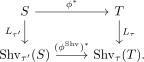
Let \((T,\tau)\) and \((S,\tau')\) be topoi equipped with Grothendieck topologies. A morphism of topoi \(\phi_*\colon T \to S\) restricts to a functor \(\phi^{\Shv}\colon \Shv_{\tau}(T) \to \Shv_{\tau'}(S)\) if and only if its associated logos morphism \(\phi^*\colon S \to T\) preserves covering monomorphisms. Indeed, by adjunction the restriction exists precisely when \(\phi^*\) sends every \(\tau'\)-covering monomorphism to a \(\tau\)-local equivalence. Since \(\phi^*\) is left exact, these images are monomorphisms, and Proposition 6.9 identifies the \(\tau\)-local equivalences which are monic with the \(\tau\)-covering monomorphisms. In this case, the functor \(\phi^{\Shv}\) is automatically a morphism of topoi. By passing to left adjoints, we see that \(\phi^*\) commutes with sheafification: