A map of animae \(f\colon X \to Y\) is an epimorphism if and only if \(f\) is acyclic, meaning that for any local system \(A\) of abelian groups on \(Y\), the induced map
\[H^*(Y,A) \xrightarrow{ \cong } H^*(X,f^*A)\]
is an isomorphism.
A map of animae \(f\colon X \to Y\) is in the right orthogonal class to the epimorphisms if and only if the group \(\pi_1(f) \in \Grp((T_{/Y})_{\leq 0})\) is hypoabelian.
For any anima \(X\), the unique factorization \(X \to *\) as
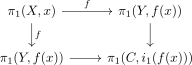
(1) Suppose first that \(f\) is an epimorphism. For any local system \(A\) on \(Y\), the Mayer–Vietoris sequence associated to the pushout square identifies the restriction map \(H^*(Y,A)\to H^*(X,f^*A)\) with an isomorphism. Thus \(f\) is acyclic.Conversely, suppose that \(f\) is acyclic and set \(C:=Y\sqcup_XY\). Let \(i_1,i_2\colon Y\to C\) be the two coprojections. For a local system \(A\) on \(C\), the Mayer–Vietoris sequence contains
The two restrictions of \(A\) to \(X\) are canonically identified, and both restriction maps from the two copies of \(H^q(Y)\) to \(H^q(X)\) are isomorphisms by acyclicity of \(f\). Exactness therefore identifies \(H^q(C,A)\) with the diagonal copy of \(H^q(Y,i_1^*A)\). In particular, \(i_1\) is itself acyclic.By Lemma 5.11, the map \(f\) induces an isomorphism on \(\pi_0\) and a surjection on every fundamental group. We may consequently apply the Seifert–van Kampen theorem componentwise to the pushout defining \(C\). It gives a pushout square in groups. Since the two maps out of \(\pi_1(X,x)\) agree and are surjective, the coprojection \(i_1\) induces an isomorphism on fundamental groups. The same van Kampen calculation on components shows that \(i_1\) induces an isomorphism on \(\pi_0\). Hence Lemma 5.12 applies and shows that \(i_1\) is an isomorphism. Since \(\nabla_f i_1=\id_Y\), the codiagonal \(\nabla_f\colon C\to Y\) is its inverse. Thus \(f\) is an epimorphism.(2) See [Hoyois 2019, Corollary 10].(3) By definition, Quillen's \(+\)-construction is the reflection of \(X\) into the subcategory of animae with hypoabelian fundamental group. By (2), this subcategory precisely consists of the objects \(Y\) for which \(Y \to *\) is right orthogonal to the epimorphisms, and the claim follows.
References
Marc Hoyois. On Quillen’s plus construction. 2019.