5.1. Epimorphisms and acyclic maps
In this section, we discuss in detail the example of a modality given by the epimorphisms in a topos. For \(\An\), this recovers the acyclic maps: those that induce isomorphisms on cohomology with local coefficients.
5.1.1. Cotruncated maps and epimorphisms
We first construct the modality of cotruncated maps and establish the perhaps surprising fact that every epimorphism of a topos is already \(0\)-connected.
Definition 5.5. (Cotruncation)
We say that a map \(f\colon X \to Y\) is \(n\)-cotruncated if it is \(n\)-truncated in \(T\catop\). Inductively, this equivalently means that the \((-2)\)-cotruncated maps are precisely the isomorphisms, and that a map \(f\) is \((n+1)\)-cotruncated if and only if its codiagonal \(\nabla_f\colon Y \sqcup_X Y \to Y\) is \(n\)-cotruncated.
Let \(L\) be the collection of \(n\)-cotruncated morphisms in \(T\). Then the pair \((L, L^{\perp})\) forms a modality on \(T\).
Proof

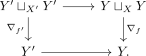
A morphism \(f\colon X \to Y\) in \(T\) is called an epimorphism if it is \((-1)\)-cotruncated, i.e. if the square

is a pushout square. Let \(T^+\subseteq T\) be the full subcategory of objects \(Z\) for which \(Z\to *\) is right orthogonal to all epimorphisms. The factorization system of Lemma 5.6 gives a reflection \((-)^+\colon T\to T^+\) and hence a factorization
into an epimorphism followed by a map which is right orthogonal to the epimorphisms.
As already mentioned in Warning 2.28, the terminology regarding `epimorphism' and `effective epimorphism' is a rather unfortunate historical accident: effective epimorphisms are not generally epimorphisms.
For \(T= \An\), the map \(S^0 \to *\) is an effective epimorphism (as it is a surjection on path components), but it is not an epimorphism: the pushout of \(S^0 \to *\) along itself is \(S^1\), which is not isomorphic to \(*\).
The situation is made even more confusing by the fact that the converse does hold.
Every epimorphism in \(T\) is 0-connected, hence in particular an effective epimorphism.
Proof
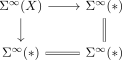
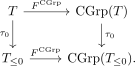
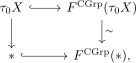
Let \(T\) be a topos, and let \(f\colon X \to Y\) be a morphism in \(T_{\leq 0}\) which is both an epimorphism and a monomorphism. Then \(f\) is an isomorphism.
Proof

5.1.2. Acyclic maps and the plus construction
We now specialize to animae. Cohomology with all local coefficient systems detects precisely the epimorphisms, and the corresponding reflection is Quillen's plus construction. We first record the two detection arguments used in the proof.
Lemma 5.11. (Detection by local coefficients)
Let \(f\colon X\to Y\) be a map of animae. If
is an isomorphism for every local system \(A\) of abelian groups on \(Y\), then \(\pi_0(f)\) is an isomorphism and \(\pi_1(X,x)\to\pi_1(Y,f(x))\) is surjective for every \(x\in X\).
Proof
Lemma 5.12. (Whitehead theorem with local coefficients)
Let \(f\colon X\to Y\) be a map of animae which induces isomorphisms on \(\pi_0\) and \(\pi_1\). If \(f\) induces an isomorphism on cohomology with every local system of abelian groups on \(Y\), then \(f\) is an isomorphism.
Proof
We now identify the epimorphisms in the topos of animae.
Consider the topos \(T = \An\).
A map of animae \(f\colon X \to Y\) is an epimorphism if and only if \(f\) is acyclic, meaning that for any local system \(A\) of abelian groups on \(Y\), the induced map
\[H^*(Y,A) \xrightarrow{ \cong } H^*(X,f^*A)\]is an isomorphism.
A map of animae \(f\colon X \to Y\) is in the right orthogonal class to the epimorphisms if and only if the group \(\pi_1(f) \in \Grp((T_{/Y})_{\leq 0})\) is hypoabelian.
For any anima \(X\), the unique factorization \(X \to *\) as
\[X \xrightarrow{ \mathrm{epi} } X^+ \xrightarrow{ \pi_1\textup{ hypoabelian} } *\]is Quillen's \(+\)-construction.
In (2), we say that a group \(G\) is perfect if it is left orthogonal to abelian groups, i.e. if every map \(G \to A\) into an abelian group is trivial, or equivalently if the abelianization \(G^{\mathrm{ab}}\) is trivial. A group \(A\) is hypoabelian if it is right orthogonal to perfect groups, i.e. if every map \(G \to A\) from a perfect group is trivial, or equivalently if \(A\) has no nontrivial perfect subgroup.
Proof

References
- Marc Hoyois. On Quillen’s plus construction. 2019.