5.6. Products of acyclic classes

Given two ideals \(I\) and \(J\) in a commutative ring \(R\), we may form their product \(IJ \subseteq R\), the ideal generated by the products \(ij\) for \(i\in I\) and \(j \in J\). There is an analogous construction for classes of morphisms in a topos. Its natural domain is the partially ordered set \(\Acyc(T)\) of acyclic classes, rather than only the smaller collection of modalities.

5.6.1. The acyclic product

Definition 5.71.

For \(u\colon A \to B\) and \(v\colon C \to D\), the pushout product

\[u \ssquare v\colon (B \times C) \sqcup_{A \times C} (A \times D) \longrightarrow B \times D\]

is the cogap map of the commutative square
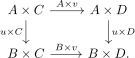
Commutative diagram generated from the LaTeX source

We already encountered this operation before in Notation 5.15.

Definition 5.72.

For acyclic classes \(K\) and \(L\), define their product as the acyclic class

\[KL \quad := \quad (K \ssquare L)^{m},\]

where \(K \ssquare L\) is the class of morphisms of the form \(u \ssquare v\) for \(u \in K\) and \(v \in L\).

Lemma 5.73.

We have an inclusion \(KL \subseteq K \cap L\).

Proof
By symmetry, it suffices to show \(KL \subseteq K\). If \(u \in K\) and \(v \in L\), then also the maps \(u \times C\) and \(u \times D\) are in \(K\), hence so is the cobase change \(A \times D \to (B \times C) \sqcup_{A \times C} (A \times D)\). By right cancellation, it follows that the cogap map \(u \ssquare v\) is in \(K\) as well.

By definition, \(KL\) is again an acyclic class. If \(K\) and \(L\) are of small generation, the following lemma shows that their product is of small generation as well and hence defines a modality.

Lemma 5.74.

Given two classes of maps \(\Sigma,\Sigma'\) in \(T\), we have \(\Sigma^m\,{\Sigma'}^m \;=\; (\Sigma \ssquare \Sigma')^m\). In particular, if \(K\) and \(L\) are acyclic classes of small generation, then so is \(KL\).

Proof
The inclusion \((\Sigma \ssquare \Sigma')^m \subseteq \Sigma^m \, {\Sigma'}^m\) is clear. For the converse, it suffices to show that \((\Sigma \ssquare \Sigma')^m\) contains \(\Sigma^m \ssquare {\Sigma'}^m\). Let us first show that it contains \(\Sigma \ssquare {\Sigma'}^m\). For a fixed morphism \(u \in \Sigma\), consider the collection of morphisms \(v \in \Ar(T)\) such that \(u \ssquare v \in (\Sigma \ssquare \Sigma')^m\). This collection clearly contains \(\Sigma'\), hence to show it contains all of \({\Sigma'}^m\) it remains to show that it is a saturated class closed under base change.Closure under base change follows from universality of colimits: if \(v'\) is a base change of \(v\), then \(u\ssquare v'\) is the corresponding base change of \(u\ssquare v\). The class clearly contains all isomorphisms. For closure under composition, let \(C\xrightarrow{v}D\xrightarrow{w}E\) be composable. The map \(u\ssquare(wv)\) factors as
\[(B\times C)\sqcup_{A\times C}(A\times E) \longrightarrow (B\times D)\sqcup_{A\times D}(A\times E) \longrightarrow B\times E.\]
The first map is a cobase change of \(u\ssquare v\), and the second is \(u\ssquare w\). Thus it belongs to \((\Sigma\ssquare\Sigma')^m\) whenever both \(u\ssquare v\) and \(u\ssquare w\) do. Finally, closure under colimits follows because \(u\ssquare-\colon\Ar(T)\to\Ar(T)\) preserves colimits.We may now repeat the argument to show that for fixed \(v \in {\Sigma'}^m\) the collection of \(u \in \Ar(T)\) such that \(u \ssquare v \in (\Sigma \ssquare \Sigma')^m\) contains \(\Sigma\) and is a saturated class closed under base change, hence contains all of \(\Sigma^m\). This finishes the proof.

Proposition 5.75. ([Anel et al. 2025, Theorem 3.2.2])

This product turns \(\Acyc(T)\) into a commutative algebra object in the category \(\Pos^{\cocompl}\) of cocomplete posets. Its unit is the acyclic class \(\All\) of all morphisms.

Corollary 5.76.

Let \(K\) and \(L\) be monogenic acyclic classes. Then \(KL\) is monogenic. If \(K\) and \(L\) are of small generation, then so is \(KL\).

Proof
By monogenicity, we may write \(K=\Sigma^m\) and \(L={\Sigma'}^m\) with \(\Sigma=K\cap\Mono\) and \(\Sigma'=L\cap\Mono\). The class \(\Sigma\ssquare\Sigma'\) consists of monomorphisms, so Lemma 5.74 shows that \(KL\) is monogenic. If \(K\) and \(L\) are of small generation, Lemma 5.56 allows us to choose \(\Sigma\) and \(\Sigma'\) to be sets, which also proves small generation of \(KL\).

Corollary 5.77.

Let \(K\) be a monogenic acyclic class. Then \(K^2 = K\).

Proof
The inclusion \(K^2 \subseteq K\) is immediate from Lemma 5.73. For the converse, we may assume that \(K = \Sigma^m\) for a class of monomorphisms \(\Sigma\), and it will suffice to show that \(u \in K^2\) for every morphism \(u\colon A \hookrightarrow B\) in \(\Sigma\). By construction, the morphism \(u \ssquare u\colon (B \times A) \sqcup_{A \times A} (A \times B) \to B \times B\) is in \(K^2\), hence so is its base change along \(\Delta\colon B \to B \times B\). Universality of pushouts identifies this base change with \(A \sqcup_{A\times_B A} A \to B\). Since \(u\) is a monomorphism, we have \(A \iso A \times_B A\), so this map identifies with \(u\colon A \to B\).

5.6.2. Examples and division

We now discuss various examples of products of acyclic classes.

Example 5.78.

Let \(L=\Conn_n\) be the \(n\)-connected maps. As a modality this is generated by the constant map \(S^{n+1}\to *\) in \(T\). The pushout product of \(S^{n+1} \to *\) with \(S^{m+1} \to *\) is \(S^{n+m+3} \to *\), so by Lemma 5.74 we get

\[(\Conn_n)(\Conn_m) \;=\; \Conn_{n+m+2}.\]

As a special case, for \(\EffEpi = (S^0 \to *)^{m}\) we get \(\Conn_n = \EffEpi^{\,n+2}\).

More generally, note that for any morphism \(u\colon X \to Y\), the pushout product \((S^0\to *) \ssquare u\) is the codiagonal \(\nabla_u\colon Y \sqcup_X Y \to Y\). It follows that for every acyclic class \(L\) we have

\[\EffEpi \cdot L \;=\; \nabla(L)^{m}.\]

Example 5.79.

For any topos \(T\), one has \(\Epi^{\,2} \subseteq \Conn_{\infty}\). Indeed, recall from Proposition 5.9 that every epimorphism is \(0\)-connected, so that

\[\Epi^{\,2} \subseteq \Conn_0^{\,2} = \Conn_2 \subseteq \Conn_1.\]

We claim that we also have an inclusion \(\Epi \cap \Conn_1 \subseteq \Conn_{\infty}\). Indeed, if \(f\colon X \to Y\) is an epimorphism, then we get a pushout square

Commutative diagram generated from the LaTeX source

If \(f \in \Conn_n\) for some \(n\), then \(\Delta_f \in \Conn_{n-1}\). The relative pushout product \(\Delta_f \ssquare_X \Delta_f\) is a base change of the ordinary pushout product, hence belongs to

\[\Conn_{n-1}\Conn_{n-1}=\Conn_{2n}.\]

Since the gap map of this square is \(f\), Blakers–Massey implies that \(f \in \Conn_{2n}\). Assuming \(f \in \Conn_1\), it follows inductively that \(f \in \Conn_{2^k}\) for all \(k\), so \(f \in \Conn_{\infty}\).

Construction 5.80.

Given acyclic classes \(K\) and \(L\), we define

\[K \backslash L := \{\,f \mid K \ssquare f \subseteq L\,\}.\]

This is again an acyclic class by [Anel et al. 2025, Lemma 3.1.2 and Theorem 3.2.2]. If \(M\) is a third acyclic class, then we have

\[KM \subseteq L \iff M \subseteq K \backslash L,\]

so that \(K\backslash L\) functions as an internal hom in \(\Acyc(T)\).

Example 5.81.

Since \((S^0\to *) \ssquare u = \nabla(u)\), we see that \(u \in \EffEpi \backslash \Iso\) if and only if \(u\) is an epimorphism. More generally, we inductively get

\[\Cotr_{n+1} = \EffEpi \backslash \Cotr_n.\]

5.6.3. Products of congruences

We now show that the acyclic product of two congruences is again a congruence. The following is the key input.

Lemma 5.82. (Key lemma, [Anel et al. 2025, Lemmas 2.3.27 and 2.3.28])

Let \(L\) be an acyclic class.

  1. \(\Delta \nabla(L) \subseteq L\).

  2. \(\Delta^{-1}(L) \cap \EffEpi \subseteq \EffEpi \cdot L\).

Proof
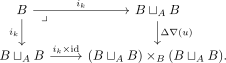
(1) For \(u\colon A \to B\) in \(L\), the morphism \(\Delta \nabla(u)\) takes the form
\[\Delta \nabla(u)\colon B \sqcup_A B \longrightarrow (B \sqcup_A B) \times_B (B \sqcup_A B).\]
The two summand inclusions \(i_k\colon B \to B \sqcup_A B\) induce two maps \(i_k \times \id \colon B \times_B (B \sqcup_A B) \to (B \sqcup_A B) \times_B (B \sqcup_A B)\) which are jointly an effective epimorphism. Since \(L\) is local, it suffices to show that the left vertical map in the following pullback square is in \(L\):
Commutative diagram generated from the LaTeX source
This holds since \(i_k\) is a cobase change of \(u\).(2) This is the substantive direction of the suspension theorem for acyclic classes, proved in [Anel et al. 2025, Lemma 2.3.28]. The assumption that \(u\) is an effective epimorphism identifies \(B\) with the colimit of the Čech nerve of \(u\). The condition \(\Delta_u\in L\), together with base-change stability and composition, controls all higher maps in this Čech nerve. The simplicial orthogonality argument of the cited lemma then shows that \(u\) belongs to the acyclic class generated by the codiagonals of maps in \(L\). By Example 5.78, this class is
\[\nabla(L)^m=\EffEpi\cdot L,\]
as required.

Corollary 5.83. ([Anel et al. 2025, Theorem 2.3.22])

For any acyclic class \(L\), we have

\[D(L) \cap \EffEpi \;=\; \EffEpi \cdot L .\]

In particular, if \(K\) is a congruence we get

\[K^{\epi} = K \cap \EffEpi = \EffEpi \cdot K.\]
Proof
Since \(D(L) = L \cap \Delta^{-1}(L)\), the inclusion “\(\subseteq\)” holds by (2) of the previous lemma. Conversely, Lemma 5.73 gives \(\EffEpi\cdot L\subseteq L\). We also have \(\EffEpi \cdot L = \nabla(L)^m\), so it remains to show that \(\nabla(L) \subseteq \Delta^{-1}(L)\). This is precisely part (1) of the previous lemma.The last statement holds because \(D(K) = K\) for any congruence \(K\).

We now prove that the product of two congruences is again a congruence.

Theorem 5.84.

Let \(K, L \in \Cong(T)\) be congruences. Then their product \(KL\) is also a congruence.

Proof
By (5) of Proposition 5.35, it suffices to show that it is closed under diagonals, i.e. \(KL \subseteq D(KL)\). Recall that any acyclic class \(M\) decomposes as \(M = M^{\mono} \vee M^{\epi}\). Applying this to \(K\) and \(L\), we can distribute the product:
\[KL = (K^{\epi} \vee K^{\mono})(L^{\epi} \vee L^{\mono}) = K^{\epi}L^{\epi} \vee K^{\epi}L^{\mono} \vee K^{\mono}L^{\epi} \vee K^{\mono}L^{\mono}.\]
The product distributes over joins by Proposition 5.75. Using that \(K^{\epi} = \EffEpi \cdot K\) and \(L^{\epi} = \EffEpi \cdot L\), we see that the first three terms are contained in \(\EffEpi \cdot K \cdot L\), which by Corollary 5.83 is contained in \(D(KL)\). It thus remains to show that \(K^{\mono} L^{\mono} \subseteq D(KL)\). The product \(K^{\mono}L^{\mono}\) is monogenic by Corollary 5.76, and it is contained in \(KL\). Hence it is contained in the largest monogenic acyclic class below \(KL\), namely \((KL)^{\mono}\). By Lemma 5.60, the latter is a congruence and therefore closed under diagonals. Thus \((KL)^{\mono} \subseteq D(KL)\), finishing the proof.

References

  1. Mathieu Anel, Georg Biedermann, Eric Finster, André Joyal. Left-exact localizations of $\infty$-topoi III: The acyclic product. 2025.