\[\left\{\textup{Grothendieck topologies on }T\right\}
\xleftrightarrow[\;K \cap \Mono \mathrel{\rotatebox[origin=c]{180}{$\mapsto$}} K\;]{\;\tau \mapsto \tau^c\;}
\left\{\textup{monogenic congruences of small generation on }T\right\}.\]
Proof
First let \(\tau\) be a Grothendieck topology on \(T\). The congruence \(\tau^c\) is monogenic, since \(\tau \subseteq \Mono\) gives \(\tau^c = \tau^m = (\tau \cap \Mono)^m\), where the first equality uses Corollary 5.43. Moreover, the saturation \(\tau^s\) is stable under base change: base-change functors preserve colimits, and a base change of a composite of covering monomorphisms is again such a composite. Hence \(\tau^m=\tau^s\), and therefore \(\tau^c=\tau^s\). In particular, \(\tau^c\) is of small generation. We claim that \(\tau^c \cap \Mono = \tau\). Since \(\tau\) consists of monomorphisms, it suffices to show \(\tau^c \cap \Mono \subseteq \tau\). Let
\[E := \{f \in \Ar(T)\mid \im(f)\in\tau\}\]
be the class of \(\tau\)-coverings (cf. [Anel et al. 2024, Proposition 3.1.10]). We claim that \(E\) is saturated and contains \(\tau\), hence \(\tau^s\subseteq E\). Clearly \(E\) contains all isomorphisms, and \(\tau \subseteq E\) since \(\im(m) = m\) for every monomorphism \(m\). Let us verify the remaining conditions.Base change. Since the epi-mono factorization is stable under base change and \(\tau\) is closed under base change, \(E\) is closed under base change.Composition. Let \(f\colon X \to Y\) and \(g\colon Y \to Z\) be morphisms in \(E\), with epi-mono factorizations
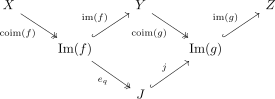
\[X \overset{\coim(f)}{\twoheadrightarrow} \Im(f) \xhookrightarrow{\im(f)} Y \overset{\coim(g)}{\twoheadrightarrow} \Im(g) \xhookrightarrow{\im(g)} Z,\]
so that \(\im(f), \im(g) \in \tau\). Let \(q\colon \Im(f) \to \Im(g)\) be the composite \(\coim(g) \circ \im(f)\), with epi-mono factorization \(q = j \circ e_q\) through some \(J\): Then \(\im(gf) = \im(g) \circ j\), so it suffices to show \(j \in \tau\). Pull back \(j\) along the effective epimorphism \(\coim(g)\colon Y \twoheadrightarrow \Im(g)\) to obtain \(\pi\colon M := Y \times_{\Im(g)} J \hookrightarrow Y\). Since \(\im(f)\) factors through \(\pi\) (via the map \(\Im(f) \to J\) and the inclusion \(\Im(f) \hookrightarrow Y\)), the composite \(\Im(f) \hookrightarrow M \xhookrightarrow{\pi} Y\) equals \(\im(f) \in \tau\). By axiom (d), it follows that \(\pi \in \tau\). Since \(\pi\) is the pullback of \(j\) along an effective epimorphism and \(\tau\) is a local class, we conclude \(j \in \tau\). Finally, \(\im(gf) = \im(g) \circ j \in \tau\) by axiom (c).Colimits. First, \(E\) is closed under coproducts: since images commute with coproducts (as both the class of monomorphisms and the class of effective epimorphisms are closed under coproducts), we have \(\im(\coprod f_i) = \coprod \im(f_i)\), and \(\tau\) is closed under coproducts by locality. For a general colimit \(f'\colon A' \to B'\) of a diagram \(\{f_i\colon A_i \to B_i\}_{i \in I}\) in \(\Ar(T)\), let \(f\colon A \to B\) be the coproduct \(\coprod_{i \in I} f_i\), so that \(f \in E\). The canonical maps \(a\colon A \twoheadrightarrow A'\) and \(b\colon B \twoheadrightarrow B'\) are effective epimorphisms, and \(f'a = bf\). Since \(b\) is an effective epimorphism (hence in \(E\)) and \(f \in E\), the composition \(bf = f'a\) lies in \(E\) by the above. Since \(a\) is an effective epimorphism, \(\im(f'a) = \im(f')\), so \(f' \in E\).This establishes that \(E\) is saturated. If \(m\in\tau^s\cap\Mono\), then \(m\in E\), so \(\im(m)=m\) lies in \(\tau\). Thus \(\tau^c\cap\Mono = \tau^s\cap\Mono\subseteq\tau\).Conversely, let \(K\) be a monogenic congruence of small generation and set \(\tau_K := K \cap \Mono\). The congruence generated by \(\tau_K\) is
\[\tau_K^c = \tau_K^m = (K \cap \Mono)^m = K,\]
where the first equality uses Corollary 5.43, and the last is the monogenicity of \(K\). We now verify that \(\tau_K\) is a Grothendieck topology.(a) The class \(\tau_K\) contains all isomorphisms. Since \(K\) is monogenic and of small generation, Lemma 5.56 provides a set \(\Sigma\subseteq\tau_K\) of monomorphisms which generates \(K\) as an acyclic class. Choose a set of generators of \(T\) and let \(\Sigma^{bc}\) be the corresponding set of base changes. Since \(\tau_K\) is closed under base change, we have \(\Sigma^{bc}\subseteq\tau_K\). Hence
where the second equality is Proposition 5.32. Thus \(\tau_K^s=K\), so \(\tau_K^s\) is of small generation.(b) The class \(\tau_K\) is local:
Closure under base change is immediate from base-change stability of \(K\) and \(\Mono\).
Closure under small coproducts follows since \(K\) is saturated (hence closed under coproducts in \(\Ar(T)\)), and coproducts of monomorphisms are monomorphisms in a topos.
For descent along effective epimorphisms, consider a pullback square as in Definition 2.46 with \(f' \in \tau_K\). Then \(f' \in K\), so \(f \in K\) by locality of \(K\). Also, since pullback along an effective epimorphism is conservative and preserves monomorphisms, \(f\) is monic. Hence \(f \in K \cap \Mono = \tau_K\).
(c) If \(f,g \in \tau_K\), then \(f,g \in K\) and \(f,g\) are monomorphisms. Since \(K\) is saturated, \(gf \in K\), and since monomorphisms are closed under composition, \(gf \in \Mono\). Thus \(gf \in \tau_K\).(d) Let \(V \xhookrightarrow{f} U \xhookrightarrow{g} X\) be monomorphisms with \(gf\in\tau_K\). Since \(gf\in K\), the image of \(gf\) in the quotient \(q\colon T\to T/K\) is an isomorphism, and thus \(q(g)\) admits a section. As \(q\) is left exact, \(q(g)\) is a monomorphism, hence an isomorphism, so \(g \in K\). Since \(g\) is monic, \(g\in K\cap\Mono=\tau_K\).Hence \(\tau_K\) is a Grothendieck topology. Together with \(\tau_K^c=K\) and \(\tau^c \cap\Mono=\tau\), this shows the two assignments are inverse.
References
Mathieu Anel, Georg Biedermann, Eric Finster, André Joyal. Left-exact localizations of ∞-topoi. II: Grothendieck topologies. J. Pure Appl. Algebra, 228 (3), 63. 2024.