Example 2.13. (Group actions)
This example previews the groupoid objects introduced in Subsection 2.2.1. Informally, a groupoid object is a simplicial object encoding objects, invertible morphisms between them, and all the coherences for composition. A group object is the special case in which the object of objects is terminal.
Let \(T\) be a topos, and let \(G\) be a group object in \(T\), regarded as a groupoid object \(G_{\bullet}\colon \simp\catop \to T\) satisfying \(G_{0} = *\). Let \(\bB G := \colim_{[n] \in \simp\catop} G_n\). Then there is an equivalence
In other words, a module over \(G\) is a simplicial object \(X_{\bullet}\) with a cartesian transformation \(X_{\bullet} \to G_{\bullet}\), which we can depict (suppressing degeneracies) as a simplicial diagram of face maps:
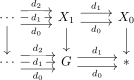
with each square cartesian. In particular, this implies \(X_1 \simeq G \times X_0\). The two maps \(G \times X_0 \simeq X_1 \to X_0\) can then be interpreted as the projection map and an action map. The rest of the simplicial diagram \(X_{\bullet}\) records the higher coherences of this \(G\)-action on \(X_0\).