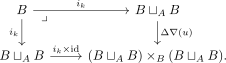
(1) For \(u\colon A \to B\) in \(L\), the morphism \(\Delta \nabla(u)\) takes the form
\[\Delta \nabla(u)\colon B \sqcup_A B \longrightarrow (B \sqcup_A B) \times_B (B \sqcup_A B).\]
The two summand inclusions \(i_k\colon B \to B \sqcup_A B\) induce two maps \(i_k \times \id \colon B \times_B (B \sqcup_A B) \to (B \sqcup_A B) \times_B (B \sqcup_A B)\) which are jointly an effective epimorphism. Since \(L\) is local, it suffices to show that the left vertical map in the following pullback square is in \(L\): This holds since \(i_k\) is a cobase change of \(u\).(2) This is the substantive direction of the suspension theorem for acyclic classes, proved in [Anel et al. 2025, Lemma 2.3.28]. The assumption that \(u\) is an effective epimorphism identifies \(B\) with the colimit of the Čech nerve of \(u\). The condition \(\Delta_u\in L\), together with base-change stability and composition, controls all higher maps in this Čech nerve. The simplicial orthogonality argument of the cited lemma then shows that \(u\) belongs to the acyclic class generated by the codiagonals of maps in \(L\). By Example 5.78, this class is
\[\nabla(L)^m=\EffEpi\cdot L,\]
as required.
References
Mathieu Anel, Georg Biedermann, Eric Finster, André Joyal. Left-exact localizations of $\infty$-topoi III: The acyclic product. 2025.