Let \(C\) be a category with pullbacks and let \(X_{\bullet}\colon I \to C\) be a functor. Then the functor \(\Fun^{\cart}(I,C)_{/X_{\bullet}} \to \lim_{i \in I\catop} C_{/X_i}\) is an equivalence.
More informally, objects of the limit are given by \(I\)-indexed diagrams \(Y_{\bullet}\) in \(C\) equipped with a cartesian natural transformation \(Y_{\bullet} \to X_{\bullet}\).
Proof
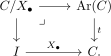
Recall that a limit of a diagram \(I\catop \to \Cat\) of categories may be computed as the category of cartesian sections of the cartesian unstraightening of the diagram. By definition, the functor \(C_{/-}\colon C\catop \to \Cat_{\infty}\) is the cartesian straightening of the target map \(t\colon \Ar(C) \to C\), so the unstraightening of \(C_{/-}\) is \(t\). It follows that the unstraightening of the functor \(i \mapsto C_{/X_i}\) is the base change of \(t\) along \(X_{\bullet}\): The category of sections \(I \to C/X_{\bullet}\) of this map is equivalent to the category of maps \(I \to \Ar(C)\) whose target projection is \(X_{\bullet}\colon I \to C\), which in turn is equivalent to the slice-category \(\Fun(I,C)_{/X_{\bullet}}\). It thus remains to show that a section \(\sigma\colon I \to C/X_{\bullet}\) is cartesian precisely if the corresponding natural transformation \(Y_{\bullet} \to X_{\bullet}\) is a cartesian natural transformation. But this is an immediate consequence of the fact that the \(t\)-cartesian morphisms in \(\Ar(C)\) are precisely the pullback squares in \(C\).