Construction 7.32.
Consider the functor
Let \(\Sigma_D\) be the largest congruence contained in the inverse image of the isomorphisms under this functor. More explicitly,
Every morphism of \(\Sigma_D\) is \(\infty\)-connected: the condition for \(n=0\) implies that every base change is a \(D\)-cover and hence an effective epimorphism, and the same applies to every diagonal.
Assume that \(\Sigma_D\) has small generation, so that it defines an accessible left exact localization. We define \(\Shv_{\tau_D}^+(C)\) by the pullback square
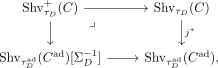
where the bottom functor is the fully faithful right adjoint of the localization. The top functor is likewise the fully faithful right adjoint of a left exact localization. The left vertical functor admits a left adjoint, and the pair
is a fractured topos.