7.4. Geometries from six-functor formalisms
Six-functor formalisms, developed systematically in [Scholze 2025], provide a categorification of classical cohomology theories. The key insight relevant to our discussion is that every six-functor formalism on a category with an admissibility structure canonically determines a topology, the \(D\)-topology, and hence gives rise to a geometric site and a fractured topos.
7.4.1. The D-topology
Let \(C\) be a category with finite limits and let \(C^{\ad}\subseteq C\) be an admissibility structure. A presentable six-functor formalism is a lax symmetric monoidal functor
A family \((X_i\to X)_i\) in \(C^{\ad}\) is a \(D\)-cover if it is a covering family for the canonical topology on \(C\) and satisfies universal \(!\)-descent: after every base change \(Y\to X\), the resulting family \((X_i\times_XY\to Y)_i\) satisfies descent for \(D^!\). The \(D\)-topology \(\tau_D\) is the topology whose covering families are the \(D\)-covers.
The triple \((C,C^{\ad},\tau_D)\) is a geometric site.
Proof
The functor
exhibits \(\Shv_{\tau_D}(C)\) as a complete fractured topos. In particular, it determines a geometric admissibility structure \(\Shv_{\tau_D}(C)^{\ad}\).
7.4.2. Passage to sheaves
Set \(\widetilde C:=\Shv_{\tau_D}(C)\). There are several natural candidates for the class of admissible morphisms in \(\widetilde C\), and they should not be identified without argument. We begin with the class directly controlled by the extension theorem.
A map \(f\colon Y\to X\) in \(\widetilde C\) is representably admissible if, for every map \(h_U\to X\) from a representable sheaf, the pullback \(Y\times_Xh_U\) is representable and the induced morphism to \(h_U\) comes from a morphism in \(C^{\ad}\). We write \(\widetilde C^{\ad}_0\) for the resulting admissibility structure.
Proposition 7.30. (Mann–Scholze)
The six-functor formalism \(D\) extends uniquely from \((C,C^{\ad})\) to \((\widetilde C,\widetilde C^{\ad}_0)\).
Proof
Marc stated in the lectures that \(D\) extends to the entire fracture-derived admissibility structure \(\Shv_{\tau_D}(C)^{\ad}\) of Corollary 7.28. No proof was given. The cited results establish the extension first for the representably admissible class \(\widetilde C_0^{\ad}\) and then for Scholze's minimal local enlargement \(\widetilde C_D^{\ad}\); they do not identify either class with \(\Shv_{\tau_D}(C)^{\ad}\).
Scholze constructs the further enlargement mentioned in the remark. More precisely, there is a minimal class \(\widetilde C_D^{\ad}\) containing \(\widetilde C_0^{\ad}\) which is stable under disjoint unions, local on the target, local on the source, and tame. The formalism extends to \((\widetilde C,\widetilde C_D^{\ad})\); see [Scholze 2025, Theorem 5.19].
7.4.3. A further congruence localization
The \(D\)-topology imposes descent along covering families. One may localize further by all morphisms which are universally invisible to \(D^!\). This second step need not arise from a Grothendieck topology.
Consider the functor
Let \(\Sigma_D\) be the largest congruence contained in the inverse image of the isomorphisms under this functor. More explicitly,
Every morphism of \(\Sigma_D\) is \(\infty\)-connected: the condition for \(n=0\) implies that every base change is a \(D\)-cover and hence an effective epimorphism, and the same applies to every diagonal.
Assume that \(\Sigma_D\) has small generation, so that it defines an accessible left exact localization. We define \(\Shv_{\tau_D}^+(C)\) by the pullback square
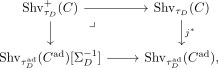
where the bottom functor is the fully faithful right adjoint of the localization. The top functor is likewise the fully faithful right adjoint of a left exact localization. The left vertical functor admits a left adjoint, and the pair
is a fractured topos.
There is a general formalism of fractured localization, in which a compatible localization of the corporeal topos induces a localization of the ambient topos and a new fracture. The preceding construction is an instance of this formalism.
The six-functor formalism descends further to a functor
Proof
The self-duality used in the proof is also the reason that universal \(!\)-descent implies universal \(*\)-descent. It is important here that descent is required after every base change: this makes the class compatible with composition of spans.
References
- Peter Scholze. Six-Functor Formalisms. 2025.
- Lucas Mann. A $p$-Adic 6-Functor Formalism in Rigid-Analytic Geometry. arXiv preprint arXiv:2206.02022. 2022.