7.3. Fractured topoi
A geometry produces two closely related sheaf topoi: the topos of all sheaves on the affine test objects, and the topos obtained by restricting to admissible morphisms. Lurie's notion of fractured topos abstracts the structure retained by such a pair. In the Zariski case, this is the structure behind the four equivalent descriptions encountered above: corporeal objects, admissible morphisms, factorization systems, and local morphisms of structured topoi.
A fractured topos is a topos \(E\) equipped with a functor \(j_!\colon E^{\corp} \to E\) satisfying the following properties:
The functor \(j_!\) is faithful and induces a fully faithful functor on groupoid cores.
The category \(E^{\corp}\) admits fiber products and \(j_!\) preserves them.
The functor \(j_!\) admits a right adjoint \(j^*\) which is conservative and preserves colimits.
For every morphism \(U \to V\) in \(E^{\corp}\), the commutative square
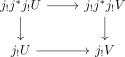
is a pullback square.
We refer to objects of \(E^{\corp}\), and to their images in \(E\), as corporeal objects. The functor \(j_!\) is generally not fully faithful. The fractured topos is called complete if every retract in \(E\) of a corporeal object is corporeal.
Let \((E,E^{\corp})\) be a fractured topos. Then:
The category \(E^{\corp}\) is a topos.
For every \(X\in E^{\corp}\), the functor
\[j_!\colon E^{\corp}_{/X}\longrightarrow E_{/j_!X}\]is fully faithful.
The topos \(E\) is generated under colimits by corporeal objects.
The functor \(j^*\) admits a right adjoint \(j_*\colon E^{\corp}\to E\), and the adjunction \(j^*\dashv j_*\) is a morphism of topoi.
Proof
We will now discuss how to construct fractured topoi.
7.3.1. Fractures from geometries
Let \((C,C^{\ad},\tau)\) be a geometric site. The category \(C^{\ad}\) inherits a topology \(\tau^{\ad}\): a sieve in \(C^{\ad}_{/X}\) is covering if its image generates a \(\tau\)-covering sieve in \(C_{/X}\). Restriction along \(j\colon C^{\ad}\hookrightarrow C\) defines a functor
Its left adjoint \(j_!\) is obtained by left Kan extension followed by sheafification.
The functor
exhibits \(\Shv_{\tau}(C)\) as a complete fractured topos.
Proof
Every geometry listed in Section 7.2 gives a fractured topos by this construction. For instance, the classical Zariski geometry gives the pair
which is the fractured topos underlying the topos-theoretic description of ordinary schemes above.
Let \((E,E^{\corp})\) be a fractured topos. A morphism \(f\colon Y\to X\) in \(E\) is admissible if, for every map \(j_!U\to X\) with \(U\in E^{\corp}\), the pullback
belongs to the image of \(E^{\corp}_{/U}\to E_{/j_!U}\). This determines a wide subcategory \(E^{\ad}\subseteq E\).
Let \(E\) be a topos. An admissibility structure \(E^{\ad}\) is called local if the following conditions are satisfied:
The class \(E^{\ad}\) is a local class of maps.
For every \(X \in E\), the slice \(E^{\ad}_{/X} := (E^{\ad})_{/X}\) is presentable, and the inclusion \(E^{\ad}_{/X} \to E_{/X}\) preserves colimits. In particular, it admits a right adjoint \(\rho_X\colon E_{/X} \to E^{\ad}_{/X}\).
Given a local admissibility structure on \(E\), we say that an object \(X \in E\) is corporeal if the functor \(\rho_X\colon E_{/X} \to E^{\ad}_{/X}\) preserves colimits. We denote by
the full subcategory spanned by the corporeal objects. We say that \(E^{\ad}\) is geometric if, moreover, \(E\) is generated under colimits by corporeal objects.
Let \(E\) be a topos. The assignments \((E,E^{\corp}) \mapsto (E,E^{\ad})\) and \((E,E^{\ad}) \mapsto (E,E^{\corp})\) determine an equivalence of posets
Proof
7.3.2. Local maps
Consider a fractured topos \((E,E^{\corp})\). Consider two morphisms of topoi \(f,g\colon T \to E\), and let \(\alpha\colon f^* \to g^*\) be a natural transformation. We say that \(\alpha\) is local if for every morphism \(h\colon U \to V\) in \(E^{\corp}\), the following square is a pullback square:
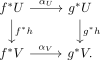
This determines a collection of maps in \(\Geom(T,E)\) which is the right class of a factorization system on \(\Geom(T,E)\). We denote by
the wide subcategory consisting of those morphisms corresponding to maps \(S \to T\) with a local natural transformation \(\alpha\) of morphisms \(S \to E\).
For \(E = \PSh(\CRing^{\mathrm{fp},\op})\), the lax slice \(\Topos_{//E}\) is the category of ringed topoi. For \(E = \Shv_{\Zar}(\CRing^{\mathrm{fp},\op})\), the lax slice \(\Topos_{//E}\) is the full subcategory of the previous one spanned by the locally ringed topoi. Here, the fracture \(E^{\corp} = \Shv_{\Zar}(\CRing^{\mathrm{fp}, \ad, \op}) \to E\) determines the subcategory \((\Topos_{//E})^{\loc}\) consisting of the local morphisms of locally ringed topoi.
We now explain how to recover the notion of schemes from the notion of local morphisms.
Let \((E,E^{\corp})\) be a complete fractured topos. Consider the functor
If \(X\) is corporeal, then \(\Gamma^X\) is representable by the pair \((E^{\ad}_{/X}, E^{\ad}_{/X} \hookrightarrow E_{/X} \to E)\).
The resulting functor
\[E^{\corp} \xrightarrow{\mathrm{Re}} \Topos^{\loc}_{//E}\]is fully faithful.
A morphism \(f\colon Y \to X\) in \(E\) is admissible if and only if, after every base change \(f'\colon Y'\to X'\) for which \(\Gamma^{X'}\) is represented by an object of \(\Topos^{\loc}_{//E}\), the functor \(\Gamma^{Y'}\) is represented by an object étale over it.
Combining these statements, it follows that the subcategory \(\Topos^{\loc}_{//E}\subseteq \Topos_{//E}\) determines the fracture structure on \(E\).
Proof
7.3.3. Schemes
In Section 7.1, we provided a topos-theoretic perspective on the classical notion of a scheme. We may extend this definition to an arbitrary geometric site \(\Gg = (C,C^{\ad},\tau)\).
Consider the fractured topos \(E = \Shv_{\tau}(C)\), \(E^{\corp} := \Shv_{\tau}(C^{\ad})\). By Theorem 7.21, we obtain a functor
An object \(f\colon T\to E\) is sent to the pro-object classified by the left exact functor
The functor \(\Gamma\) admits a right adjoint
called the spectrum functor. If \(\tau\) is subcanonical, then \(\Spec_{\Gg}\) is fully faithful. See [Lurie 2011, Chapter 2] for this structured-topos formulation of the spectrum construction.
We define the subcategory
of \(\Gg\)-schemes as the full subcategory on those objects which are locally in the image of \(\Spec_{\Gg}\). Concretely, a \(\Gg\)-scheme admits a jointly surjective family of étale morphisms from affine objects \(\Spec_{\Gg}(A)\) with \(A\in\Pro(C)\).
Does this category depend only on the fractured topos \((E,E^{\corp})\), or is the choice of geometric site important?
References
- Jacob Lurie. Spectral Algebraic Geometry. under construction (version dated February 2018), www.math.ias.edu/~lurie/papers/SAG-rootfile.pdf. 2018.
- Jacob Lurie. Derived algebraic geometry V: Structured spaces. 2011.