Let \(C\) be an accessible category with weakly contractible colimits. If \(C\) is stable, then it is a locus.
Proof
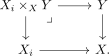
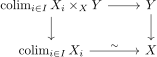
Let \(C\) be a stable accessible category with weakly contractible colimits. It has all finite limits, so in particular pullbacks. First, weakly contractible colimits are universal. Given a map \(Y \to X = \colim_{i \in I} X_i\), form the pullback squares Since pullback squares agree with pushout squares, they are closed under colimits, so the induced square is still a pullback square. In particular, the top map is an isomorphism.It remains to verify the full van Kampen condition. Let \(X\colon I\to C\) with \(I\) weakly contractible. A cartesian transformation \(Y\to X\) determines cofiber sequences
\[Y_i\longrightarrow X_i\longrightarrow K_i.\]
Since every naturality square is a pullback and hence also a pushout, every map \(K_i\to K_j\) is an isomorphism. Thus \(K\colon I\to C\) factors through the maximal anima of \(C\). Since \(\abs I\) is contractible, \(K\) is uniquely equivalent to a constant diagram. Consequently, cartesian transformations \(Y\to X\) are equivalently pairs consisting of an object \(K\in C\) and a map \(X\to\const_K\). Taking colimits identifies these with pairs \((K,\colim_I X\to K)\), which in turn are equivalent, by taking fibers, to objects of \(C_{/\colim_I X}\). Hence