Let \(C\) be a category with pullbacks and weakly contractible colimits. Then the following conditions are equivalent:
The category \(C\) is a locus;
The category \(\int_{\An} C\) is a topos;
For every topos \(T\), the category \(\int_T C\) is a topos.
Moreover, the following conditions are equivalent to each other:
The category \(C\) is a locus in which every map is an effective epimorphism;
There exists a topos \(T\) such that \(C = T^{\geq \infty}\).
There exists a topos \(T\) such that \(T_{\leq \infty} = \An\) and \(T^{\geq \infty} = C\).
Proof
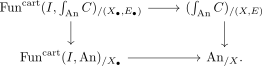
We momentarily assume the equivalence between (1)–(3) and deduce the equivalence between (4)–(6). It is clear that (6) implies (5), while (5) implies (4) by Lemma 6.176. Assume (4), and set \(T=\int_{\An}C\), which is a topos by (2). The terminal object of \(T\) lies over \(*\in\An\), and therefore determines a terminal object \(*\in C\). Since every map in \(C\) is an effective epimorphism, every truncated object of \(C\) is terminal. Indeed, for a \(0\)-truncated object the diagonal is both a monomorphism and an effective epimorphism, hence an isomorphism, and the claim follows; the general case follows inductively by applying the same argument to iterated diagonals.The projection \(\pi\colon T\to\An\) has a fully faithful right adjoint \(r(A)=(A,\const_*)\). For every \((A,X)\in T\), the map \((A,X)\to r(A)\) is \(\infty\)-connected: its iterated diagonals are computed in \(C\), where every map is an effective epimorphism. Hence \(r(A)\) is the hypercompletion of \((A,X)\). It follows that \(T_{\leq\infty}\simeq\An\). Moreover, \((A,X)\) is \(\infty\)-connected precisely when \(A\simeq *\), so the fiber \(C\) over \(*\) identifies with \(T^{\geq\infty}\). This proves (6).For the equivalence of (1)–(3), first note that (2) is equivalent to (3), since \(\int_T C = T \otimes \int_{\An} C\), where the right-hand side is the product of topoi if \(\int_{\An}C\) is a topos. For (2) \(\implies\) (1), the projection \(\int_{\An}C\to\An\) is an accessible functor between presentable categories and \(C\) is its fiber over \(*\). Thus Corollary 6.171 applies. It remains to show that (1) implies (2).Choose a regular cardinal \(\kappa\) for which \(C\) is \(\kappa\)-accessible and its weakly contractible colimit operations are accessible. The usual accessibility argument for Grothendieck constructions shows that \(\int_{\An}C\) is generated under \(\kappa\)-filtered colimits by pairs \((A,X)\) with \(A\)\(\kappa\)-compact and \(X\) taking values in a small subcategory of \(\kappa\)-compact objects of \(C\). Hence \(\int_{\An}C\) is accessible. It has all colimits by Proposition 6.162, so it is presentable. It remains to show that its colimits are van Kampen.Consider a diagram \((X_{\bullet}, E_{\bullet}) \colon I \to \int_{\An}C\), where \(X_i \in \An\) and \(E_i \in \Fun(X_i, C)\). We need to show that the functor \(\colim \colon \Fun^{\cart}(I,\int_{\An}C)_{/(X_{\bullet}, E_{\bullet})} \to (\int_{\An}C)_{/(X,E)}\) is an equivalence. Note that this functor fits in a commutative diagram as follows: The vertical two maps are cartesian fibrations and the bottom map is an equivalence, so it will suffice to show that the top map induces equivalences on fibers.Note that \((\int_{\An}C)_{/(X,E)} \simeq \lim_{x \in X} (\int_{\An}C)_{/(*,E_x)}\), so it will suffice to prove the claim when \(X = *\). In that case \(\An_{/X} \simeq \An\). Given \(Y \in \An\), the map on fibers over \(Y\) is identified with a limit over \(y \in Y\) of copies of the following map
and it remains to show this is an equivalence. Rewriting the left-hand side as a limit over the category of elements \(\El(X_{\bullet})\), the map becomes
The realization of \(\El(X_{\bullet})\) is \(X\simeq *\), so this indexing category is weakly contractible. The map is therefore an equivalence by the van Kampen condition in \(C\). This proves (1)–(3); compare [Hoyois 2019, Corollary 5].
References
Marc Hoyois. Topoi of parametrized objects. Theory Appl. Categ., 34, 243–248. 2019.