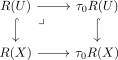
Let \(U \hookrightarrow X\) be a monomorphism. Then also \(\tau_0 U \hookrightarrow \tau_0 X\) is a monomorphism, and the square
is a pullback square.
Proof
Choose a left exact localization \(L\colon \PSh(C) \to T\) with fully faithful right adjoint \(R\colon T \hookrightarrow \PSh(C)\), as in Theorem 2.42. Since \(R\) preserves limits, the map \(R(U) \to R(X)\) is again a monomorphism. Truncation and limits in the presheaf topos are computed pointwise. For every \(c \in C\), the monomorphism of animae
\[R(U)(c) \hookrightarrow R(X)(c)\]
is the inclusion of a union of connected components. Consequently, \(\tau_0R(U)(c) \to \tau_0R(X)(c)\) is a monomorphism and the corresponding naturality square is a pullback. It follows pointwise that the square is a pullback in \(\PSh(C)\). Applying the left exact functor \(L\) preserves this pullback square and the monomorphism on the right. Moreover, Lemma 3.8 identifies \(L\tau_0R(U)\) and \(L\tau_0R(X)\) with \(\tau_0U\) and \(\tau_0X\), respectively. This gives the asserted square in \(T\).