3.2. Connectivity
Complementary to the \(n\)-truncated morphisms are the \(n\)-connected morphisms. Truncated morphisms have no homotopy above degree \(n\), while connected morphisms become terminal after discarding homotopy above degree \(n\). We formulate this using relative truncation, identify the resulting orthogonality relation, and obtain the connected–truncated factorization system.
Let \(T\) be a topos, and let \(n \geq -2\).
We say that \(X \in T\) is \(n\)-connected if \(\tau_n X = *\).
We say \(f \colon X \to Y\) is \(n\)-connected if it is \(n\)-connected in \(T_{/Y}\).
We denote by \(T^{\geq n+1}\) the full subcategory of \(T\) spanned by the \(n\)-connected objects.
In the classical algebraic topology literature, what we call an \(n\)-connected morphism is often called \((n-1)\)-connected. Our indexing is chosen so that \(n\)-connected and \(n\)-truncated morphisms form complementary classes with the same index, and so that the definition applies unchanged in every slice topos.
Note that every object is \((-2)\)-connected. The universal property of relative truncation gives the complementary orthogonality description. Namely, \(f\colon X \to Y\) is \(n\)-connected if and only if for every solid commutative diagram of the form

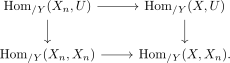
where \(g\) is \(n\)-truncated, the anima of diagonal fillers is contractible. Indeed, this anima is the fiber of
over the given map \(X \to U\). Since \(U \to Y\) is \(n\)-truncated, the universal property of \(\tau_n(X/Y)\) identifies the target with \(\Hom_{/Y}(\tau_n(X/Y),U)\). Thus the filler animae are contractible for all such \(U\) precisely when the map \(\tau_n(X/Y) \to Y\) induces equivalences into every \(n\)-truncated object. Since both its source and target are \(n\)-truncated in \(T_{/Y}\), Yoneda identifies this condition with \(\tau_n(X/Y) \iso Y\).
Let \(T\) be a topos.
The pair (\(n\)-connected, \(n\)-truncated) forms a factorization system on \(T\).
The \(n\)-connected maps are stable under base change.
A map \(f\colon X \to Y\) is \(n\)-connected if and only if the functor \(f^*\colon (T_{/Y})_{\leq n} \to (T_{/X})_{\leq n}\) is fully faithful.
Proof

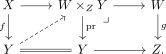

Consider a pullback square in a topos

in which \(g\) is an effective epimorphism. Then, for every \(n \geq -2\), the morphism \(f\) is \(n\)-truncated (resp. \(n\)-connected) if and only if \(f'\) is \(n\)-truncated (resp. \(n\)-connected).
Proof
A morphism is \((-1)\)-connected if and only if it is an effective epimorphism.
Proof
Every pointed object \(X \in T_*\) is \((-1)\)-connected.