A.1. Factorization systems
We begin with the definition of orthogonality.
Let \(C\) be a category. A morphism \(l \colon A \to B\) is said to be left orthogonal to a morphism \(r \colon X \to Y\), written \(l \perp r\), if the following square is a pullback square:
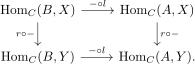
Equivalently, for every commutative square

the anima of dashed fillers making both triangles commute is contractible. In this case, we also say that \(r\) is right orthogonal to \(l\).
Given a collection of morphisms \(S\), we denote by \(S^\perp\) the collection of all morphisms that are right orthogonal to every morphism in \(S\), and by \({}^\perp S\) the collection of those that are left orthogonal to every morphism in \(S\).
A factorization system on a category \(C\) consists of two classes of morphisms \(L\) and \(R\) of \(C\) satisfying the following two conditions:
Existence of factorization: Every morphism \(f\colon A\to B\) in \(C\) admits a factorization
\[A\xrightarrow{l}X\xrightarrow{r}B\]with \(l\in L\) and \(r\in R\).
Orthogonality: Every morphism \(l \in L\) is left orthogonal to every morphism \(r \in R\).
The classes of maps in a factorization system satisfy various useful closure properties.
Let \((L,R)\) be a factorization system on \(C\).
We have \(L = {}^{\perp}R\) and \(R = L^{\perp}\).
The classes \(L\) and \(R\) are closed under composition and contain all isomorphisms.
The classes \(L\) and \(R\) are closed under retracts.
The class \(R\) is closed under base change (pullbacks).
The class \(L\) is closed under cobase change (pushouts).
The class \(R\) has the left cancellation property: if \(g \circ f \in R\) and \(g \in R\), then \(f \in R\).
The class \(L\) has the right cancellation property: if \(g \circ f \in L\) and \(f \in L\), then \(g \in L\).
If \(C\) admits small limits, the class \(R\) is closed under small limits in \(\Ar(C)\).
If \(C\) admits small colimits, the class \(L\) is closed under small colimits in \(\Ar(C)\).
Proof
Let \((L,R)\) be a factorization system on \(C\). Any morphism \(f\colon X \to Y\) which is both in \(L\) and in \(R\) is an isomorphism.
Proof

Let \((L,R)\) be a factorization system on \(C\), and consider morphisms \(X \xrightarrow{f} Y \xrightarrow{g} Z\).
Assume \(C\) admits pullbacks. If \(gf \in R\) and \(\Delta_g \in R\), then \(f \in R\).
Assume \(C\) admits pushouts. If \(gf \in L\) and \(\nabla_f \in L\), then \(g \in L\).
Proof
Lemma A.6. ([Anel et al. 2022, Lemma 3.1.8])
Let \((L,R)\) be a factorization system on a category \(C\). Then for every object \(X \in C\) the slice \(C_{/X}\) admits a factorization system in which a morphism lies in the left, resp. right, class if and only if its underlying morphism in \(C\) lies in \(L\), resp. \(R\).
Proof
Let \((L,R)\) be a factorization system on \(C\).
Let \(\Ar^R(C) \subseteq \Ar(C)\) denote the full subcategory spanned by the morphisms in \(R\). Then the inclusion \(\Ar^R(C) \hookrightarrow \Ar(C)\) admits a left adjoint. Given a morphism \(f\colon A \to B\) with factorization \(A \xrightarrow{l} C \xrightarrow{r} B\), this left adjoint sends \(f\) to \(r\).
Similarly, the inclusion \(\Ar^L(C) \hookrightarrow \Ar(C)\) of the morphisms in \(L\) admits a right adjoint, sending \(f\) to \(l\).
For every object \(X\in C\), let \(R[X]\subseteq C_{/X}\) be the full subcategory spanned by the morphisms in \(R\). Then \(R[X]\) is reflective in \(C_{/X}\), and the reflection sends a morphism \(f\colon A\to X\) to its right factor \(r\colon C\to X\).
Proof

References
- Jacob Lurie. Higher topos theory. Ann. Math. Stud. 170, Princeton, NJ: Princeton University Press. 2009.
- Mathieu Anel, Georg Biedermann, Eric Finster, André Joyal. Left-exact localizations of ∞-topoi. I: Higher sheaves. Adv. Math., 400, 64. 2022.