Proposition 14.3.6. Let \(L\colon C \to D\) be a symmetric monoidal functor between symmetric monoidal \(\infty \)-categories. Assume that \(L\) (as a plain functor from \(C\) to \(D\)) admits a right adjoint \(R\colon D \to C\). Then the following statements hold:
- (1)
-
The functor \(L^{\otimes }\colon C^{\otimes } \to D^{\otimes }\) admits a right adjoint \(R^{\otimes }\colon D^{\otimes } \to C^{\otimes }\).
- (2)
-
The functor \(R^{\otimes }\) has a canonical structure as a functor over \(\Span (\Fin )\) for which \(L^{\otimes }\dashv R^{\otimes }\) is a relative adjunction over \(\Span (\Fin )\).
- (3)
-
With this structure, \(R^{\otimes }\) defines a morphism of \(\infty \)-operads from \(\Mm _D\) to \(\Mm _C\).
- (4)
-
The underlying functor of this operad map is \(R\colon D \to C\).
In particular, the right adjoint of a symmetric monoidal functor is canonically lax symmetric monoidal.
Proof. (1) By the pointwise criterion for right adjoints from Lemma 21.1.4, it will suffice to show that for every object \(Y = \{y_j\}_{j \in J} \in D^{\otimes }\) there exists an object \(R^{\otimes }Y\) together with a counit map \(\epsilon _Y\colon L^{\otimes }R^{\otimes }Y \to Y\) such that for every other \(X \in C^{\otimes }\) the composite \begin {equation} \label {eq:Monoidal_Adjunction} \Hom _{C^{\otimes }}(X,R^{\otimes }Y) \xrightarrow {L^{\otimes }} \Hom _{D^{\otimes }}(L^{\otimes }X,L^{\otimes }R^{\otimes }Y) \xrightarrow {\epsilon _Y \circ -} \Hom _{D^{\otimes }}(L^{\otimes }X,Y) \end {equation} is an equivalence. We define \(R^{\otimes }Y := \{Ry_j\}_{j \in J}\). We then have \(L^{\otimes }R^{\otimes }Y \simeq \{LRy_j\}_{j \in J}\) and so the counit map \(\epsilon _Y\) may be taken to be the collection of morphisms \(\epsilon _{y_j}\colon LRy_j \to y_j\), resulting in a morphism in \(D^{\otimes }_J \simeq \prod _{j \in J} D\).
To show that the composite (14.1) is an equivalence, it suffices to show that it induces an equivalence on the fibers over any span \(\alpha \colon I \xleftarrow {f} K \xrightarrow {g} J\) in \(\Span (\Fin )\). Let \(\widetilde {\alpha }\colon X \to \alpha _!X\) denote a cocartesian lift of the span \(\alpha \). Since \(L^{\otimes }\) preserves cocartesian morphisms, also the map \(L^{\otimes }(\widetilde {\alpha }) \colon L^{\otimes }X \to L^{\otimes }\alpha _!X\) is cocartesian. Precomposition with these maps then induces a commutative diagram

Since the vertical maps induce equivalences on fibers over \(\Hom _{\Span (\Fin )}(J,J) \xrightarrow {- \circ \alpha } \Hom _{\Span (\Fin )}(I,J)\), we have thus reduced to the case of the identity span \(\alpha = \id _J\). In this case, the fibers are the hom animae in the fibers \(C^{\otimes }_J \simeq \prod _{j \in J} C\) and \(D^{\otimes }_J \simeq \prod _{j \in J} D\) respectively. The claim thus follows from the fact that for every \(j \in J\) the composite \[ \Hom _C((\alpha _!X)_j, Ry_j) \xrightarrow {L} \Hom _D(L(\alpha _!X)_j, LRy_j) \xrightarrow {\epsilon _{y_j} \circ -} \Hom _D(L(\alpha _!X)_j, y_j) \] is an equivalence due to the adjunction \(L \dashv R\).
(2) We will now equip \(R^{\otimes }\) with the structure of a functor over \(\Span (\Fin )\). We claim that it makes the following diagram commute:
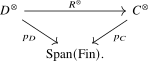
To this end, we claim that the adjunction counit \(\epsilon \colon L^{\otimes } R^{\otimes } \to \id _{D^{\otimes }}\) induces an equivalence \[ p_C R^{\otimes } \simeq p_D L^{\otimes } R^{\otimes } \xrightarrow {p_D \epsilon } p_D \id _{D^{\otimes }} \simeq p_D. \] This may be checked objectwise for \(X \in D^{\otimes }\), where it is clear from the construction of \(\epsilon _X\). The displayed identification equips \(R^{\otimes }\) with the structure of a functor over \(\Span (\Fin )\) and lifts \(\epsilon \) to a morphism in \(\Fun _{/\Span (\Fin )}(D^{\otimes },D^{\otimes })\). Thus \(L^{\otimes }\dashv R^{\otimes }\) is a relative adjunction over \(\Span (\Fin )\) by Definition 14.3.3.
(3) The functor \(R^{\otimes }\) preserves finite products because it is a right adjoint. Thus \(R^{\otimes }\) is an operad map.
(4) By uniqueness of adjoints, the restriction of \(R^{\otimes }\) to \(D = D^{\otimes }_{\lra {1}}\) is \(R\), and we deduce that \(R^{\otimes }\) is a lax symmetric monoidal refinement of \(R\). □
Generated from the authoritative LaTeX source.