Lemma 21.1.4. Consider a functor \(F\colon C \to D\) and let \(D_R \subseteq D\) be a full subcategory. Assume that for every \(Y \in D_R\) there exists a right adjoint object \(Z\) to \(Y\) under \(F\). Then these right adjoint objects assemble into a functor \(G\colon D_R \to C\) which comes equipped with a natural isomorphism \[ \Hom _D(F(-),-) \cong \Hom _C(-,G(-)) \] of functors \(C\catop \times D_R \to \An \).
Dually, if \(D_L \subseteq D\) is a subcategory such that every \(Y \in D_L\) admits a left adjoint object under \(F\), then these left adjoint objects assemble into a functor \(L\colon D_L \to C\) that comes equipped with a natural isomorphism \[ \Hom _C(L(-),-) \cong \Hom _{D}(-,F(-)) \] of functors \(D_L\catop \times C \to \An \).
Proof. We will prove the claim for right adjoints; the claim for left adjoints is dual. The assumption on \(F\) is that for every \(Y\) in \(D_R\) the functor \(\Hom _D(F(-),Y) \colon C\catop \to \An \) is representable, in the sense that it lies in the image of the Yoneda embedding \(Y\colon C \hookrightarrow \Fun (C\catop ,\An )\). Since the Yoneda embedding is fully faithful, this means there exists a functor \[ G \colon D_R \to C \] making the following diagram commute:
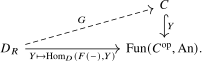
Here the bottom functor is the one obtained from currying the functor \(\Hom _D(F(-),-)\colon C\catop \times D_R \to \An \). Since \(Y(X) = \Hom _C(-,X)\), this commutative triangle precisely encodes a natural isomorphism \[ \Hom _D(F(-),-) \cong \Hom _{C}(-,G(-)) \] of functors \(C\catop \times D_R \to \An \), as desired. □
Generated from the authoritative LaTeX source.