Slice categories organize morphisms with a fixed source or target, and provide the indexing categories for the pointwise formulas for Kan extensions and cofinality used in the next two sections. We begin with the relative construction.
Definition 21.3.1 (Slice category). Let \(C\) be an \(\infty \)-category and let \(x\) be an object in \(C\). We define the slice categories \(C_{/x}\) and \(C_{x/}\), also known as the over category and the under category, respectively, via the following two pullback squares:


Note that an object of \(C_{/x}\) is a pair \((y,f\colon y \to x)\) of an object \(y\) equipped with a morphism to \(x\), and dually objects of \(C_{x/}\) are pairs \((y,f\colon x \to y)\). As a result of Proposition 1.4.4 morphisms \((y,f) \to (y',f')\) in \(C_{/x}\) may equivalently be encoded by commutative triangles of the form

and dually for morphisms in \(C_{x/}\).
We denote by \[ s\colon C_{/x} \to C \qquadtext { and } t\colon C_{x/} \to C \] the assignments \(s(y,f\colon y \to x) = y\) and \(t(y,f\colon x \to y) = y\), i.e. we first include the slice into the arrow category \(\Ar (C)\) and then apply the source/target functor.
Lemma 21.3.2. Consider an object \(x\) of \(C\) and consider two objects \((y,f)\) and \((y',f')\) of the slice category \(C_{/x}\). Then the hom anima in \(C_{/x}\) sits in a pullback square of the form
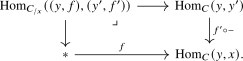
A dual formula holds for the hom animae of \(C_{x/}\).
Proof. By Chapterexercise 1.4, the hom anima in \(C_{/x}\) may be computed as the following pullback:

Using the equivalence \(\Fun ([1] \times [1],C) \simeq \Fun ([2],C) \times _{\Ar (C)} \Fun ([2],C)\) from the commutative square axiom, the top right hom anima in \(\Ar (C)\) sits in a pullback square as follows:
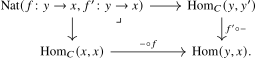
The claim thus follows by pasting pullback squares. □
Corollary 21.3.3. Let \(x\) be an object of \(C\). Then the slice category \(C_{/x}\) admits a terminal object \((x,\id _x)\), while \(C_{x/}\) admits an initial object \((x,\id _x)\).
Proof. The claim for \(C_{x/}\) is immediate from Lemma 21.3.2, since for every \((y, f) \in C_{/x}\) the induced map \(\id _x \circ -\colon \Hom _C(y,x) \to \Hom _C(y,x)\) is an equivalence, hence its fiber over \(f\) is contractible. The claim for \(C_{/x}\) is dual. □
Lemma 21.3.4. Let \(x\) be an object in an \(\infty \)-category \(C\).
- (1)
-
The object \(x\) is terminal in \(C\) if and only if the forgetful functor \(s\colon C_{/x} \to C\) is an equivalence;
- (2)
-
The object \(x\) is initial in \(C\) if and only if the forgetful functor \(t\colon C_{x/} \to C\) is an equivalence.
Proof. We only prove (1); the case of (2) is dual. If \(C_{/x} \to C\) is an equivalence, then it follows from Corollary 21.3.3 that \(x\) is terminal in \(x\), as it is the image under this equivalence of the terminal object \((x,\id _x) \in C_{/x}\). So assume that \(x\) is a terminal object. By Remark 21.2.3, this means that the functor \(x\colon * \to C\) is a right adjoint to \(p_C\colon * \to C\), and in particular there is a natural transformation \(\epsilon \colon \id _C \to \const _x\) satisfying the triangle identity. We may now construct a functor \[ \phi \colon C \to C_{/x}, \qquad y \mapsto (y, \epsilon _y\colon y \to x). \] More precisely, we may think of \(\epsilon \) as a functor \(\overline {\epsilon }\colon C \to \Ar (C)\), and since the target of \(\epsilon \) is \(\const _x\) we see that \(\overline {\epsilon }\) canonically factors through the slice \(C_{/x}\). It is also clear from this definition that we have \(s \circ \phi \cong \id _C\). It remains to show that we also have \(\phi \circ s \cong \id _{C_{/x}}\).
The functor \(\overline {\epsilon }\colon C \to \Ar (C)\) induces a functor \(\overline {\epsilon }_*\colon \Ar (C) \to \Fun ([1] \times [1],C)\), which informally speaking sends a morphism \(f\colon y \to z\) to the ‘naturality square’ induced by \(\epsilon \):

Note that for \(z = x\), it follows from the triangle identities for the adjunction that the map \(\epsilon _x\colon x \to x\) is the identity map. So restricting the naturality square to objects of the form \((y,f) \in C_{/x}\), this square takes the form

This shows that the object \((y,f)\) of \(C_{/x}\) is naturally isomorphic to \((y, \epsilon _y\colon y \to x)\), producing the desired natural isomorphism \(\phi \circ s \cong \id _{C/x}\). □
Definition 21.3.5 (Relative slice category). For a functor \(F\colon C \to D\) and an object \(d\) of \(D\), we define the relative slice categories \(C_{/d}\) and \(C_{d/}\) via the following two pullback squares:


Objects of \(C_{/d}\) consist of pairs \((y,f\colon F(y) \to d)\), and objects of \(C_{d/}\) consist of pairs \((y,f\colon d\to F(y))\).
Remark 21.3.6. These relative slice categories are sometimes also denoted by \(F/d\) and \(d/F\), which makes their dependencies on \(F\) more transparent.
Generated from the authoritative LaTeX source.