This section recalls the definition of an adjunction and develops the characterizations by units, counits, and adjoint objects that will be used throughout the book. We begin with the Hom-isomorphism formulation from Definition 1.8.13:
Definition 21.1.1. Let \(F\colon C \to D\) and \(G \colon D \to C\) be two functors. An adjunction between \(C\) and \(D\) consists of a natural isomorphism \[ \Hom _D(F(-),-) \cong \Hom _C(-,G(-)) \] of functors \(C\catop \times D \to \An \). We often write \(F \dashv G\) to indicate that such an isomorphism has been given.
Proposition 21.1.2. Consider two functors \(F\colon C \to D\) and \(G \colon D \to C\). The following data are equivalent:
- (1)
-
The data of an adjunction \(F \dashv G\);
- (2)
-
The data of a natural transformation \(\eta \colon \id _C \to GF\), called the unit, such that for all objects \(X\) of \(C\) and \(Y\) of \(D\) the induced map \[ \Hom _D(FX,Y) \xrightarrow {G} \Hom _C(GFX,GY) \xrightarrow {- \circ \eta _X} \Hom _C(X,GY) \] is an equivalence;
- (3)
-
The data of a natural transformation \(\epsilon \colon FG \to \id _D\), called the counit, such that for all objects \(X\) of \(C\) and \(Y\) of \(D\) the induced map \[ \Hom _C(X,GY) \xrightarrow {F} \Hom _D(FX,FGY) \xrightarrow {\epsilon _Y \circ -} \Hom _D(FX,Y) \] is an equivalence;
- (4)
-
The data of both a unit \(\eta \colon \id \to GF\) and a counit \(\epsilon \colon FG \to \id \) together with commutative triangles as follows, called the triangle identities:1


Proof sketch. First assume (1), so that there is a natural equivalence \(\Hom _D(FX,Y) \simeq \Hom _C(X,GY)\). If we fix \(X \in C\), then by the Yoneda lemma the natural transformation \(\Hom _D(FX,-) \iso \Hom _D(X,G(-))\) corresponds to a map \(\eta _X \colon X \to GFX\): we obtain this map by taking \(Y = FX\) and letting \(\eta _X\) be the map that under this equivalence corresponds to the identity map \(\id _{FX}\colon FX \to FX\). Conversely, the map \(\eta _X\) determines the transformation as the composite \[ \Hom _D(FX,-) \xrightarrow {G} \Hom _C(GFX,G(-)) \xrightarrow {- \circ \eta _X} \Hom _C(X,-). \] The naturality of the equivalence in \(X\) corresponds to the naturality of \(\eta \colon \id _C \to GF\), showing the equivalence between (1) and (2).
The equivalence between (1) and (3) is proved similarly, where now the counit map \(\epsilon _Y\colon FGY \to Y\) corresponds to the identity map \(\id _{GY}\colon GY \to GY\).
To show that these conditions are also equivalent to (4), assume first that (1)-(3) are satisfied. For the first triangle identity, observe that by definition the map \(\eta _X\colon X \to GFX\) is a preimage of \(\id _{FX}\colon FX \to FX\) under the equivalence \[ \Hom _C(X,GFX) \xrightarrow {F} \Hom _D(FX,FGFX) \xrightarrow {\epsilon _{FX} \circ -} \Hom _D(FX,FX). \] This precisely says that the composite \(\epsilon _{FX} \circ F\eta _X\) is equivalent to \(\id _{FX}\), naturally in \(X\), which is the first triangle identity. The second triangle identity similarly follows from the fact that the morphism \(\epsilon _Y\colon FGY \to Y\) is a preimage of \(\id _{GY}\colon GY \to GY\) under the equivalence \[ \Hom _D(FGY,Y) \xrightarrow {G} \Hom _C(GFGY,GY) \xrightarrow {- \circ \eta _{GY}} \Hom _C(GY,GY). \] Finally, assume that (4) is satisfied. An easy check shows that in this case the map defined in (2) is inverse to the map defined in (3), producing the desired natural equivalence \(\Hom _D(FX,Y) \simeq \Hom _C(X,GY)\). □
It turns out that we may detect left/right functors ‘objectwise’:
Definition 21.1.3. Let \(F\colon C \to D\) be a functor and let \(Y\) be an object of \(D\).
- (1)
-
An object \(Z\) of \(C\) is called a right adjoint object to \(Y\) under \(F\) if it comes equipped with a map \(\epsilon _Y\colon FZ \to Y\) such that for every other object \(X\) of \(C\) the induced map \[ \Hom _C(X,Z) \xrightarrow {F} \Hom _D(FX,FZ) \xrightarrow {\epsilon _Y \circ -} \Hom _D(FX,Y) \] is an equivalence of animae.
- (2)
-
Dually, \(Z\) is called a left adjoint object to \(Y\) under \(F\) if it comes equipped with a map \(\eta _Y\colon Y \to FZ\) such that for every other object \(X\) of \(C\) the induced map \[ \Hom _C(Z,X) \xrightarrow {F} \Hom _D(FZ,FX) \xrightarrow {- \circ \eta _Y} \Hom _D(Y,FX) \] is an equivalence of animae.
Lemma 21.1.4. Consider a functor \(F\colon C \to D\) and let \(D_R \subseteq D\) be a full subcategory. Assume that for every \(Y \in D_R\) there exists a right adjoint object \(Z\) to \(Y\) under \(F\). Then these right adjoint objects assemble into a functor \(G\colon D_R \to C\) which comes equipped with a natural isomorphism \[ \Hom _D(F(-),-) \cong \Hom _C(-,G(-)) \] of functors \(C\catop \times D_R \to \An \).
Dually, if \(D_L \subseteq D\) is a subcategory such that every \(Y \in D_L\) admits a left adjoint object under \(F\), then these left adjoint objects assemble into a functor \(L\colon D_L \to C\) that comes equipped with a natural isomorphism \[ \Hom _C(L(-),-) \cong \Hom _{D}(-,F(-)) \] of functors \(D_L\catop \times C \to \An \).
Proof. We will prove the claim for right adjoints; the claim for left adjoints is dual. The assumption on \(F\) is that for every \(Y\) in \(D_R\) the functor \(\Hom _D(F(-),Y) \colon C\catop \to \An \) is representable, in the sense that it lies in the image of the Yoneda embedding \(Y\colon C \hookrightarrow \Fun (C\catop ,\An )\). Since the Yoneda embedding is fully faithful, this means there exists a functor \[ G \colon D_R \to C \] making the following diagram commute:
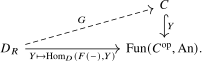
Here the bottom functor is the one obtained from currying the functor \(\Hom _D(F(-),-)\colon C\catop \times D_R \to \An \). Since \(Y(X) = \Hom _C(-,X)\), this commutative triangle precisely encodes a natural isomorphism \[ \Hom _D(F(-),-) \cong \Hom _{C}(-,G(-)) \] of functors \(C\catop \times D_R \to \An \), as desired. □
Corollary 21.1.5. A functor \(F\colon C \to D\) admits a right adjoint if and only if every object of \(D\) admits a right adjoint object under \(F\). Dually, \(F\) admits a left adjoint if and only if every object of \(D\) admits a left adjoint object under \(F\).
Proof. We again only prove the claim about right adjoints. If a right adjoint \(G\colon D \to C\) exists, then by Proposition 21.1.2 we see that the object \(Z := GY\) together with the counit map \(\epsilon _Y \colon FGY \to Y\) provides a right adjoint object to \(Y\) under \(F\). Conversely, if all the right adjoint objects exists, then we may apply Lemma 21.1.4 with \(D = D_R\) to obtain a functor \(G\colon D \to C\) together with a natural isomorphism \[ \Hom _C(F(-),-) \cong \Hom _{D}(-,G(-)), \] which means that \(G\) is a right adjoint to \(F\). □
Every adjunction automatically induces new adjunctions at the level of functor categories:
Lemma 21.1.6. Let \(F \dashv G\) be an adjunction of \(\infty \)-categories. Then:
- (1)
-
For every \(\infty \)-category \(E\) the functors \[ G^*\colon \Fun (C,E) \rightleftarrows \Fun (D,E) \noloc F^* \] form an adjunction, with unit and counit given by \[ G^*F^* = (FG)^* \xrightarrow {\epsilon ^*} \id _D^* = \id _{\Fun (D,E)} \qquadtext { and } \id _{\Fun (C,E)} = \id _C^* \xrightarrow {\eta ^*} (GF)^* = F^*G^*. \]
- (2)
-
For every \(\infty \)-category \(E\) the functors \[ F_*\colon \Fun (E,C) \rightleftarrows \Fun (E,D) \noloc G_* \] form an adjunction, with unit and counit given by \[ F_*G_* = (FG)_* \xrightarrow {\epsilon _*} (\id _D)_* = \id _{\Fun (D,E)} \qquadtext { and } \id _{\Fun (C,E)} = (\id _C)_* \xrightarrow {\eta _*} (GF)_* = G_*F_*. \]
Proof. The triangle identities for \(\epsilon ^*\) and \(\eta ^*\), resp. \(\epsilon _*\) and \(\eta _*\), follow immediately from the triangle identities for \(\epsilon \) and \(\eta \). We leave the details to the reader. □
Every adjunction induces an equivalence on geometric realizations:
Lemma 21.1.7. Let \(F\colon C \rightleftarrows D \noloc G\) be an adjunction of \(\infty \)-categories. Then the induced maps \(\geom {F}\colon \geom {C} \to \geom {D}\) and \(\geom {G}\colon \geom {D} \to \geom {C}\) are inverse equivalences.
Proof. Thinking of the counit \(\epsilon \colon FG \to \id _D\) as a functor \([1] \times D \to D\), it induces another functor \[ [1] \times \geom {D} \to \geom {[1]} \times \geom {D} \overset {\text{1.5.24}}{\simeq } \geom {[1] \times D} \xrightarrow {\geom {\epsilon }} \geom {D}, \] i.e. a natural transformation \(\geom {F} \geom {G} = \geom {FG} \to \geom {\id _D} = \id _{\geom {D}}\). Since \(\geom {D}\) is an anima, this natural transformation is automatically a natural isomorphism by Axiom J. Similarly, the unit \(\eta \colon \id _C \to GF\) induces a natural transformation \(\geom {\eta }\colon \id _{\geom {C}} \to \geom {G} \geom {F}\). This shows that \(\geom {G}\) is inverse to \(\geom {F}\), as desired. □
Notes
Generated from the authoritative LaTeX source.