This section relates limits and colimits to adjunctions, and uses this relation to control how adjoint functors interact with them. We begin with the adjoint characterization of a limit or colimit:
Lemma 21.2.1. Let \(I\) and \(C\) be \(\infty \)-categories and let \(F\colon I \to C\) be a functor.
- (1)
-
An object \(W\) in \(C\) equipped with a cone \(\epsilon _F\colon \const _W \to F\) is a limit of \(F\) in \(C\), in the sense of Definition 1.7.1, if and only if \(\epsilon _F\) exhibits \(W\) as a right adjoint object to \(F\) under the functor \(\const \colon C \to \Fun (I,C)\), in the sense of Definition 21.1.3.
- (2)
-
Dually, an object \(W\) equipped with a cocone \(\eta _F\colon F \to \const _W\) is a colimit of \(F\) in \(C\) if and only if it exhibits \(W\) as a left adjoint object to \(F\) under \(\const \colon C \to \Fun (I,C)\).
Proof. This is simply a matter of unwinding definitions: the condition in (1) that \(W\) is a right adjoint object to \(F\) under \(\const \) means that for every other object \(X\) of \(C\) the composite \[ \Hom _C(X,W) \xrightarrow {\const } \Nat (\const _X,\const _W) \xrightarrow {\epsilon } \Nat (\const _X,F) \] is an equivalence, where we recall that we write \(\Nat (-,-)\) for the hom anima in \(\Fun (I,C)\). But this is precisely the universal property of the limit from Definition 1.7.1! □
Corollary 21.2.2. Let \(I\) and \(C\) be \(\infty \)-categories. Then \(C\) admits all \(I\)-indexed limits if and only if the functor \[ \const \colon C \to \Fun (I,C), \qquad W \mapsto \const _W \] admits a right adjoint \[ \lim _I\colon \Fun (I,C) \to C. \] Dually, \(C\) admits all \(I\)-indexed colimits if and only if \(\const \colon C \to \Fun (I,C)\) admits a left adjoint \[ \colim _I\colon \Fun (I,C) \to C. \]
Proof. In light of Lemma 21.2.1 this is an immediate consequence of the pointwise criterion for adjoints from Corollary 21.1.5. □
As a particular consequence of the previous corollary, we see that limit cones and colimit cocones are fully functorial in the functor \(F\colon I \to C\): the transformations \[ \const _{\lim F} \to F \qquadtext { and } F \to \const _{\colim F} \] are given by the counit and unit, respectively, of the adjunctions \(\const \dashv \lim _I\) and \(\colim _I \dashv \const \).
Remark 21.2.3. For an object \(x\) of \(C\), it follows from Corollary 21.2.2 that \(X\) is terminal if and only if the functor \[ x\colon * \to C \] is right adjoint to the functor \(p_C\colon C \to *\). Dually, \(x\) is initial if and only if it is left adjoint to \(p_C\colon C \to *\).
Lemma 21.2.4. Let \(i\) be an initial object of an \(\infty \)-category \(I\). Then every \(\infty \)-category \(C\) admits \(I\)-indexed limits, and the limit functor is given by evaluation at \(i\): \[ \lim _I = \ev _i\colon \Fun (I,C) \to C. \] Dually, if \(i\) is terminal in \(I\) then \(C\) admits \(I\)-indexed colimits which are given by evaluating at \(i\).
Proof. By Corollary 21.2.2 it suffices to show that \(\ev _i\) defines a right adjoint to \(\const \colon C \to \Fun (I,C)\). This adjunction may be obtained by considering the adjunction \(p_I\colon I \to * \noloc i\) and passing to functor categories using Lemma 21.1.6.
(An alternative proof would be to cite Lemma 21.5.5.) □
Lemma 21.2.5. Let \(F\colon C \to D\) be a functor and let \(I\) be an \(\infty \)-category such that both \(C\) and \(D\) admit \(I\)-indexed limits. Then \(F\) preserves \(I\)-indexed limits if and only if the ‘canonical’ natural transformation \[ F(\lim _I (-)) \to \lim _I(F_*(-)) \] of functors \(\Fun (I,C) \to D\) is a natural isomorphism.
Proof. Consider the following commutative diagram:
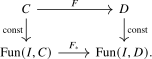
The ‘canonical’ transformation above is the one that under the adjunction \(\const \dashv \lim _I\) corresponds to the transformation \[ \const _{F(\lim _I(-))} \cong F_*(\const _{\lim _I(-)}) \to F_*(-) \] induced by the counit \(\const _{\lim _I(X)} \to X\). By Axiom J we may check that this map is an isomorphism for every fixed diagram \(X\colon I \to C\). But now we observe that the map \(F(\lim _I(X)) \to \lim _I(F_*(-))\) is an isomorphism if and only if the associated cone \(\const _{F(\lim _I(X))} \to F_*(X) = F \circ X\) is a limit cone, giving the claim. □
Lemma 21.2.6. Let \(F\colon C \rightleftarrows D \noloc G\) be an adjunction of \(\infty \)-categories. Then \(F\) preserves all colimits that exist in \(C\) and \(G\) preserves all limits that exist in \(D\).
Proof. We prove that \(F\) preserves colimits; the proof for \(G\) preserving limits is dual. Let \(X\colon I \to C\) be a diagram that admits a colimit in \(C\), and let \(\eta \colon X \to \const _{\colim _I X}\) denote the associated colimit cone. We need to show that the cocone \[ F(\eta )\colon F \circ X \to F(\const _{\colim _IX}) = \const _{F(\colim _I X)} \] is a colimit cone in \(D\). By definition, this means that for every other object \(W\) in \(D\) the map \[ \Hom _D(F(\const _{\colim _IX}),W) \to \Nat (F \circ X,\const _W) \] is an equivalence of animae. But under the adjunction \(F \dashv G\) and the induced adjunction \(F \circ - \dashv G \circ -\) from Lemma 21.1.6, this map is equivalent to the map \[ \Hom _C(\const _{\colim _IX},G(W)) \to \Nat (X, G \circ \const _W) = \Nat (X, \const _{G(W)}). \] Since the latter map is an equivalence by the universal property of the colimit \(\colim _IX\), this finishes the proof. □
As a consequence, we see that limits commute with limits and that colimits commute with colimits.
Corollary 21.2.7. If \(C\) admits \(I\)-indexed limits, then \(\lim _I\colon \Fun (I,C) \to C\) preserves all limits that exist in \(\Fun (I,C)\). If \(C\) admits \(I\)-indexed colimits, then \(\colim _I\colon \Fun (I,C) \to C\) preserves all colimits that exist in \(\Fun (I,C)\).
Lemma 21.2.8. Consider \(\infty \)-categories \(C\) and \(I\), and assume that \(C\) admits all \(I\)-indexed limits (resp. colimits).
- (1)
-
For every \(\infty \)-category \(E\), the functor category \(\Fun (E,C)\) admits \(I\)-indexed limits (resp. colimits).
- (2)
-
For every functor \(E' \to E\), the restriction functor \(\Fun (E,C) \to \Fun (E',C)\) preserves \(I\)-indexed limits (resp. colimits).
- (3)
-
In particular, for every object \(X\) of \(E\) the functor \[ \ev _X\colon \Fun (E,C) \to C \] preserves \(I\)-indexed limits (resp. colimits).
Proof. We treat the case for limits; the case for colimits is dual. By Corollary 21.2.2 there is an adjunction \[ \const \colon C \rightleftarrows \Fun (I,C) \noloc \lim _I. \] By Lemma 21.1.6 this adjunction induces an adjunction on functor categories of the form \[ \Fun (E,C) \rightleftarrows \Fun (E,\Fun (I,C)) \simeq \Fun (I,\Fun (E,C)). \] By applying Corollary 21.2.2 another time this says that \(\Fun (E,C)\) admits \(I\)-indexed limits.
Observe that the limit-functor for \(\Fun (E,C)\) is given as the composite \[ \Fun (I,\Fun (E,C)) \simeq \Fun (E,\Fun (I,C)) \xrightarrow {(\lim _I)_*} \Fun (E,C). \] This description makes it clear that precomposition with any functor \(E' \to E\) preserves \(I\)-limits. □
Since the \(\infty \)-category \(\An \) admits small limits and colimits, this immediately implies:
Corollary 21.2.9. Let \(C\) be an \(\infty \)-category. The presheaf category \(\PSh (C)\) admits all small limits and colimits. The evaluation functors \(\ev _x\colon \PSh (C) \to \An \) preserve all small limits and colimits. □
As another consequence, we get the following result on colimits along product categories:
Lemma 21.2.10. Let \(I\), \(J\) and \(C\) be \(\infty \)-categories such that \(C\) admits all \(I\)-indexed and \(J\)-indexed colimits. Then \(C\) admits all \((I \times J)\)-indexed colimits, and for a functor \(F\colon I \times J \to C\) we have \[ \colim _{(i,j) \in I \times J} F(i,j) \cong \colim _{i \in I} \colim _{j \in J} F(i,j). \]
Proof. The adjunction \(\colim _J \colon \Fun (J,C) \rightleftarrows C \noloc \const \) induces an adjunction \[ \Fun (I \times J, C) \simeq \Fun (I,\Fun (J,C)) \rightleftarrows \Fun (I,C) \] by applying Lemma 21.1.6. Composing this with the adjunction \(\colim _I \colon \Fun (I,C) \rightleftarrows C \noloc \const \) then gives the result. □
More generally, colimits may be iterated when the indexing category itself is assembled as a colimit of varying categories:
Theorem 21.2.11. Let \(J\) be a small \(\infty \)-category and consider a \(J\)-indexed family of small \(\infty \)-categories \(I_{\bullet }\colon J \to \Cat _{\infty }\). Define \(I := \colim _j I_j\), and let \(\varepsilon \colon I_{\bullet } \to \const _{I}\) denote the colimit cone, giving functors \(\varepsilon _j\colon I_j \to I\). Let \(C\) be an \(\infty \)-category and let \(F\colon I \to C\) be a functor.
- (1)
-
Assume that the restricted diagram \[ F\vert _{I_j} \colon I_j \xrightarrow {\varepsilon _j} I \xrightarrow {F} C \] admits a colimit for every \(j \in J\). Then these colimits assemble into a functor \[ F'\colon J \to C, \qquad j \mapsto \colim (F\vert _{I_j}\colon I_j \to C). \]
- (2)
-
In this case, the functor \(F\) admits a colimit in \(C\) if and only if the functor \(F'\) admits a colimit in \(C\), and then we have \[ \colim _{i \in I} F(i) \cong \colim _{j \in J} \colim (F\vert _{I_j}). \]
Dually, assume that \(F\vert _{I_j}\) admits a limit for every \(j \in J\). Then these limits assemble into a functor \[ F''\colon J\catop \to C, \qquad j \mapsto \lim (F\vert _{I_j}\colon I_j \to C). \] The functor \(F\) admits a limit if and only if \(F''\) admits a limit, and then \[ \lim _{i \in I} F(i) \cong \lim _{j \in J\catop } \lim _{i \in I_j} F(i). \]
Proof. See Reference ? of [Cisinski et al. (2026)]. □
Generated from the authoritative LaTeX source.