Corollary 13.2.4. Let \((C,C_L,C_R)\) and \((D,D_L,D_R)\) be adequate triples. Let \(F\colon C \rightleftarrows D \noloc G\) be an adjunction of \(\infty \)-categories and assume that \(F\) and \(G\) are morphisms of adequate triples.
- (1)
-
Assume that the unit map \(\eta _X\colon X \to G(F(X))\) is in \(C_R\) for all \(X \in C\) and the counit map \(\epsilon _Y\colon F(G(Y)) \to Y\) is in \(D_R\) for all \(Y \in D\). Furthermore, assume that for every morphism \(l\colon Z \to X\) in \(C_L\) and every morphism \(l'\colon Z' \to X'\) in \(D_L\), the commutative squares
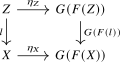
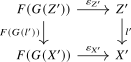
are pullback squares. Then \(F\) and \(G\) induce an adjunction \begin {align*} \Span (F)\colon \Span _{L,R}(C) \mathrel {\substack {\xrightarrow {\rule {25pt}{0cm}} \
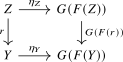
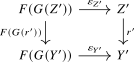
are pullback squares. Then \(F\) and \(G\) induce an adjunction \begin {align*} \Span (G)\colon \Span _{L,R}(D) \mathrel {\substack {\xrightarrow {\rule {25pt}{0cm}} \\[-3.2pt] \xleftarrow {\rule {25pt}{0cm}}}} \Span _{L,R}(C) \noloc \Span (F). \end {align*}
Proof. We prove (1), as (2) is dual. By Construction 13.2.1 and Lemma 13.2.3, the unit \(\eta \colon \id \to GF\) and counit \(\epsilon \colon FG \to \id \) induce transformations \[ \Span ^{\mathrm {R}}(\eta )\colon \Span (\id ) \to \Span (G) \circ \Span (F) \qquadtext {and} \Span ^{\mathrm {R}}(\epsilon ) \colon \Span (F) \circ \Span (G) \to \id . \] Compatibility with vertical composition and whiskering from Lemma 13.2.3 shows that these transformations satisfy the triangle identities. They therefore exhibit the asserted adjunction by Proposition 21.1.2. □
Generated from the authoritative LaTeX source.