Lemma 17.1.9. Let \((\Ll ,\Rr )\) be a factorization system on \(C\), and let \(\Ar _{\Rr }(C) \subseteq \Ar (C)\) denote the full subcategory spanned by the morphisms in \(\Rr \). Then the target functor \(t\colon \Ar _{\Rr }(C) \to C\) is a cocartesian fibration, with cocartesian morphisms given by those commutative squares

such that \(f \in \Ll \).
Proof. Given \(r\) and \(g\), factor the composite \(gr\) as \(r'f\) with \(f\in \Ll \) and \(r'\in \Rr \). This provides a lift of \(g\) of the displayed form. We show that every such lift is \(t\)-cocartesian.
Consider a third object \((r''\colon x''\to y'')\) in \(\Ar _{\Rr }(C)\). We must show that the square
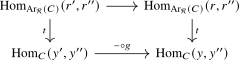
is a pullback square. Fix a morphism \(g'\colon y'\to y''\) and a morphism \((h,g'g)\colon r\to r''\) over \(g'g\). The fiber in question is the anima of maps \(k\colon x'\to x''\) fitting into the diagram

Indeed, the two required triangles say precisely that \(kf\simeq h\) and \(r''k\simeq g'r'\). This filler anima is contractible because \(f\perp r''\). It follows that the displayed square of hom animae is a pullback, so the original morphism is \(t\)-cocartesian.
Conversely, every \(t\)-cocartesian lift of \(g\) with source \(r\) is isomorphic to one constructed by factoring \(gr\). Its top morphism is therefore the composite of a morphism in \(\Ll \) with an isomorphism, and hence lies in \(\Ll \). □
Generated from the authoritative LaTeX source.