Proposition 17.1.3. Let \(S\) be a collection of morphisms in an \(\infty \)-category \(C\).
- (1)
-
The classes \(S^\perp \) and \({}^\perp S\) are closed under composition and contain all equivalences. In particular, they are encoded by wide subcategories of \(C\).
- (2)
-
The classes \(S^\perp \) and \({}^\perp S\) are closed under retracts.
- (3)
-
The class \(S^\perp \) is closed under base change (pullbacks).
- (4)
-
The class \({}^\perp S\) is closed under cobase change (pushouts).
- (5)
-
The class \(S^\perp \) has the left cancellation property: if \(g \circ f \in S^\perp \) and \(g \in S^\perp \), then \(f \in S^\perp \).
- (6)
-
The class \({}^\perp S\) has the right cancellation property: if \(g \circ f \in {}^\perp S\) and \(f \in {}^\perp S\), then \(g \in {}^\perp S\).
- (7)
-
If \(C\) admits small limits, the class \(S^\perp \) is closed under small limits in \(\Ar (C)\).
- (8)
-
If \(C\) admits small colimits, the class \({}^\perp S\) is closed under small colimits in \(\Ar (C)\).
Proof. These properties all follow from the definition of orthogonality in terms of hom animae. The proofs of (1) and (2) are left to the reader. For (3), consider a pullback square in \(C\) where \(r \in S^\perp \):

For any \(l \colon A \to B\) in \(S\), we must show \(l \perp r'\). This means showing that the left square in the diagram below is a pullback square of animae:

The right square is a pullback because \(\Hom _C(A,-)\) preserves pullbacks, so by the pasting lemma for pullback squares it remains to show that the outer rectangle is a pullback. But this holds as we may rewrite it as the pasting of the square obtained from the original pullback square by applying \(\Hom _C(B,-)\) and the pullback square exhibiting the orthogonality relation \(l \perp r\). The argument for (4) is dual.
For (5), consider morphisms \(f\colon X \to Y\) and \(g\colon Y \to Z\) in \(C\), and assume that \(g \circ f\) and \(g\) lie in \(S^{\perp }\). To show that \(f \in S^{\perp }\), let \(l\colon A \to B\) be a morphism in \(S\), and consider the following commutative diagram:
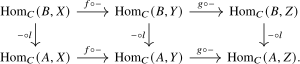
By assumption, the right and outer squares are pullback squares, hence by the pasting law so is the left square, as was to be shown. The argument for (6) is dual.
For (7), let \(f \colon I \to \Ar (C)\) be a diagram where each morphism \(f(i)\colon X(i) \to Y(i)\) lies in \(S^\perp \). Let \(r \colon \lim _i X(i) \to \lim _i Y(i)\) be the limit morphism. For any \(l \colon A \to B\) in \(S\), we have a chain of equivalences: \begin {align*} \Hom _C(B, \lim _i X(i)) &\simeq \lim _i \Hom _C(B, X(i)) \\ \Hom _C(A, \lim _i X(i)) &\simeq \lim _i \Hom _C(A, X(i)) \\ \Hom _C(B, \lim _i Y(i)) &\simeq \lim _i \Hom _C(B, Y(i)) \\ \Hom _C(A, \lim _i Y(i)) &\simeq \lim _i \Hom _C(A, Y(i)). \end {align*}
The square defining the orthogonality \(l \perp r\) is the limit of the squares defining \(l \perp f(i)\) for each \(i \in I\). Since limits of pullback squares are pullback squares, the claim follows. The proof for (8) is dual. □
Generated from the authoritative LaTeX source.