Definition 21.4.1. Let \(I\), \(J\) and \(C\) be \(\infty \)-categories and let \(\phi \colon I \to J\) be a functor.
- (1)
-
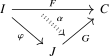
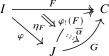
Given a functor \(F\colon I \to C\), a left Kan extension of \(F\) along \(\phi \) is a left adjoint object to \(F\) under the restriction functor \(\phi ^*\colon \Fun (J,C) \to \Fun (I,C)\). More explicitly, it is a functor \(\phi _!(F)\colon J \to C\) equipped with a natural transformation \(\eta _F\colon F \to \phi ^*\phi _!(F)\) such that for every other functor \(G\colon J \to C\) the composite \[ \Nat (\phi _!(F),G) \xrightarrow {\phi ^*} \Nat (\phi ^*\phi _!(F), \phi ^*G) \xrightarrow {- \circ \eta _F} \Nat (F,\phi ^*G) \] is an equivalence.
- (2)
-
Dually, a right Kan extension of \(F\) along \(\phi \) is a right adjoint object to \(F\) under \(\phi ^*\), i.e. a functor \(\phi _*(F)\colon J \to C\) equipped with a transformation \(\eta _F\colon \phi ^*\phi _*(F) \to F\) inducing equivalences \[ \Nat (G,\phi _*(F)) \iso \Nat (\phi ^*(G),F) \] for all \(G\colon J \to C\).
Generated from the authoritative LaTeX source.