Lemma 17.1.12. Let \((\Ll ,\Rr )\) be a factorization system on an \(\infty \)-category \(C\), and let \(p\colon E \to C\) be a functor such that for every morphism \(l\colon A \to B\) in \(\Ll \) and every object \(\tilde {A} \in E_A\), there exists a \(p\)-cocartesian lift \(\widetilde {A} \to \widetilde {B}\) of \(l\). Then \(E\) admits a factorization system \((\widetilde {\Ll },\widetilde {\Rr })\), where \(\widetilde {\Ll }\) consists of the \(p\)-cocartesian morphisms over \(\Ll \) and \(\widetilde {\Rr }\) consists of morphisms over \(\Rr \).
Proof. Both classes define wide subcategories of \(E\): they contain all isomorphisms, and they are closed under composition because \(\Ll \) and \(\Rr \) are, and because composites of \(p\)-cocartesian morphisms are again \(p\)-cocartesian.
(1) For orthogonality, consider \(\tilde {l}\colon \widetilde {A} \to \widetilde {B}\) in \(\widetilde {\Ll }\) and \(\tilde {r}\colon \widetilde {X} \to \widetilde {Y}\) in \(\widetilde {\Rr }\). Let \(l\colon A \to B\) and \(r\colon X \to Y\) be their images in \(C\). We need to show that the top square in the following commutative cube is a pullback square:
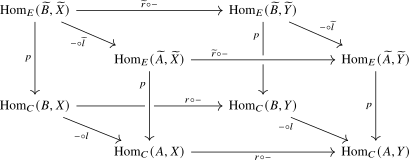
Since \(\widetilde {l}\) is \(p\)-cocartesian, the left and right squares are pullback squares, and since \(l \perp r\) the bottom square is a pullback square. The claim thus follows from the pasting law of pullback squares.
(2) For factorization, consider a morphism \(\widetilde {f}\colon \widetilde {X} \to \widetilde {Z}\). We may factor its image \(X \to Z\) in \(C\) as a composite of a morphism \(l\colon X \to Y\) in \(\Ll \) and a morphism \(r\colon Y \to Z\) in \(\Rr \). We may then take \(\widetilde {l}\colon \widetilde {X} \to \widetilde {Y}\) to be a \(p\)-cocartesian lift of \(l\), which exists by assumption. The cocartesian property produces a unique morphism \(\widetilde {r}\colon \widetilde {Y} \to \widetilde {Z}\) over \(r\) through which \(\widetilde {f}\) factors, as desired. □
Generated from the authoritative LaTeX source.